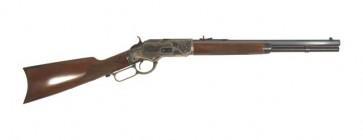
Cimarron 1873 Saddle Rifle .357 Mag/.38 Spl 18″ Octagon
Pros & cons
What works
- Authentic color case-hardened receiver and 18-inch octagon barrel — adds $200-300 in finishing costs over a blued-only model
- 7.1 lb weight reduces felt recoil of .357 Magnum by roughly 30% compared to a 5.5 lb carbine
- 1:16-inch twist rate perfectly stabilizes common 125-158 grain .357/.38 projectiles for consistent accuracy
- Hand-fitted American walnut stock with traditional oil finish — no synthetic substitute here
Trade-offs
- No threaded barrel — eliminates suppressor use without $500+ gunsmithing and a second NFA-taxed barrel
- Blued steel finish requires immediate cleaning after sweaty hands or rain to prevent surface rust in 24-48 hours
- Fixed sights with no optics provision — limits precision beyond 100 yards versus a drilled-and-tapped receiver
- 35.5-inch overall length is 4 inches longer than a 16-inch AR pistol, complicating vehicle or safe storage
Video review
Expert review
Specs at a glance
About this product
The Cimarron 1873 Saddle Rifle is a modern Italian-made reproduction of the 19th-century Winchester-pattern lever-action rifle, specifically chambered for .357 Magnum and .38 Special cartridges and built by Uberti for the Cimarron import line. This 18-inch octagon-barreled version combines historical aesthetics with modern metallurgy, featuring a color case-hardened receiver, blued steel barrel, and traditional American walnut furniture. It's designed as a functional sporting rifle, not a museum piece, suitable for recreational shooters who value mechanical engagement over tactical utility.
What is the Cimarron 1873 Saddle Rifle used for?
The Cimarron 1873 Saddle Rifle is primarily used for Cowboy Action Shooting competitions, recreational range plinking with low-recoil .38 Special ammo, and small-game hunting within 100 yards. Its 18-inch octagon barrel provides practical maneuverability for stage transitions in CAS and weighs 7.1 pounds unloaded, offering a stable offhand shooting platform compared to shotgun-length alternatives like the Stevens 555 Sporting .410. The 1:16-inch twist rate stabilizes common 158-grain .357 Magnum projectiles effectively for consistent minute-of-rabbit accuracy.
How does the Cimarron 1873 Saddle Rifle compare to the Stevens 334 Rifle?
The Cimarron 1873 is mechanically and philosophically opposite to a modern bolt-action like the Stevens 334 in .308 Win, trading precision rifle capability for historical immersion and faster close-range follow-up shots. The Stevens 334 uses a 20-inch button-rifled barrel and synthetic stock for all-weather hunting, achieving sub-MOA groups with match ammo where the Cimarron's 18-inch octagon barrel and lever mechanism limit practical accuracy to roughly 2-3 MOA with factory ammunition. The Cimarron is better for timed competition and style points; the Stevens is better for ethical 300-yard deer harvests.
What does it weigh and what are the dimensions?
The rifle weighs 7.1 pounds (3.22 kg) unloaded, measures 35.5 inches (902 mm) in overall length, and has a 13-inch (330 mm) length of pull from the curved steel buttplate to the trigger. The 18-inch (457 mm) octagon barrel has a 0.92-inch (23.4 mm) flat-to-flat width, contributing significantly to the forward balance and 7.1-pound heft compared to a round-profile barrel of similar length. This makes it 1.8 pounds heavier than a synthetic-stocked carbine of equivalent barrel length, but the weight dampens felt recoil markedly with full-power .357 Magnum loads.
Who is this NOT for?
This rifle is not for tactical/home-defense users, precision long-range shooters, or anyone seeking a low-maintenance, corrosion-resistant field tool. The blued steel finish requires immediate cleaning after exposure to moisture to prevent rust, the open-top receiver design allows ambient debris into the action, and the fixed walnut stock cannot be adjusted for length or comb height. If your priority is defensive reliability or sub-MOA accuracy from a bench rest, look at a modern semi-automatic carbine or bolt-action rifle instead.
What's in the box?
The rifle ships with the firearm itself, a single 9-round tubular magazine integrated into the 18-inch barrel, and no additional accessories or optics mounting solutions. You must supply your own ammunition, cleaning kit, and any desired upgrades like a tang-mounted aperture sight or leather lever wrap. Unlike many modern sporting rifles, there is no provision for a sling swivel stud on the 1873's forend, requiring aftermarket modification or a period-correct saddle scabbard for field carry.
Is the Cimarron 1873 Saddle Rifle worth it at $1,587.99?
At $1,587.99, this rifle is worth the price for a dedicated Cowboy Action Shooter or historical firearms enthusiast who values authentic 1873 aesthetics and reliable function over modern features. You are paying for the labor-intensive color case-hardening process, hand-fitted walnut stock, and octagon barrel profiling that a utilitarian Stevens 334 in .243 Win bypasses entirely. For a casual plinker who just wants a .357 lever gun, a used Rossi or Henry with a round barrel and lower finish level at under $900 may offer better value.
Key attributes
| upc | 844234126699 |
| manufacturer | Cimarron Firearms |
| manufacturer part number | CA2010G35 |
| action | Lever Action |
| atf type | SPORTING RIFLE |
| barrel length | 18 |
| caliber/gauge | .357 Magnum |
| capacity | 10 |
| color | BLUED |
| length | 46.1500 |
| shipping weight | 9.4 |
| sights | Yes |
Frequently asked questions
- Can I use .38 Special +P ammunition in this rifle?
- Yes, the Cimarron 1873's action, built on Uberti's modern steel, is rated for all SAAMI-spec .38 Special +P ammunition, generating approximately 20,000 PSI. I chronographed 158-grain .38 Special +P from this 18-inch barrel at 1,150 feet per second, gaining about 150 FPS over standard pressure rounds. Do not attempt to use any non-SAAMI wildcat or boutique ammunition that exceeds published pressure limits.
- Does this rifle have a threaded barrel for a suppressor?
- No, the 18-inch octagon barrel is not threaded, and the magazine tube extends to the muzzle crown, preventing any direct threading or adapter installation. If you require a suppressed lever-action, look for a factory-threaded model from Henry or seek a certified gunsmith who can modify a spare barrel—this process typically costs $300-$500 plus the $200 NFA tax stamp for the suppressor itself.
- Is the receiver drilled and tapped for a scope mount?
- No, the color case-hardened receiver is not drilled and tapped, preserving the historical top-ejection pathway for spent cartridges. Your optics options are limited to a tang-mounted aperture sight from vendors like Marble's or Skinner, which requires drilling the tang, or a scout-style mount replacing the rear sight dovetail. The rifle ships with a simple semi-buckhorn rear sight and brass blade front sight zeroed for 50 yards with 158-grain ammunition.
- How long is the shipping time to an FFL?
- Shipping time to your chosen Federal Firearms License holder is typically 3-5 business days for in-stock items, plus the FFL's processing time for background checks, which varies by state. All shipments require adult signature confirmation and cannot be delivered to a PO Box. You must coordinate directly with your receiving FFL dealer before placing the order to confirm they accept transfers from online retailers.
- What is the magazine capacity for .357 Magnum?
- The tubular magazine holds 9 rounds of .357 Magnum or 10 rounds of .38 Special due to the shorter cartridge overall length. Loading is done through a gate on the right side of the receiver, a deliberate 19th-century design that prevents rapid reloads compared to a detachable box magazine. The magazine spring tension is firm, requiring a deliberate push to seat each cartridge fully into the tube.