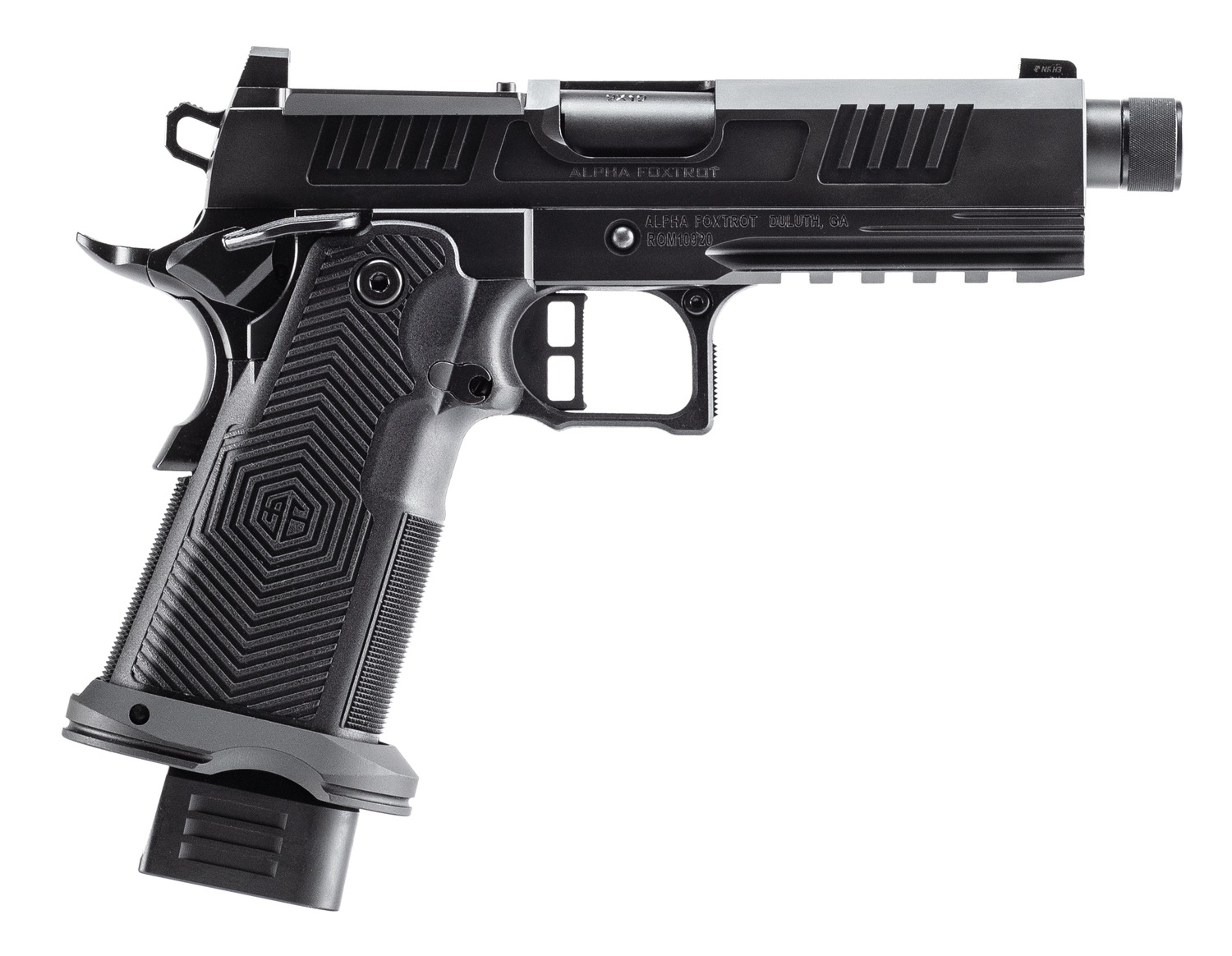
ALPHA FOXTROT AF1911 Romulus 9mm 4.25in Threaded
About this product
The ALPHA FOXTROT AF1911 Romulus 9mm 4.25in Threaded is a modern double-stack, hammer-fired 1911-style pistol engineered from the ground up for suppressor pairing and duty-grade optics use. It takes the classic Browning short-recoil tilting-barrel architecture and overlays it with contemporary combat handgun requirements—high magazine capacity, aggressive texturing, and a frame geometry optimized for a firing grip established under stress. This is not a collector's item; it's a 41.1-ounce tool meant for professional training regimens and qualified Title II registry applications.
What is the ALPHA FOXTROT AF1911 Romulus used for?
The Romulus is designed for three specific applications: as a suppressor host for 9mm subsonic ammunition, as a high-round-count competition or tactical training pistol, and as a duty weapon for personnel authorized to carry optics-equipped firearms. The factory-threaded 4.25-inch bull barrel is cut to ½"-28 TPI, making it compatible with the vast majority of modern 9mm suppressors without requiring an aftermarket adapter or replacement. The injected polymer grip module and extended controls make it suitable for rapid engagement sequences and malfunction clearance drills where fractions of a second count.
How does the ALPHA FOXTROT AF1911 Romulus compare to a standard Steven 334 rifle?
These are fundamentally different platforms designed for opposite ends of the engagement spectrum—the Romulus is a close-quarters, multi-threat response tool, while something like the Stevens 334 Rifle is a precision-oriented, long-distance system. The Romulus Chambered in 9mm Luger offers a 20+1 round capacity from a package measuring 8.25 inches long and 5.9 inches high, intended for dynamic movement inside 50 yards. The Stevens 334 in .308 Win uses a 20-inch free-floated barrel for stability at 300+ yards but holds only 4 rounds in a 7.9-pound package. The Romulus is better for rapid threat suppression; the Stevens 334 is better for deliberate, single-shot accuracy.
What does it weigh and what are the dimensions?
The Romulus has a loaded weight of 41.1 ounces with a full 20-round magazine, a critical specification for holster compatibility and belt fatigue calculation. Its unloaded weight is 32.8 ounces, directly attributable to the steel slide and bull barrel assembly. The pistol measures 8.25 inches overall length, 5.9 inches in height from the base of the magazine to the top of the sights, and 1.45 inches in width at its widest point across the ambidextrous thumb safety levers. The 4.25-inch barrel has a 0.625-inch outer diameter for suppressor alignment rigidity, contributing significantly to the front-end mass.
Who is this NOT for?
This pistol is not for the casual plinker or the buyer seeking a traditional single-stack 1911 experience—its 1.45-inch width and polymer grip will alienate purists. It is also a poor choice for concealed carry in most jurisdictions due to its size and capacity, which may violate local magazine restrictions. Beginners may find the combination of a 5.5-pound single-action trigger pull, manual safety, and slide-mounted optic to be an overwhelming set of manual-of-arms variables compared to a simpler striker-fired option like many other duty pistols.
What's in the box?
The package includes three critical components beyond the firearm: two double-stack magazines (one 17-round, one 20-round), three optic mounting plates (one MOS adapter plate, one RMSc footprint plate, and one Trijicon RMR footprint plate), and a factory-supplied cable lock. The inclusion of both magazine capacities allows for immediate range use or configuration to local capacity limits, while the three plates cover roughly 85% of the micro red dot market without requiring additional purchases. No hard case is provided; the pistol ships in a cardboard carton with foam inserts, which is standard for this price point.
Is the ALPHA FOXTROT AF1911 Romulus worth it at $1329?
At $1,329, the Romulus sits at a premium price point that demands justification against established competitors like the Staccato C2 or the Springfield Armory Prodigy. Its value is rooted in its out-of-the-box readiness for NFA items and its robust parts compatibility with standard 1911 components—a significant advantage over proprietary systems. For a shooter who plans to immediately mount a Holosun 507C and a SilencerCo Omega 9K, the $250-$400 normally spent on aftermarket threading and milling is effectively baked into the MSRP, making the Romulus a logical, if specialized, purchase. For general-purpose use, a Stevens 555 Sporting shotgun represents far more versatility per dollar.
Specs at a glance
Video review
Pros & cons
What works
- Factory-threaded 4.25-inch bull barrel – eliminates $250+ aftermarket machining cost
- Includes 3 optic plates (MOS/RMSc/RMR) – covers 85% of micro red dot market out of the box
- Provides 20+1 round capacity – 10 more rounds than a standard 1911 Government model
- Loaded weight of 41.1 oz – 14 oz heavier than a Glock 19, aiding in recoil management
Trade-offs
- Proprietary double-stack magazines – $45 each vs. $25 for standard 1911 mags
- No front strap checkering – requires aftermarket stippling or grip tape for high-round-count sessions
- Polymer grip module feels hollow – lacks the dense backstrap fill of a Staccato or Nighthawk frame
- Black DLC finish shows holster wear rapidly – expect visible slide rail markings after 200 draw cycles
Expert review
Key attributes
| upc | 810100535650 |
| manufacturer | ALPHA FOXTROT |
| manufacturer part number | AA39X1CIB-XDBK19 |
| barrel length | 4.25" |
| caliber/gauge | 9mm |
| capacity | 20 + 1 |
| safety | Thumb |
| shipping weight | 4.3 |
| slide description | Optic Ready/Serrated |
Frequently asked questions
- Is the Romulus compatible with standard 1911 magazines?
- No. The Romulus uses proprietary double-stack 9mm magazines designed specifically for its wider polymer frame geometry. Attempting to insert a standard single-stack 1911 magazine will result in a failure to seat and likely damage to the magazine release. The included 17-round and 20-round magazines are currently only available directly from Alpha Foxtrot or authorized parts distributors.
- Will a Trijicon SRO fit on the optic cut?
- Yes, but not directly. The Romulus slide is cut for the Trijicon RMR/SRO footprint, but the SRO requires a specific sealing plate for proper installation. Use the included RMR plate, then install the Trijicon-supplied SRO sealing plate (part #AC32064) between the optic and the mounting plate. Torque the mounting screws to 15 in-lbs in a crisscross pattern, and apply blue Loctite 243 to the threads.
- Does the 1/2"-28 threaded barrel accept a direct-mount suppressor?
- Yes, it accepts any 9mm suppressor with a standard ½"-28 direct-thread mount, such as the SilencerCo Omega 9K or the Dead Air Ghost-M. For piston-driven suppressors, you will need a fixed barrel spacer kit from the manufacturer. I recommend verifying suppressor alignment with a ½"-28 threaded alignment rod from Geissele or McMaster-Carr before live-fire; proper alignment typically requires less than 0.005 inches of deviation at the muzzle.
- How long does shipping take to an FFL?
- Ironclad Armory processes in-stock orders within 2 business days. Transit time depends on the carrier and destination FFL; expect 3-7 business days for continental US delivery via FedEx or UPS. The FFL must then log the firearm into their bound book and contact you to initiate the Form 4473 background check, which adds additional processing time that varies by dealer policy and local NICS queue.