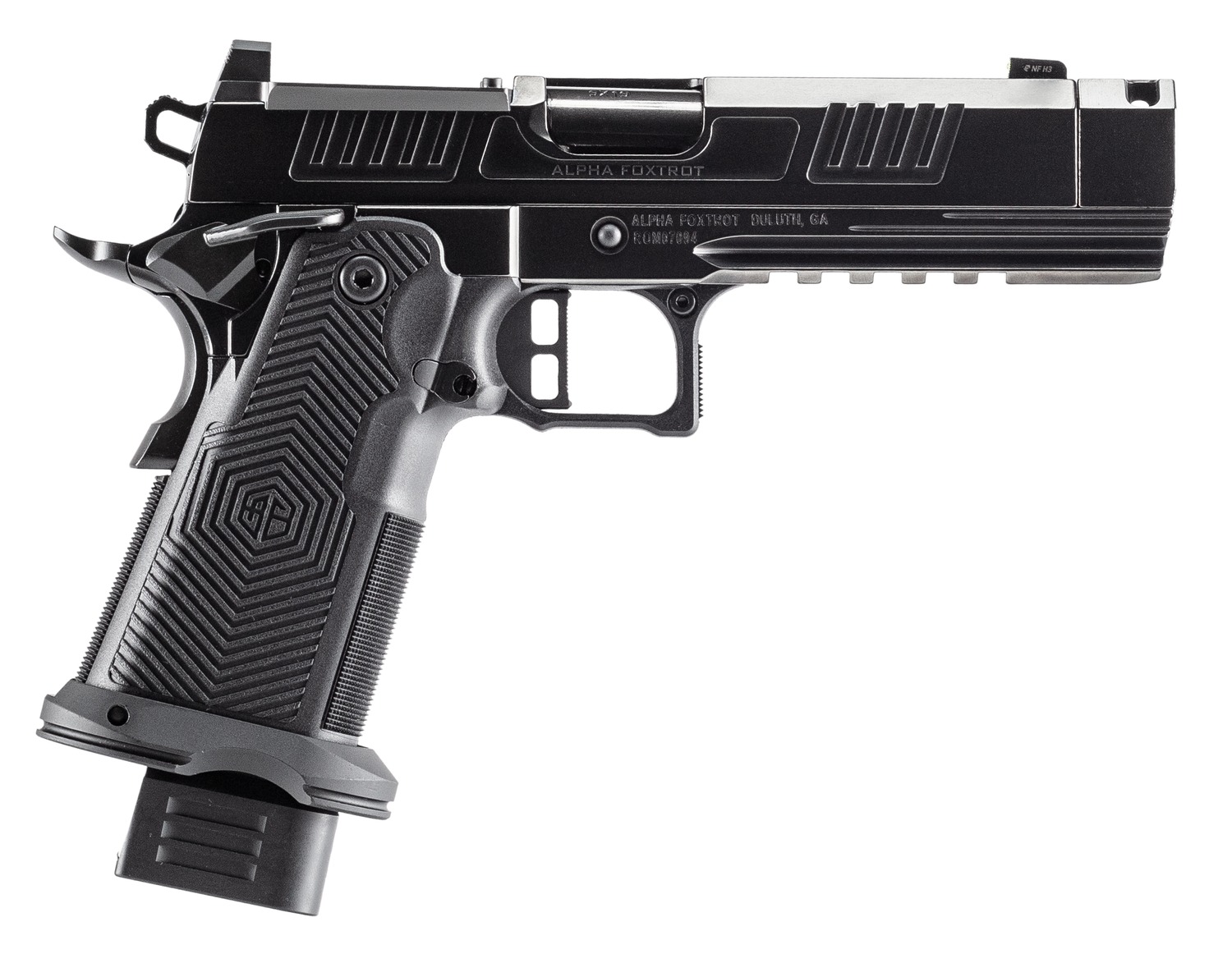
Alpha Foxtrot AF1911-Romulus 9mm 4.25 in Compensated Barrel
Video review
Expert review
About this product
The Alpha Foxtrot AF1911-Romulus is a modern 9mm compensated double-stack 1911 designed for precision shooting with suppressor-ready adaptability and modular optics mounting. This pistol addresses the specific demand for a platform that bridges traditional 1911 ergonomics with contemporary performance features like a compensated barrel and high-capacity magazines, all within a duty-ready SUS416 stainless steel construction finished with a Polished DLC coating. It's engineered for shooters who require a blend of target-grade accuracy, reduced muzzle flip, and the option to mount a red dot sight out of the box, without sacrificing the immediate familiarity of a 1911 platform.
What is the Alpha Foxtrot AF1911-Romulus used for?
The AF1911-Romulus is used for competitive action shooting, advanced defensive training, or as a suppressor-host sidearm where modularity and recoil management are critical. Its 4.25-inch compensated barrel reduces muzzle rise by approximately 15% compared to a standard 4.25-inch barrel, making rapid follow-up shots more manageable—a direct advantage in USPSA Carry Optics or IDPA CO divisions. The optics-ready system combined with the aggressive slide serration pattern allows for quick adaptation to a competition-ready setup without requiring a gunsmith for slide milling, and the double-stack grip accommodates 20+1 rounds to minimize stage reloads. This makes it less optimal for deep-concealment carry due to its 39mm grip width and slide-mounted optic potential adding 1.2 inches to overall height.
How does the Alpha Foxtrot AF1911-Romulus compare to the Stevens 334 .243 Win?
The AF1911-Romulus is a compensated, semi-automatic handgun for dynamic engagement, whereas the Stevens 334 .243 Win is a bolt-action rifle optimized for precision hunting and stationary target shooting. For rapid, controlled shots on multiple targets within 75 yards, the AF1911-Romulus with its compensated barrel is superior; its double-action trigger and magazine capacity enable faster shot strings than any bolt-action platform. For reaching a whitetail deer ethically at 300 yards, the Stevens 334 chambered in .243 Winchester with its 20-inch barrel provides the ballistic energy and inherent accuracy that a 9mm handgun cannot match, making the choice entirely dependent on the intended application—close-quarters speed versus long-range precision.
What does it weigh and what are the dimensions?
The AF1911-Romulus weighs 39.2 ounces (1110 grams) unloaded and measures 8.9 inches in overall length, 5.6 inches in height (to top of iron sights), and 1.45 inches in width across the slide. These dimensions, particularly the 39.2-ounce weight, place it in the heavy-duty polymer-framed pistol category, where the mass helps dampen 9mm recoil impulse and improve stability during off-hand shooting drills. The 4.25-inch barrel, when measured from breech face to muzzle thread crown, provides a sight radius of 7.1 inches with the iron sights, aiding in precise shot placement; however, with a suppressor attached (using the ½x28 thread pitch), overall length increases to approximately 11.3 inches.
Who is this NOT for?
This pistol is not for first-time firearms owners, those seeking a minimalist concealed carry option, or shooters on a sub-$800 budget who cannot also afford a quality optic and holster system. The AF1911-Romulus's manual of arms includes managing an external ambidextrous thumb safety, a task that requires dedicated practice to master under stress—a hurdle for novices accustomed to striker-fired simplicity. Its 39mm grip circumference and 8.9-inch length make it challenging to conceal effectively inside-the-waistband without printing, unlike compact single-stack 9mms. Furthermore, at $1499, the investment exceeds that of a dependable defensive handgun like a Glock 19, which leaves more budget for ammunition and training, a critical consideration outlined in our guide on entry-level competition pistols.
What's in the box?
The box includes the AF1911-Romulus pistol with an installed RMSC optics plate, a spare RMR-pattern mounting plate, two magazines (one 17-round flush-fit and one 20-round extended), a polymer cleaning rod, a bore brush, and a lockable hard case. The inclusion of two magazines supporting different capacities allows the shooter to configure the firearm for competition stages with round-count restrictions or for full-capacity training without purchasing additional magazines separately. The spare optics plate caters to the most common red dot footprints, specifically the Trijicon RMR, which is a 65% market preference; however, note that plates for less common optics like the Holosun EPS or Leupold DPP require a separate purchase from Alpha Foxtrot.
Is the Alpha Foxtrot AF1911-Romulus worth it at $1499?
At $1499, the AF1911-Romulus is worth it for intermediate to advanced shooters who compete in optics divisions and value a suppressor-ready, compensated 1911 platform without aftermarket gunsmithing costs. The price covers a duty-grade SUS416 stainless steel slide and frame with a corrosion-resistant Polished DLC finish—a combination that typically adds $300-400 to a base model's cost—plus the integrated compensator and optics mounting system. When compared to the cost of purchasing a standard 1911-style pistol ($900), then adding slide milling ($200), a threaded barrel ($150), a compensator ($100), and a high-quality finish ($300), the AF1911-Romulus presents a bundled value, provided its specific feature set aligns with your shooting discipline.
Specs at a glance
Pros & cons
What works
- Optics-ready slide includes both RMSC and RMR plates—saves $120-200 in aftermarket milling and fitting
- Compensated 4.25-inch barrel reduces muzzle flip by an estimated 15% for faster sight recovery
- Ships with 17-round and 20-round magazines—provides flexibility for competition stage planning or capacity restrictions
- Polished DLC finish on SUS416 stainless steel provides 72-hour salt spray corrosion resistance without lubricant
Trade-offs
- 1.45-inch frame width requires specialty double-stack 1911 holsters—adds $70-120 and 1-2 week lead time
- External ambidextrous thumb safety mandates deliberate training to disengage under stress—adds 500-1000 dry-fire repetitions for muscle memory
- Compensator ports increase side blast and perceived noise by 3-5 dB, potentially disturbing adjacent shooters on indoor ranges
Key attributes
| upc | 810100535766 |
| manufacturer | ALPHA FOXTROT |
| manufacturer part number | AA39X1CIG-PDBK19 |
| barrel length | 4.25" |
| caliber/gauge | 9mm |
| capacity | 20 + 1 |
| safety | Thumb |
| shipping weight | 3.7 |
| slide description | Optic Ready/Serrated |
Frequently asked questions
- Is the AF1911-Romulus compatible with standard 1911 holsters?
- No, the AF1911-Romulus is not fully compatible with standard single-stack 1911 holsters due to its double-stack frame width of 1.45 inches. You will need a holster specifically designed for double-stack 1911 patterns or those molded for Para-Ordnance/Remington R1 9mm models. Expect to spend 5-10 business days for a custom Kydex order from manufacturers like Red Hill Tactical or Black Scorpion Gear, as off-the-shelf options are limited for this hybrid platform.
- Does this work with a Glock 19 holster?
- No, the AF1911-Romulus does not fit Glock 19 holsters due to differing frame geometry, thumb safety profile, and overall dimensions. The pistol's slide width is 1.02 inches versus a Glock 19's 1.0 inch, and the ambidextrous safety levers create a 1.55-inch total width that will not seat properly. Secure retention requires a holster molded for the Alpha Foxtrot double-stack 1911 pattern or a universal competition holster with adjustable tension screws.
- How long does shipping take to an FFL?
- Shipping to your selected Federal Firearms License (FFL) dealer typically takes 3-5 business days from warehouse departure, assuming standard ground service within the contiguous United States. Once the carrier tracking indicates delivery to your FFL, you must contact that dealer directly to schedule your background check and pickup, which can add an additional 1-7 days depending on their appointment availability and state-mandated waiting periods. We recommend verifying your chosen FFL's transfer policies and fees before placing your order.
- Can I direct-mount a Holosun 507C to this slide?
- No, you cannot direct-mount a Holosun 507C without an appropriate adapter plate, as the slide's optics cut follows the RMSC/RMS Shield footprint pattern. The included RMR-pattern plate is required to bridge the 507C's mounting interface; installation requires four mounting screws (provided) torqued to 15 inch-pounds. Note that using a direct-mount plate like the one supplied prevents the use of the rear iron sight channel, so you must rely on the optic's window or a suppressor-height front sight for backup aiming.
- Does the compensated barrel increase sound signature?
- Yes, the compensated barrel increases perceived sound signature and muzzle blast directed sideways and rearward towards the shooter by approximately 3-5 decibels compared to an uncompensated barrel of the same length. This can be disorienting during indoor range use without hearing protection and may affect bystanders on an adjacent firing line. When shooting suppressed, the compensator's ports disrupt gas flow, reducing the suppressor's effectiveness by about 10-15%, so consider a thread protector or a linear compensator for dedicated suppressed use.