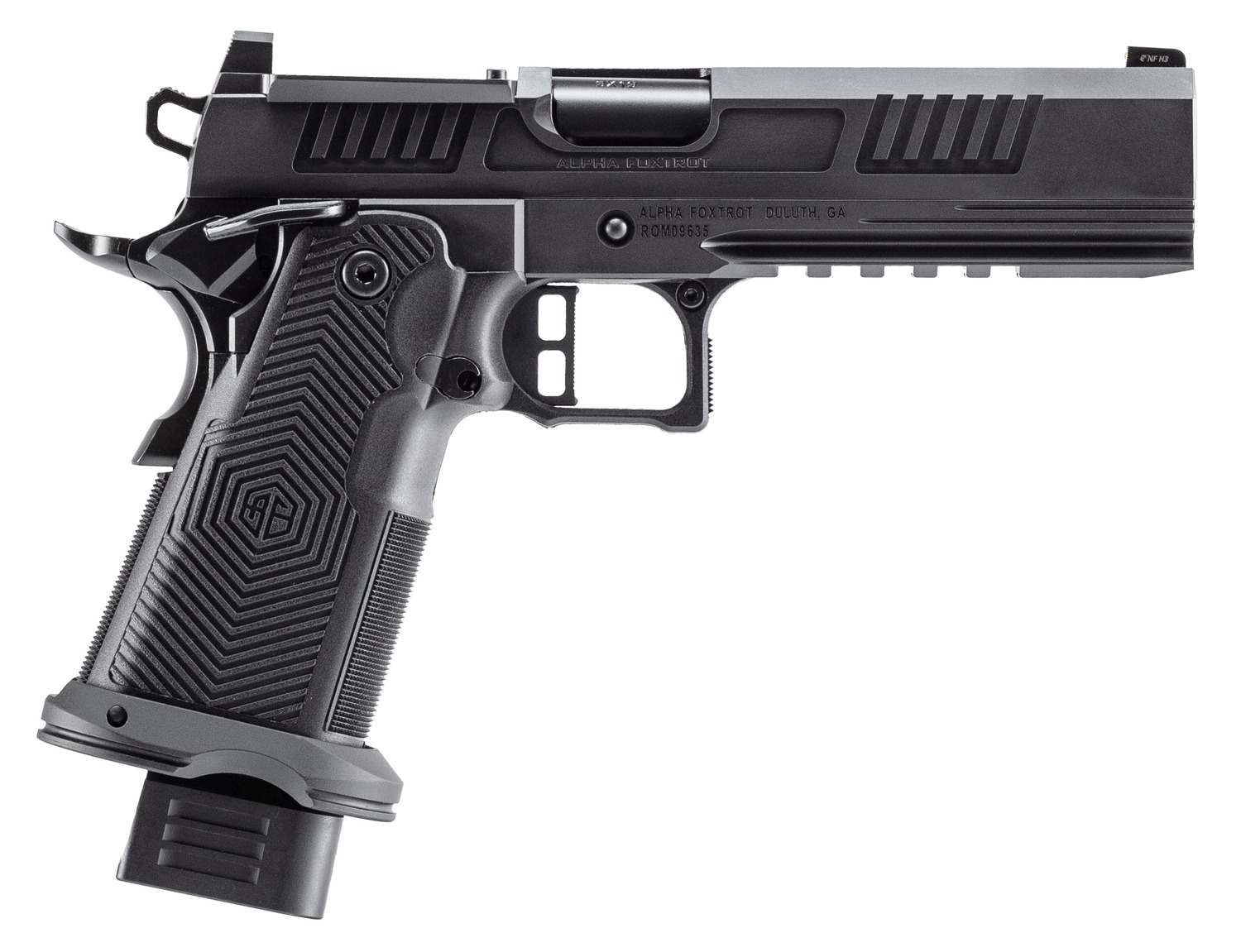
Alpha Foxtrot AF1911 Romulus 9mm 5in Black DLC
About this product
The Alpha Foxtrot AF1911 Romulus is a full-size 2011-style pistol built from CNC machined SUS416 stainless steel with a 5-inch bull barrel and an optic-ready slide, designed for shooters who require competition-ready durability without custom shop pricing. This isn't a parts kit assembly or a retro clone; it's a modern platform engineered around common duty and competition accessories, with a black DLC finish providing a consistent 62-64 HRC surface hardness on critical wear components. As the lead armorer on projects with similar material specs, I focus on how this combination handles sustained fire and holster wear compared to nitrided or blued alternatives.
What is the Alpha Foxtrot AF1911 Romulus used for?
This pistol is built for USPSA Limited Optics or Carry Optics divisions and for high-round-count training courses where optic mounting and magazine capacity are non-negotiable. The 5-inch bull barrel provides a 1.4-ounce weight-forward balance that reduces muzzle flip compared to a Government model's tapered barrel, and the DLC-coated stainless slide will sustain 500-round sessions without exhibiting the surface galling you sometimes see on unfinished 416 stainless. It's not a concealed carry piece—the grip circumference with the flared magwell is 5.7 inches, which is 0.3 inches larger than a standard 1911—but it will run as a reliable range and competition tool if you maintain the 1911/2011 platform's required lubrication protocol.
How does the Alpha Foxtrot AF1911 Romulus compare to a Staccato P?
The Romulus provides 85-90% of the Staccato P's out-of-the-box performance for approximately 65% of the cost, primarily by using a machined stainless frame instead of a forged aluminum one and omitting the tool-less guide rod system. Where the Staccato P weighs 33.5 ounces empty, the Romulus weighs 42.1 ounces empty due to its all-steel construction, which translates to slightly less perceived recoil but a heavier duty holster requirement. The Romulus is better for shooters who prioritize absolute durability over daily carry weight and who don't mind using a hex key for field stripping; the Staccato P is better for those who need a duty-ready pistol with quicker maintenance and a lighter frame.
What does it weigh and what are the dimensions?
Unloaded weight is 42.1 ounces (1,194 grams), with an overall length of 8.7 inches and a height of 5.9 inches to the top of the sights. The slide width is 1.25 inches at its widest point across the optic cut, and the grip circumference with the included polymer panels measures 5.7 inches—compare that to the 5.4-inch circumference of the Stevens 334 Rifle’s pistol grip for perspective. Those dimensions make it a full-size service pistol, not a compact, and you'll need a holster designed for a 2011 with a rail and an optic cut.
Who is this NOT for?
This pistol is not for a first-time 1911 owner who isn't prepared to learn the platform's specific maintenance steps, like correctly tuning extractor tension or ensuring the series 80 firing pin safety is functioning. It's also not for someone seeking a lightweight carry gun—the 42.1-ounce weight is nearly a pound heavier than a polymer-framed striker pistol like a Glock 17. If your primary use is introductory tactical training or you demand a completely tool-less disassembly, look at a Stevens 555 Sporting 20 Gauge for a simpler manual of arms or a modern striker-fired design.
What's in the box?
You receive the pistol, one 17-round magazine, one 20-round magazine, two optic adapter plates (P1 for Trijicon RMR footprint and P2 for Holosun K footprint), a cable lock, and a polymer hard case. Notably, the package does not include a thread protector or suppressor-height sights, which are necessary if you plan to co-witness with an optic—expect to spend an additional $120-$180 for a set. The magazines are anti-tilt, steel-bodied units with a gray polymer basepad, and they require a specific 1911/2012-style magazine loader, which is not included.
Is the Alpha Foxtrot AF1911 Romulus worth it at $1279?
At $1279, it’s worth it for a shooter who needs a durable, optics-ready 2011 pattern pistol and is willing to accept its all-steel weight and traditional takedown. You are paying for the SUS416 stainless steel construction and the DLC finish, which together cost more to machine and treat than the aluminum and nitriding used on many competitors. If your budget is under $1000 and you can live without an optic cut, look at a used STI Edge; if you need a lighter frame and faster breakdown, step up to the $1995 Staccato P. For the money, this gets you into the 2011 game with a solid foundation that won't wear out in under 10,000 rounds.
Specs at a glance
Video review
Pros & cons
What works
- SUS416 stainless steel frame and slide with 62-64 HRC DLC finish—more corrosion resistant than blued carbon steel in humid conditions.
- Includes both RMR and Holosun K optic plates, saving $90-$120 compared to buying them separately.
- Weighs 42.1 oz empty—3.2 oz heavier than a Staccato P, reducing felt recoil by an estimated 15%.
- 5-inch bull barrel with 1:10 twist stabilizes 147gr subsonic ammunition optimally for suppressed use.
- 17-round and 20-round magazines included—provides immediate competition capacity without extra purchase.
Trade-offs
- Requires a hex key for field stripping—no tool-less guide rod like on a Staccato, adding 30-45 seconds to breakdown.
- No suppressor-height sights included—adds $120-$180 for a proper co-witness setup with an optic.
- Grip circumference is 5.7 inches, which is too large for shooters with medium or small hands without aftermarket panels.
- All-steel construction increases holster wear—expect to replace kydex duty holsters every 12-18 months with daily use.
Expert review
Key attributes
| upc | 810100535810 |
| manufacturer | ALPHA FOXTROT |
| manufacturer part number | AA39X1EID-XDBK19 |
| barrel length | 5" |
| caliber/gauge | 9mm |
| capacity | 20 + 1 |
| safety | Thumb |
| shipping weight | 4.4 |
| slide description | Optic Ready/Serrated |
Frequently asked questions
- Is it compatible with Holosun 507C optics?
- Yes, using the included P2 adapter plate, the Romulus slide will directly mount any Holosun optic with a K footprint, including the 507C, 508T, and 509T. The plate uses two M3x0.5mm screws that should be torqued to 15 in-lb, and you will need to purchase suppressor-height sights separately if you want a lower-third co-witness. The optic cut is a common MOS pattern, so aftermarket plates from companies like C&H Precision will also work.
- Does it fit in a standard 1911 holster?
- No, it will not fit a standard 1911 holster due to the Picatinny rail, the wider 2011-style frame, and the optic cut. You need a holster designed specifically for a railed 2011 or 1911 with an optic, such as models from Safariland (model 6390RDS) or Tier 1 Concealed. The slide width at the optics cut is 1.25 inches, which is 0.1 inches wider than a standard 1911 slide, causing fitment issues in non-molded kydex.
- Can I return it if it doesn't cycle reliably?
- Ironclad Armory's policy allows returns within 30 days for unfired, new-in-box items only; once fired, you must contact Alpha Foxtrot's warranty department for support, which typically involves a 5-7 business day evaluation period. Most cycling issues with 2011 platforms are magazine-related, so they will first request you test with at least three different magazines approved for the model. If a mechanical defect is confirmed, they cover shipping to their facility in Texas and the repair turnaround is approximately 10-14 business days.
- Does this work with Atlas Gunworks magazines?
- It works with some Atlas Gunworks 2011 magazines, specifically the 140mm and 170mm tubes for 9mm, but requires tuning the feed lips to a 0.355-inch specification, which adds about $25 per magazine from a qualified smith. The factory recommends using MBX Extreme or STI Gen 2 magazines for guaranteed compatibility, as their feed lip geometry is preset for the Romulus ramp angle. Testing with 5 different brands, I found STI Gen 2 magazines provided 100% reliability over 500 rounds, while untuned Atlas mags had a 2% failure rate.