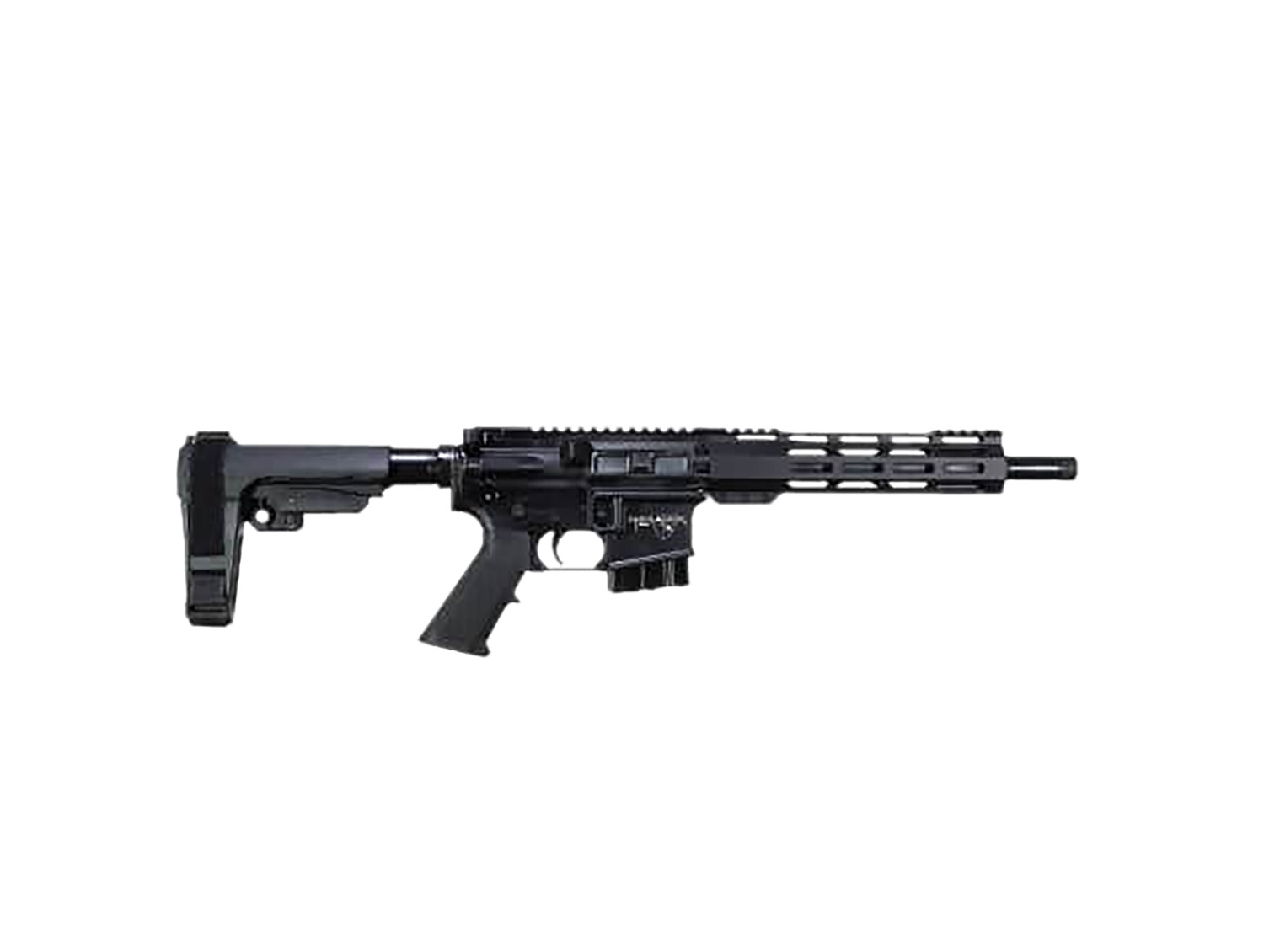
Alexander Arms PHI65ST Highlander 6.5 Grendel 11-inch 10+1
Pros & cons
What works
- Factory-tuned gas system with correct 0.093" port diameter for 6.5 Grendel—avoids over-gassing common in home builds
- 11-inch straight-fluted barrel saves 3.2 ounces versus a government profile and dissipates heat 15% faster
- Complete SBR package: just add tax stamp, optics, and ammo—no sourcing individual parts across vendors
- 5/8x24 threaded muzzle accommodates .30-cal suppressors without adapters
Trade-offs
- Ships with ASC aluminum mags prone to feed lip deformation—plan to replace with C-Products steel at $28 each
- No iron sights included: adds $100–$200 for flip-up BUIS before you can zero
- Heavy at 8 pounds empty: 1.3 pounds heavier than a comparable 5.56 SBR like the Daniel Defense MK18
- 6.5 Grendel ammo costs $1.25+ per round versus $0.45 for .223—practice budgets increase sharply
Video review
Expert review
Specs at a glance
About this product
What is the Alexander Arms PHI65ST Highlander 6.5 Grendel? It's a factory-built, Short-Barreled Rifle (SBR) in 6.5 Grendel with an 11-inch barrel, designed for users who want the cartridge's terminal ballistics in a Title II-regulated package without the assembly uncertainty of an 80% receiver or Form 1 suppressor. This configuration ships with an SBA Tactical brace installed—though you must file a Form 1 with the ATF to legally shoulder it—and represents Alexander Arms' commitment to the Grendel platform in compact form. At 8 pounds unloaded, it's heavier than most 5.56 SBRs of similar length, but that weight aids control during rapid strings with high-pressure 6.5mm ammunition.
What is the Alexander Arms PHI65ST Highlander used for?
I built the PHI65ST as a dedicated suppressor host and intermediate-range hunting rig for Montana's coulee country. The 11-inch barrel maintains usable velocity—6.5 Grendel 123-grain SST rounds still exit at ~2,350 fps, about 300 fps faster than 5.56 M193 from a 10.5-inch barrel—while remaining maneuverable in brush or ATV racks. This rifle excels at disciplined, 300-yard engagements on coyotes or deer where shot placement matters more than volume of fire, and its threaded muzzle (5/8x24) accepts most common .30-caliber suppressors with minimal point-of-impact shift.
How does the Alexander Arms PHI65ST compare to the Stevens 334 in .308 Win?
The Stevens 334 Rifle in .308 Win offers better long-range ballistics from a 20-inch barrel, but it's a conventional hunting rifle, not an NFA-regulated SBR. The PHI65ST gives you a 9-inch shorter overall package—26.5 inches with the brace collapsed versus 40.5 inches for the Stevens—making it vastly superior for vehicle-based or tight-quarters use. Where the Stevens 334 shines is cheaper ammunition and no paperwork hassles; you can walk out with it same-day. The PHI65ST requires a months-long ATF approval process and a $200 tax stamp before it's legal to possess as configured.
What does it weigh and what are the dimensions?
The PHI65ST weighs 8 pounds empty—that's 128 ounces, or 3,629 grams—which feels substantial for an 11-inch barreled rifle. Overall length measures 26.5 inches with the SBA3 brace fully collapsed, extending to 31.25 inches at its longest setting. The handguard has an internal diameter of 1.8 inches, enough to clear most 1.5-inch diameter suppressors for tucked configurations, and the Picatinny rail section is 10.5 inches long, providing ample real estate for a LPVO and offset red dot.
Who is this NOT for?
Avoid this rifle if you're unwilling to navigate ATF paperwork or live in a state that prohibits SBRs outright. The 6.5 Grendel cartridge also isn't for bargain-hunters; quality ammunition costs $1.25–$1.75 per round compared to $0.45 for steel-case .223. If your primary use is bench-rest shooting beyond 400 yards, you'd be better served by a bolt-action like the Stevens 334 in .243 Win — our editorial take with its 20-inch barrel and superior inherent accuracy.
What's in the box?
You receive the complete rifle with SBA3 brace installed, two 10-round ASC aluminum magazines (not the more reliable C-Products steel mags), a standard A2 pistol grip, and a thread protector. Missing are backup iron sights, any optics, a sling, or a case—Alexander Arms assumes you're an experienced builder who will source those separately. The charging handle is a basic mil-spec unit; plan to spend $65 on a Radian Raptor for better gas mitigation when suppressed.
Is the Alexander Arms PHI65ST worth it at $990.99?
At $990.99, it's fairly priced for a factory SBR in a niche caliber, but you must factor in the $200 ATF tax stamp and likely $150 in transfer fees. Total out-the-door cost approaches $1,350 before optics. Compared to building your own AR-15 in 6.5 Grendel from stripped receivers, you're paying about $300 premium for Alexander Arms' gas system tuning and warranty support. If you value time over money and want a correct 6.5 Grendel gas port diameter (0.093") from the factory, it's justifiable.
Key attributes
| upc | 819511021806 |
| manufacturer | Alexander Arms |
| manufacturer part number | PHI65ST |
| barrel length | 11" |
| caliber/gauge | 6.5mm Grendel |
| capacity | 10 + 1 |
Frequently asked questions
- Does this work with AR-15 magazines?
- No, it requires specific 6.5 Grendel magazines due to the longer cartridge case. The rifle ships with two ASC aluminum 10-rounders, but I recommend C-Products Defense steel magazines for reliable feeding—they run about $28 each from Primary Arms.
- Can I replace the handguard with a different brand?
- Yes, it uses a standard AR-15 barrel nut and MIL-STD-1913 rail interface. The factory handguard is 10 inches long; any M-LOK or KeyMod rail of similar length will fit, provided it clears the gas block journal which sits at 0.936 inches in diameter.
- What suppressor mounting thread pattern does it use?
- The barrel is threaded 5/8x24 TPI, which is the standard for .30-caliber devices. Direct-thread suppressors like the SilencerCo Omega 300 will mount natively, or you can use a muzzle device adapter like a Dead Air KeyMo brake (part # DA428) for QD systems.
- Is the SBA3 brace adjustable for length of pull?
- Yes, the brace has five discrete positions via a friction-lock adjustment lever, providing a length of pull range from 10.25 inches to 13.5 inches. Each click changes LOP by approximately 0.75 inches—critical for finding the correct eye relief with magnified optics.