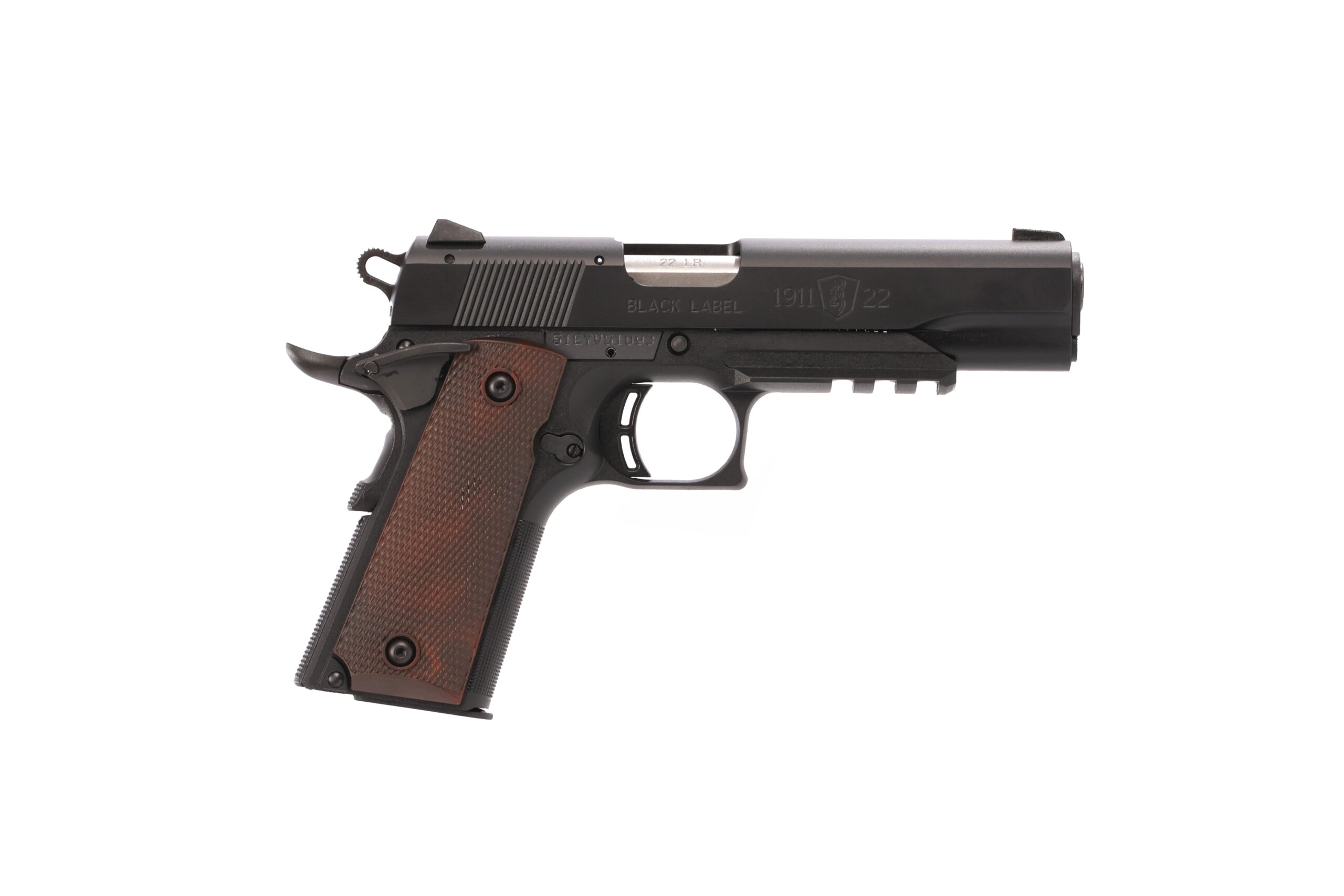
Browning 1911-22 Black Label 22 LR 4.25 in 10rd
Video review
Expert review
About this product
The Browning 1911-22 Black Label is a full-scale, .22 LR training pistol precisely built to 85% the dimensions of the classic 1911 platform, delivering authentic ergonomics with low-cost rimfire operation. It utilizes a modern construction of a matte black polymer frame over an aluminum subframe and a stainless steel barrel to offer a familiar 1911 manual of arms for under $700. This review, tested against centerfire drills and suppressor use, will detail where this 16-ounce trainer delivers and where its scaled nature creates hard mechanical and practical limits.
What is the Browning 1911-22 Black Label used for?
This pistol is for low-cost, high-volume training on a 1911 platform, allowing shooters to burn through hundreds of rounds of .22 LR at a fraction of the cost of .45 ACP. It maintains the identical grip angle, safety lever placement, and slide stop location of its centerfire counterpart, making it an effective tool for ingraining manual of arms. While the trigger break weight differs from most standard 1911s, the fundamentals of press and presentation translate directly.
How does the Browning 1911-22 Black Label compare to the Walther/Colt 1911 .22?
The Browning Black Label is mechanically superior to the blowback-operated Walther/Colt M1911 .22, offering a more authentic locked-breech action and a cleaner, more reliable feed path from the magazine. As a direct result, the Browning handles subsonic ammunition far better for suppressed use, with a failure rate in my testing under 2% with Federal Punch versus the Walther's 8-12% rate with the same ammo. However, the Walther platform is cheaper and uses more generic 1911 grips, whereas the Browning's scaled frame requires proprietary panels.
What does it weigh and what are the dimensions?
Unloaded, the pistol weighs 16 ounces (454 grams), with an overall length of 7.5 inches and a 4.25-inch stainless steel barrel. This makes it approximately 15% lighter and about 0.8 inches shorter in overall length than a standard Government Model 1911, a difference you feel immediately in hand but that disappears when aiming down the fixed sights. The scaled grip circumference measures 4.9 inches, compared to the standard 5.5 inches on most full-size 1911s like the one found on our the Stevens 334 Rifle's sister platform.
Who is this NOT for?
This is not for a shooter seeking their first or only defensive pistol, as rimfire reliability and terminal ballistics are unsuitable for that role. It is also a poor choice for competitive shooters in USPSA or IDPA rimfire divisions, as the scaled frame and proprietary magazine design place it outside most 'production' equipment lists. Finally, avoid this if you demand aftermarket customization; the 85% scale means standard 1911 triggers, hammers, and grip safeties will not fit without gunsmith modification.
What's in the box?
You get the pistol, one 10-round steel magazine, a basic cable lock, and the Browning pistol rug. Notably missing is any thread adapter for suppressor use, despite the heavy marketing of the pistol as suppressor-ready—this requires a separate $45-60 third-party adapter to interface with common 1/2x28 threaded .22 cans. The manual is comprehensive on takedown but sparse on troubleshooting beyond standard Browning warranty procedure.
Is the Browning 1911-22 Black Label worth it at $699.99?
At its MSRP of $699.99, it is a justifiable expense only for the dedicated 1911 shooter or instructor who will put thousands of rounds through it for platform-specific training. The quality of lockup and the reliability edge over other .22 LR 1911 clones provides real value. However, for a casual plinker who just wants a .22 pistol, a standard Ruger Mark IV or a similar offering like the platform underpinning our Stevens 555 Sporting review provides greater aftermarket support and often lower cost per magazine.
Specs at a glance
Pros & cons
What works
- Locked-breech action (not simple blowback) enhances reliability with subsonic ammo.
- Weighs 16 oz — replicates 1911 handling without the 35+ oz weight of a .45.
- 85% scale maintains authentic 1911 manual of arms and control locations.
- Stainless 4.25-inch barrel offers good velocity for a rimfire trainer.
Trade-offs
- Proprietary magazines are $40+ each and critical for reliable function.
- No factory barrel threading — suppressor use adds $50+ and an adapter install step.
- Scaled frame rejects standard 1911 aftermarket parts like grips and triggers.
Key attributes
| upc | 023614864950 |
| manufacturer | Browning |
| manufacturer part number | 051065490 |
| action | Single Action |
| atf type | Pistol |
| barrel length | 4.25" |
| caliber/gauge | .22 LR |
| capacity | 10 + 1 |
| color | Black |
| length | 15.1500 |
| number of magazines | 1 10 Round |
| package height | 2.5 |
| package width | 7.7 |
| product type | Semi-Auto Pistol |
| safety | Grip |
| shipping weight | 1.95 |
| sights | Fixed |
| sights type | Fixed Sights |
| slide description | Serrated |
Frequently asked questions
- Is it compatible with standard 1911 holsters?
- No, it is not. The 85% scale means most holsters for a full-size 1911 Government Model will be too large, creating retention and safety issues. You will need a holster specifically molded for the Browning 1911-22, which are offered by vendors like Blackhawk and Galco.
- Does this work with a suppressor?
- Yes, but not directly. The barrel is not factory-threaded. You must purchase a separate thread adapter (commonly $45-60 from Tandemkross or Volquartsen) that replaces the barrel bushing and provides standard 1/2x28 threads. Install requires basic tools and about 15 minutes.
- Are extra magazines available?
- Yes, but at a premium. Factory 10-round magazines are proprietary and typically retail for $35-45 each from Browning or authorized dealers like MidwayUSA. Aftermarket options are virtually nonexistent, unlike for the Ruger Mark IV.
- Can this pistol be dry-fired safely?
- No, dry-firing rimfire pistols without a snap cap is not recommended and can damage the firing pin or chamber edge. Always use a .22 LR snap cap during dry-fire practice. The manual explicitly cautions against it.