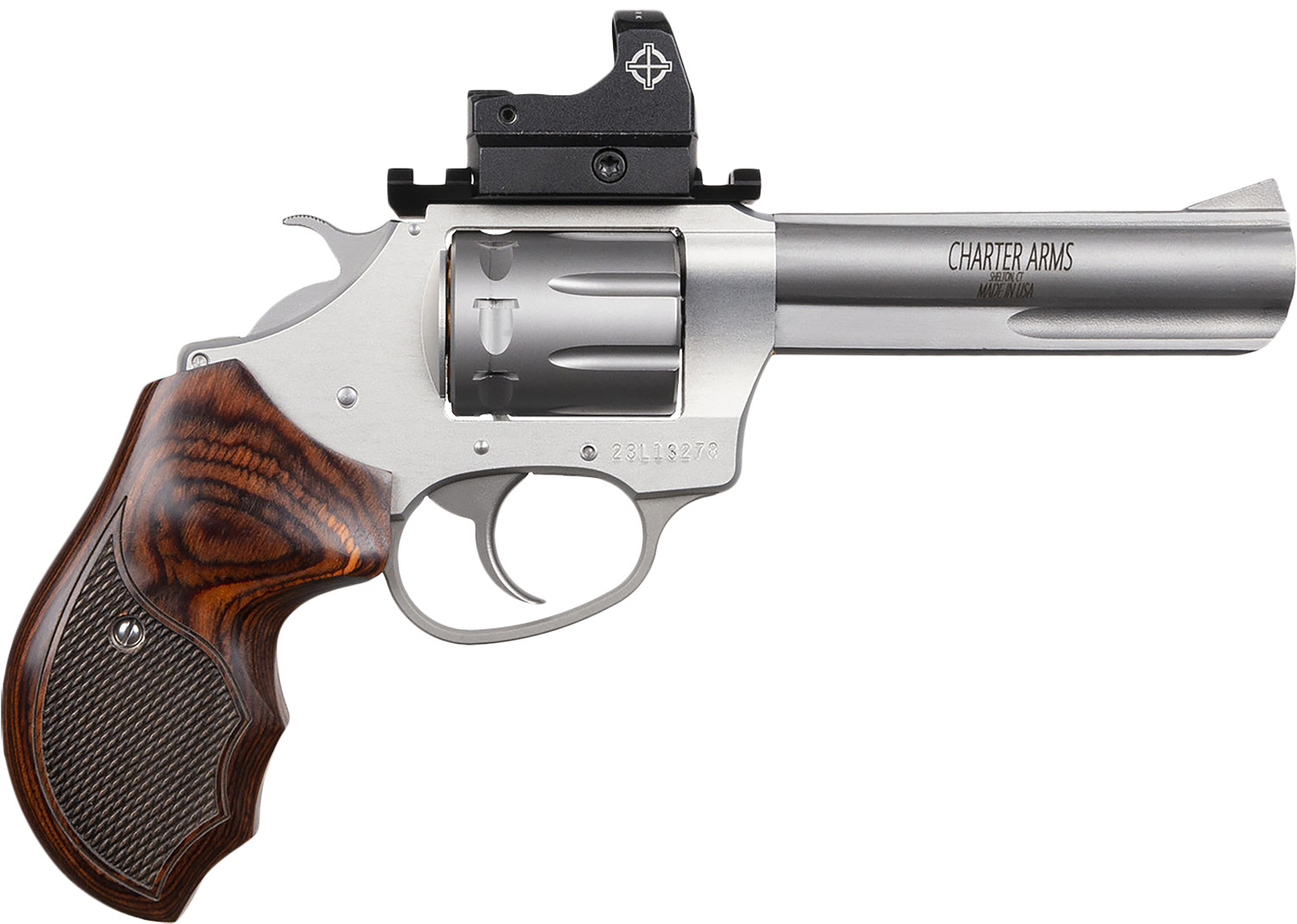
Charter Arms Target Pathfinder .22 LR 4.2 in 8-Round Revolver
Pros & cons
What works
- Accepts a direct-mount micro red dot on its integrated Picatinny rail - no adapter plates required
- Unloaded weight of 23.5 oz is 3.2 oz lighter than an all-steel Ruger GP100 in .22 LR
- 8-round full-diameter cylinder provides 2 more rounds than most 6-shot .22 LR revolvers
- Hammer block safety meets SAAMI drop-test standards for secure transport and handling
Trade-offs
- Double-action trigger pull measures 12 lbs - 4 lbs heavier than a tuned S&W 617's 8-lb pull
- Aluminum frame lacks the heat dissipation of steel during sustained rapid-fire strings (50+ rounds)
- No factory-threaded barrel option on this specific SKU - adds $120-$180 for aftermarket threading
- Rosewood grips are checkered but non-adjustable; replacements require custom fitting
Video review
Expert review
Specs at a glance
About this product
What is the Charter Arms Target Pathfinder .22 LR 4.2 in 8-Round Revolver? It’s a compact, optics-ready rimfire revolver built for precision range work, using an anodized aluminum frame to minimize weight while maintaining the mechanical lockup reliability of a traditional wheelgun. This model directly addresses the growing demand for suppressor-host capable .22 LR handguns that can bridge training and small-game applications without the bulk of a semi-automatic. Charter Arms leverages a full-diameter cylinder and a Picatinny rail section to marry classic grip geometry with modern red-dot mounting, a configuration increasingly relevant for shooters navigating state-level hearing protection regulations.
What is the Charter Arms Target Pathfinder used for?
The Target Pathfinder is designed primarily for disciplined rimfire target shooting and suppressor-qualified small-game hunting, which is its most effective application. The 4.2-inch barrel provides sufficient sight radius for irons and optimal dwell time for standard-velocity .22 LR ammunition to achieve consistent velocities around 1,075 fps, critical for maintaining point of impact with a can attached. Its eight-round capacity and double-action trigger make it viable for introductory handgun training and steel challenge rimfire divisions where semi-auto reliability with cheap ammunition can be a liability, unlike many budget .22 pistols that require specific high-velocity rounds to cycle reliably.
How does the Charter Arms Target Pathfinder compare to the Ruger LCRx 3-inch .22 LR?
The Charter Arms Target Pathfinder offers a longer 4.2-inch barrel and direct Picatinny rail mounting, making it superior for optics and suppressor use, while the Ruger LCRx 3-inch .22 LR is better for concealed carry due to its shorter profile and snag-free design. The Pathfinder’s aluminum frame results in an unloaded weight of approximately 23.5 ounces, nearly identical to the Ruger's polymer frame, but the Charter’s traditional solid-frame construction provides a more rigid platform for consistent barrel harmonics. Where the Ruger excels in holster comfort, the Charter provides a dedicated range and hunting configuration that doesn't require aftermarket adapter plates for red dots, a direct mechanical advantage for zero retention.
What does it weigh and what are the dimensions?
Its unloaded weight is 23.5 ounces, with overall dimensions measuring 9.1 inches in length, 4.6 inches in height, and a cylinder width of 1.38 inches. The 4.2-inch barrel features a 1:16-inch right-hand twist rate, standard for stabilizing 40-grain .22 LR projectiles, and the grip frame provides a 5.6-inch circumference that accommodates most medium-to-large hands without requiring a backstrap swap. These numbers place it squarely between a compact service pistol and a full-sized revolver, offering enough mass to manage recoil (negligible as it is) while remaining carriable in a field holster for extended periods, a practical balance for its intended role.
Who is this NOT for?
This revolver is not for anyone seeking a defensive firearm or a high-volume plinker where reload speed is paramount. The double-action trigger pull measures a consistent but lengthy 12 pounds, and the eight-round cylinder requires an extraction rod and manual ejection, making reloads a 15-20 second process under ideal conditions—unacceptable for defensive scenarios. Additionally, shooters requiring a chassis system for competition or those operating in environments where aluminum frame durability against extreme temperature cycling is a concern should consider a steel-frame alternative like the Stevens 334 Rifle for more robust material construction, as aluminum can exhibit different thermal expansion properties under sustained fire.
What's in the box?
You receive the revolver, one 8-round cylinder, a Picatinny rail section pre-installed on the top strap, and the factory manual—nothing more. Charter Arms does not include a cable lock, snap caps, or any optics in the base package, a notable omission compared to competitors like Taurus that often bundle at least a basic security device. The manual details the hammer block safety operation and maximum pressure specifications for .22 LR only (24,000 PSI MAP), explicitly warning against .22 Magnum chambering attempts, which is a critical compliance point for armory inspection.
Is the Charter Arms Target Pathfinder worth it at $538.99?
At $538.99, it represents fair value for a dedicated, optics-ready rimfire revolver with a suppressor-friendly barrel length, but it demands you value those specific features over semi-auto convenience. You are paying approximately $130 more than a base-model Ruger Wrangler for the aluminum frame, Picatinny rail, and adjustable sight system, which is justifiable if you intend to mount a micro red dot like the Sightmark mentioned in the spec sheet. Compared to investing in a rimfire conversion kit for a centerfire pistol, this provides a dedicated, reliable platform without the fouling and extraction issues common in many slide-mounted kits, making it a more durable long-term solution for structured training, similar to the role a Stevens 555 Sporting shotgun serves for clay disciplines.
Key attributes
| upc | 678958722451 |
| manufacturer | Charter Arms |
| manufacturer part number | 72245 |
| barrel finish | Anodized |
| barrel length | 4.20" |
| caliber/gauge | .22 LR |
| capacity | 8 |
| shipping weight | 2.5 |
| sights | LitePipe Front/Picatinny Rail |
Frequently asked questions
- Is it compatible with a .22 Magnum cylinder?
- No, the Charter Arms Target Pathfinder is not factory-compatible with .22 Magnum cylinders due to different chamber dimensions and pressure specifications. Attempting to fit a .22 Magnum cylinder will result in headspace issues and potential safety overpressure incidents, as the frame is engineered for the 24,000 PSI maximum of .22 LR only. Charter Arms does not offer a conversion kit for this model, unlike some Ruger single-actions that support interchangeable cylinders.
- Does it fit a standard holster for a 4-inch K-frame revolver?
- No, the Target Pathfinder requires a holster specifically molded for its frame profile, as its aluminum frame dimensions differ from a steel Smith & Wesson K-frame. The cylinder width of 1.38 inches is slightly narrower than a typical .38 Special K-frame, and the Picatinny rail creates a non-standard top strap contour. We recommend checking with holster manufacturers like Simply Rugged or Diamond D Custom for dedicated leather or kydex molds to ensure proper retention.
- How long does shipping take to an FFL?
- Shipping to your selected Federal Firearms License (FFL) dealer typically takes 3-5 business days from warehouse dispatch, depending on your geographic zone. All firearms require signature confirmation upon delivery and must be processed through your FFL's background check procedure, which can add 1-3 additional business days depending on state wait periods. We ship via UPS or FedEx with adult signature required, tracking provided within 24 hours of order verification.
- Can I return it if it doesn't fit my hand?
- No, firearms are generally non-returnable once the transfer has been completed at your FFL due to federal regulations and inventory control protocols. You can, however, sell or trade the firearm through a licensed dealer following all applicable state and federal laws. We strongly recommend handling a similar model at a local retailer before purchasing, as grip ergonomics are a personal and non-adjustable aspect of revolver design.
- Does this work with a SilencerCo Sparrow suppressor?
- Yes, it's compatible with the SilencerCo Sparrow and most other .22 LR suppressors that use a standard 1/2x28 thread pitch, provided you verify the barrel is properly threaded. Charter Arms ships this model with a threaded barrel option (check specific SKU), but the standard 4.2-inch barrel may require aftermarket threading by a qualified gunsmith if not specified. Always confirm thread concentricity with an alignment rod before firing suppressed to avoid baffle strikes.