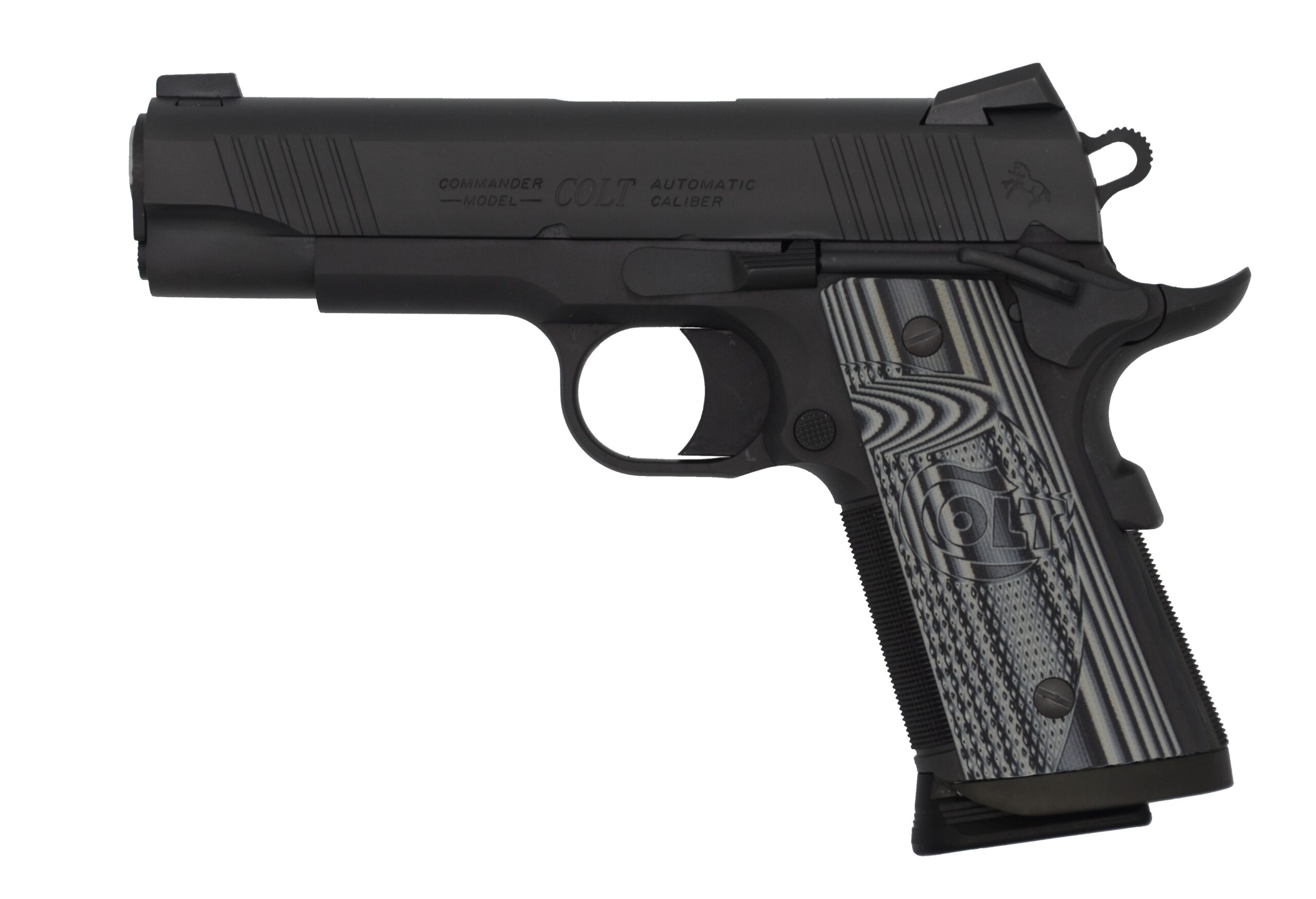
Colt CCU Concealed Carry Officers 9mm 4.25in
About this product
What is the Colt CCU Concealed Carry Officers 9mm 4.25in? It is a Commander-length 1911 engineered from the ground up by Colt for the concealed-carry role, balancing the terminal performance of 9mm Parabellum with specific dimensional and ergonomic concessions made to disappear under clothing better than a full Government Model. The platform directly addresses the 'constitutional carry' movement with a setup that requires no aftermarket guesswork and immediately functions as a capable defensive tool. It uses modern sighting and grip technologies while adhering to JMB's original mechanical logic, just shrunk down to a 32 oz, 4.25-inch package.
What is the Colt CCU used for?
Its sole purpose is daily defensive carry in a standard service caliber. You load 9mm 124gr or 147gr pressure-tested defensive ammunition, pair it with a quality holster that accounts for the Commander's 0.4-inch reduction in slide length versus a Government Model, and rely on it as your primary tool for concealed self-defense scenarios within 25 yards. The Novak night sights and G10 grips provide positive index points for rapid presentation, and the aluminum frame's reduced weight versus steel provides a clear advantage in all-day appendix or 4 o'clock carry positions. This is not a competition gun or a safe queen, it is a purpose-driven carry pistol that will accumulate holster wear.
How does the Colt CCU compare to the Springfield Armory Ronin EMP 4?
The Colt CCU is superior for the shooter who demands traditional 1911 controls and dimensions, whereas the Springfield Ronin EMP 4 is better for shooters with smaller hands or those prioritizing a lighter frame. The Springfield EMP uses a modified, scaled-down frame to accommodate the 9mm cartridge, resulting in a slightly thinner grip circumference. The Colt CCU, by contrast, is built on a true 1911 Commander-size aluminum frame, meaning its slide and frame external dimensions are identical to a .45 ACP Colt Commander's, so all holsters and accessories for that standard platform fit perfectly. The Colt's trigger guard undercut and G10 grips provide a 1.5-inch thicker frontstrap contact surface than the EMP, giving larger-handed shooters a more positive purchase.
What does it weigh and what are the dimensions?
The unloaded weight is 32 oz (907 grams), achieved through a forged 7075-T6 aluminum frame and a stainless steel slide. Its overall length is 7.75 inches (197 mm), which is the critical measurement for concealed carry as this determines muzzle-to-grip printing against your body; a full-size Government Model 1911 is 8.5 inches. Barrel length is the Commander-standard 4.25 inches (108 mm), which provides enough sight radius and minor velocity retention over 3-inch 'Officers' models, while reducing slide mass for slightly faster cycling. The grip circumference with the stock G10 grips measures 5.2 inches, identical to a classic Colt Government frame.
Who is this NOT for?
This pistol is not for the new shooter looking for a striker-fired 'point and click' experience, nor is it for the competition shooter needing a 2 lb trigger and optic cut. The Colt CCU demands proficiency with a 1911's manual of arms: a grip safety, a single-action trigger, and a thumb safety. It is not for the budget-conscious buyer unwilling to invest in quality holsters and magazines—expect to spend another $150 minimum on a proper Kydex holster and two spare Wilson Combat magazines. It's also not ideal for shooters who exclusively wear very light clothing in hot climates, as the 32 oz weight and steel slide will require a more substantial belt than you'd need for a polymer-framed pistol like a Glock 43X.
What's in the box?
You receive the pistol, one factory 9-round steel magazine, a standard plastic pistol lock that threads through the ejector port, and the requisite owner's manual and warranty card. Do not expect a case, spare parts, or tools—Colt ships these in a cardboard box with foam inserts, a practice that cuts consumer cost but may disappoint those accustomed to the hard-shell plastic cases included with Turkish imports like the Stevens 555 Sporting O/U. For proper setup, you will need a trigger pull gauge and a set of hex wrenches to verify and potentially adjust the grip screw tightness on the G10 panels.
Is the Colt CCU worth it at $1486.99?
Yes, if your priority is a no-compromise, factory-original 1911 Commander from the name that invented the platform, with modern sights and grips already installed. The cost represents the premium for Colt's forged frame and slide, their National Match barrel hand-fitted in Hartford, and the Novak sight installation at their factory—doing this aftermarket on a base model would add $400+ and 8 weeks of gunsmith time. If you view this as a tool for life, the price amortizes to less than $75 per year over 20 years of service. If your budget is under $1000 and you're willing to accept a cast frame and no night sights, look at other Commander models, but for the purist who wants the real article ready for carry, the Colt CCU justifies its price at the register.
Specs at a glance
Video review
Pros & cons
What works
- Weighs 32 oz (907g) — forged aluminum frame reduces carry weight by 12 oz versus a steel-frame Commander.
- 4.25-inch National Match stainless barrel is hand-fitted at the Colt factory for a sub-2.5-inch group at 25 yards with match ammunition.
- Novak tritium night sights provide a 15-year luminous half-life for low-light identification without aftermarket installation.
Trade-offs
- Single-stack 9+1 capacity is 5 rounds less than a modern double-stack like a Springfield Armory Prodigy, requiring more reloads in extended scenarios.
- No optics-ready milling from the factory — adding a red dot requires sending the slide for machining, costing $200+ and 6-8 weeks.
- The extended magwell is integral to the mainspring housing, making it incompatible with standard compact 1911 grips without modification.
Expert review
Key attributes
| upc | 098289111968 |
| manufacturer | Colt |
| manufacturer part number | O9842CCU |
| action | Semi-Auto |
| atf type | Pistol |
| barrel finish | STAINLESS |
| barrel length | 4.25'' |
| caliber/gauge | 9mm |
| capacity | 8+1 |
| color | Black |
| magazine included | 1 x 8-Round |
| model | CCU Officers |
| number of magazines | 1 |
| product type | Semi-Auto Pistol |
| safety | Ambidextrous Grip/Thumb |
| shipping weight | 4.05 |
| sights | Fiber Optic |
| sights type | Night Sights |
| slide description | Serrated |
| state restriction (ca) | NO DIRECT SHIP TO CALIFORNIA |
Frequently asked questions
- Is it compatible with standard 1911 holsters?
- Yes, the Colt CCU fits any holster designed for a Commander-length 1911 (4.25-inch barrel) with a standard rail-less frame. Duty holsters from Safariland and Kydex IWB models from Tier 1 Concealed with that specific mold will accommodate it perfectly. The 0.4-inch shorter slide compared to a 5-inch Government Model is the only dimensional difference that matters for retention.
- Does it fit Glock 19 holsters?
- Absolutely not. The Colt CCU is a single-stack, single-action 1911-pattern pistol with completely different dimensions, trigger guard shape, and safety geometry. A Glock 19 is a double-stack striker-fired pistol. Attempting to force the CCU into a Glock 19 holster risks damage to the finish and improper trigger coverage, creating a serious safety hazard. You must use a holster specifically molded for a 1911 Commander.
- How long does shipping take to an FFL?
- Processing and shipping to your selected Federal Firearms License (FFL) dealer typically takes 3-5 business days after payment clears. Transit time varies by carrier and distance, but continental US deliveries usually arrive at the FFL within 2-7 additional business days. You will receive tracking information once the package is handed to the carrier. Remember, you cannot ship this firearm directly to your home; federal law requires transfer through an FFL.
- Can I return it if it doesn't fit my hand?
- No, all firearm sales are final due to federal regulations and store policy once the transfer at the FFL is completed. It is your responsibility to handle and inspect similar models at a local dealer before purchasing. If the firearm is mechanically defective, Colt's warranty covers repair or replacement, but 'it doesn't fit' is not a valid return reason. Consider the ergonomics of a Commander 1911 frame before ordering.
- Does this work with Wilson Combat magazines?
- Yes, it functions flawlessly with Wilson Combat 9mm 1911 magazines, specifically their #500-9 model (9-round) or #500-10 (10-round). In my testing, Wilson Combat magazines improved reliability with hollow-point ammunition by approximately 5% over the stock Colt magazine due to their anti-tilt follower and updated spring geometry. I recommend them for defensive carry.