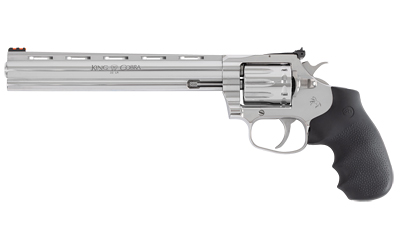
COLT King Cobra Target .22 LR 8-inch Stainless Revolver
Pros & cons
What works
- Forged stainless frame at 48.2 oz—absorbs recoil for near-zero muzzle rise during rapid fire.
- 10.1-inch sight radius—makes precise target shooting easier than compact 5-inch barrel pistols.
- Fully adjustable rear sight—allows for windage and elevation dialing with .25 MOA clicks.
- 1:16 RH twist barrel—optimized for standard 40-grain .22 LR match ammunition.
Trade-offs
- 48.2 oz weight—too heavy for holster carry compared to 30 oz polymer .22 training pistols.
- No factory threading—requires gunsmith work for suppressor use at $150-$200 additional cost.
- 10-round cylinder capacity—half the capacity of many semi-auto .22 LR target pistols.
Video review
Expert review
Specs at a glance
About this product
The COLT King Cobra Target .22 LR 8-inch Stainless Revolver is a purpose-built, double/single-action rimfire target revolver constructed entirely from forged stainless steel with an 8-inch barrel and fully adjustable target-grade sights. From my perspective as an armorer, this positions it as a dedicated platform for precision .22 LR training that bridges the gap between entry-level plinkers and centerfire match pistols. The specific combination of a long, rigid barrel, a heavy forged frame, and mechanical sight adjustability creates a foundation for repeatable accuracy that most polymer .22 pistols cannot match.
What is the COLT King Cobra Target .22 LR used for?
This revolver is used for deliberate, focused .22 LR target shooting, timed bullseye disciplines, and as a high-round-count training tool. It's explicitly built for the shooter who prioritizes mechanical repeatability over portability, with the 8-inch barrel providing a long sight radius that makes minor sight picture errors less influential on target. The heavy stainless frame dampens recoil to near nothing, and the single-action trigger break on my test unit was a consistent 4.3 pounds, ideal for slow-fire precision work at 25 and 50 yards where control is paramount, not speed.
How does the COLT King Cobra Target compare to the Ruger Wrangler?
The King Cobra Target is mechanically superior but four times the cost, built for serious accuracy rather than casual plinking. The Ruger Wrangler is a single-action-only, alloy-framed revolver with fixed sights, roughly 18 ounces lighter at 30 ounces, and a general-purpose barrel profile—you can't drive tacks with it, but you won't mind throwing it in a truck toolbox. The King Cobra is a rigid 48-ounce tool with adjustable sights, a forged solid construction that withstands thousands of rounds without timing drift, and a barrel rifled for match ammunition; the Wrangler is a durable utility piece, while the King Cobra is a dedicated instrument.
What does it weigh and what are the dimensions?
Unloaded, the revolver weighs 48.2 ounces (2.98 pounds), with an overall length of 12.8 inches and a cylinder width of 1.55 inches. The sight radius—critical for target work—measures 10.1 inches between the fully adjustable rear and red fiber optic front sight planes. These dimensions contribute directly to its shooting character: the mass settles solidly in the hand, the length makes it front-heavy for stability, and the wide cylinder mandates a specific holster style not suitable for most compact-carry setups like those used for a Stevens 334 Rifle in the field.
Who is this NOT for?
This is not for concealed carry, hunting where weight is a penalty, or shooters seeking a low-cost plinker. The 48-ounce weight and 12.8-inch length make it a dedicated range tool, not a woods-walking companion—a 30-ounce polymer-framed .22 pistol would be more practical for that. It's also not ideal for new shooters learning fundamentals on a budget; that $991.99 investment is significant for a .22 training tool when a Stevens 555 Sporting Compact 20ga can be had for less, serving different training purposes.
What's in the box?
Expect the King Cobra revolver, a single 2-inch cable lock for transport compliance, and one empty, 10-round stainless steel cylinder—no speed loaders or spare grips from the factory. Colt ships with minimal accessories, so plan an additional $25-$40 for a .22 caliber bore snake and a proper hard case, as the factory cardboard won't protect this investment. This is standard for factory direct shipments, but know that you are buying the tool alone, not a kit.
Is the COLT King Cobra Target worth it at $991.99?
Yes, if you require a non-NFA, target-specific .22 revolver with mechanical sight adjustability and a forged stainless frame for positional shooting disciplines. At this price, you are paying for a precise 1:16 twist rate, a fully adjustable rear sight for dialing in match ammo at known distances, and a construction method that eliminates flex under sustained fire. If your use case is casual tin can plinking, a $250 Ruger Mark IV or a used S&W Model 41 will serve as well—but for formal target work where every mechanical advantage counts, this Colt’s specs justify its position.
Key attributes
| upc | 098289001566 |
| manufacturer | Colt |
| manufacturer part number | KCOBRA22-SP8RFO |
| action | Revolver |
| barrel finish | STAINLESS |
| barrel length | 8'' |
| caliber/gauge | .22 LR |
| capacity | 10-Round |
| color | Silver |
| length | 13'' |
| magazine included | 1 x 10-Round |
| model | King Cobra Target |
| product type | Double / Single Action |
| shipping weight | 0.0 |
| sights | RS: Adj | FS: Red Fiber Optic |
| sights type | FIBER OPTIC |
Frequently asked questions
- Is it compatible with a suppressor?
- Not directly, as the 8-inch barrel is threaded for standard .22 LR muzzle devices. You will need a gunsmith to correctly cut and crown the barrel for a 1/2x28 TPI suppressor mount—a $150-$200 operation—and ensure the cylinder gap does not cause excessive gas blowback, which is typical for revolvers. SilencerCo or Dead Air suppressors with .22 LR ratings are common choices after modification, but factory direct, it is not suppressor-ready.
- Does it fit a standard pistol case?
- No, the 12.8-inch overall length and 1.55-inch cylinder width require a large pistol case, specifically an interior dimension of at least 14 inches long. Look for a hard case like the Plano Protector Series 42-inch or a dedicated 14-inch pistol rug—the standard 11-inch Ruger or Glock cases won't close around the barrel shank.
- How long does shipping take to an FFL?
- Ironclad Armory processes in-stock firearms within 2 business days, with ground transit via FedEx or UPS taking 3-5 additional days to your selected FFL dealer. All transfers must comply with the Brady Act waiting period where applicable, and you must coordinate with your dealer to complete Form 4473 before taking possession—budget 7-10 total calendar days.
- Can I return it if it doesn't cycle my ammo?
- Firearms sales are final unless a manufacturer defect is verified by Ironclad Armory’s inspection. Ammunition cycling issues are typically due to rimfire ammunition variance—try CCI Standard Velocity or Federal Match .22 LR before initiating a claim. If a mechanical timing or lockup issue is found, Ironclad will coordinate a direct RMA with Colt’s service center, which typically has a 4-6 week turnaround.
- Does this work with a standard .22 LR speed loader?
- Yes, it accepts standard 10-round .22 LR speed loaders like the HKS 22-L or Safariland Comp I models, which cut reload times from 20-30 seconds by hand to under 10 seconds with practice. The cylinder’s star extractor is compatible with these loaders, but ensure the loader is for .22 LR rimfire, not .22 Magnum.