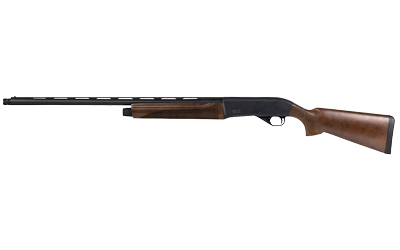
CZ 712 G3 12 GA 28″ Walnut Semi-Auto
About this product
The CZ 712 G3 12 GA 28″ Walnut Semi-Auto is a gas-operated sporting shotgun built to handle both 2¾" and 3" shotshells with tunable reliability. It represents a calculated entry point into semi-auto versatility for shooters who demand more than a basic pump action but don’t require the premium expense of a top-tier autoloader. From upland game to sporting clays, its design prioritizes functional adaptability over flash.
What is the CZ 712 G3 12 GA 28″ Walnut Semi-Auto used for?
This shotgun is primarily for waterfowl hunters, upland game shooters, and recreational clay busters. Its 28-inch choked barrel and gas-operated action provide a smooth, manageable swing for flighting birds and breaking clays, while the walnut stock offers traditional handling that synthetic-stocked field guns lack. The included five Active-Choke tubes (F, IM, M, IC, C) let you tailor the pattern from tight goose-stopping Full to open Improved Cylinder for close-flushing grouse.
How does the CZ 712 G3 compare to the Stevens 555 Sporting O/U?
The CZ 712 G3 is the better choice for high-volume shooting and waterfowl, while the Stevens 555 Sporting O/U excels at formal clay sports. The gas-operated semi-auto action of the 712 G3 soaks up more recoil, a tangible benefit over 500 shells in a day, and its single barrel is easier to clean after foul-weather hunts. The over/under Stevens 555, however, offers instant choke selection and is marginally faster for disciplined doubles due to its dual, pre-selected barrels.
What does it weigh and what are the dimensions?
It weighs 7.5 pounds and measures 49.75 inches in overall length with a 28-inch chrome-lined barrel. At 49.75 inches, it’s 4.25 inches longer than the Stevens 555 Sporting Compact, giving it a smoother, more deliberate swing arc ideal for pass shooting. The weight balances just forward of the receiver, which aids in follow-through but requires more forearm strength for extended carry compared to lighter 20-gauge models.
Who is this NOT for?
This is not for the tactical/home defense shooter or someone who exclusively shoots heavy 3.5" magnum shells. The 28-inch barrel is cumbersome for indoor scenarios, and the chamber is limited to 3-inch shells, unlike some specialized waterfowl guns. It’s also a poor fit for the shooter who refuses to perform basic maintenance, as the gas system’s two pistons require occasional cleaning to ensure reliable cycling with light target loads.
What’s in the box?
You get the shotgun, five Active-Choke tubes (F, IM, M, IC, C), two gas pistons (light and heavy load), a basic choke wrench, and the owner’s manual. The inclusion of both pistons is critical—the light-load piston is for 2¾" target loads under 1,250 fps, while the heavy-load piston handles 3" magnums, a setup that prevents most cycling issues out of the box. Note that a hard case is not included; plan for that separately.
Is the CZ 712 G3 worth it at $478.99?
At $478.99, it represents strong value for a tunable, walnut-stocked semi-auto with a chrome-lined barrel. You are getting a feature set—multiple chokes, dual pistons, a corrosion-resistant barrel—that often starts at $600 in competing brands. The trade-off is a simpler finish and a more utilitarian feel than a Beretta A300, but for a shooter needing one gun for both ducks and clays, the performance per dollar is difficult to beat.
Specs at a glance
Video review
Pros & cons
What works
- Dual gas pistons included — allows reliable cycling from 1-ounce target loads to 3-inch magnums
- Chrome-lined 28" barrel — resists corrosion from foul-weather waterfowling and simplifies cleaning
- Five choke tubes (F, IM, M, IC, C) — provides immediate pattern flexibility for clays, upland game, and waterfowl
- 49.75" overall length — delivers a smooth, stable swing plane for consistent pass shooting and sporting clays
Trade-offs
- Proprietary Active-Choke threading — limits aftermarket choke options compared to ubiquitous Mobil/Invector patterns
- No included hard case — adds $40-75 to the total cost for proper transport and storage
- Fixed walnut stock — cannot be adjusted for length of pull, a limitation for shooters outside the average build
- Matte finish shows handling wear quickly — expect visible marks on the receiver within the first few range sessions
Expert review
Key attributes
| upc | 806703061672 |
| manufacturer | CZ-USA |
| manufacturer part number | 06167 |
| action | Semi-Auto |
| barrel finish | MATTE BLACK |
| barrel length | 28" |
| caliber/gauge | 12 Gauge |
| capacity | 3 + 1 |
| chokes included | F,IM,M,IC,C |
| color | Black |
| model | 712 G3 |
| safety | Crossbolt |
| shipping weight | 16.2 |
| sights | Bead |
| atf type | Shotgun |
| length | 47 |
| magazine included | 1 x 3-Round |
| package height | 4.0 |
| package width | 11.1 |
| product type | Shotgun |
| sights type | Fixed Sights |
Frequently asked questions
- Can I use this for 3.5" magnum shells?
- No, the chamber is machined for a maximum shell length of 3 inches. Attempting to chamber a 3.5" shell will not only fail to feed but can create a dangerous obstruction. For 3.5" waterfowl loads, you need a dedicated magnum shotgun like certain Benelli or Beretta models.
- What is the magazine tube capacity?
- The published capacity is 3+1 (three in the magazine tube, one in the chamber). This is a standard field configuration for most states' migratory bird regulations. The tube is not readily pluggable; you must insert a physical dowel to limit capacity for jurisdictions requiring a two-shell total.
- Is the barrel threaded for choke tubes?
- Yes, it uses the proprietary CZ Active-Choke system, which is not compatible with common Beretta/Benelli Mobilchokes or Winchester/Invector threads. The included five tubes cover all standard constrictions from Cylinder to Full.
- How long does it take to clean the gas system?
- A thorough field-strip and gas piston cleaning takes about 15 minutes after you're familiar with the process. The two pistons and their respective rings are the critical components; fouling here after 250-300 rounds of cheap target loads is the primary cause of failure-to-cycle complaints.