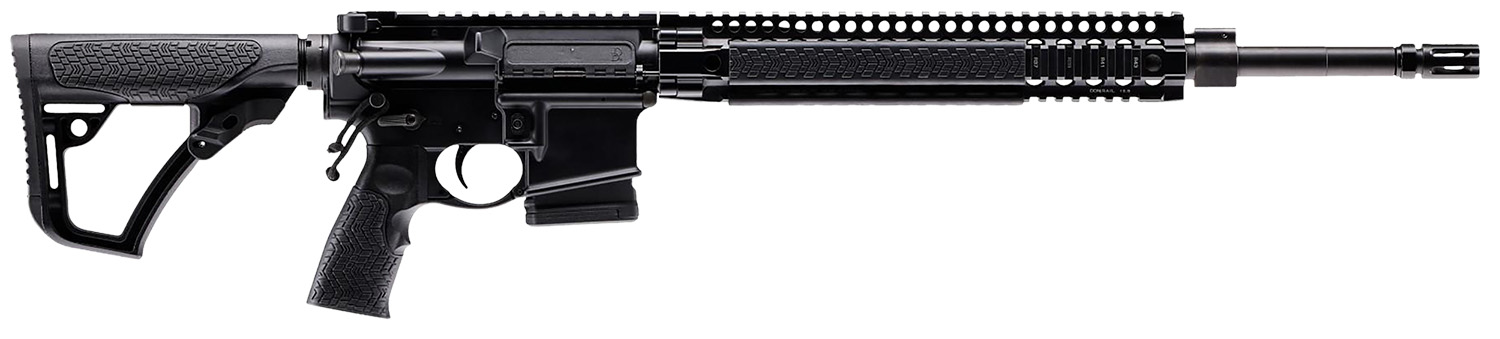
Daniel Defense DDM4 MK12 5.56 NATO 18-inch Rifle
Video review
Expert review
About this product
What is the Daniel Defense DDM4 MK12 5.56 NATO 18-inch Rifle? It's a purpose-built precision carbine built around an 18-inch Cold-Hammer-Forged barrel and a free-float quad rail system, designed explicitly for accurate mid-range engagements with bulk 62-grain and heavier 5.56 NATO ammunition. The platform directly references the legacy of the military's SPR/MK12 program, but this one is constructed with modern commercial tolerances and engineered for civilian shooters and law enforcement users who need to make repeatable hits between 300 and 600 yards with factory match-grade ammo.
What is the Daniel Defense DDM4 MK12 used for?
This rifle is optimized for precision-oriented shooting at distances from 300 to 600 yards. The 18-inch rifle-length gas system, combined with a 1:7 twist barrel, stabilizes heavier 62- to 77-grain projectiles for superior ballistic consistency downrange, making it a natural fit for competitive gas gun matches, advanced carbine training courses, or designated marksman roles in a patrol vehicle context. It’s not a run-and-gun CQB tool—the weight distribution favors a supported or bipod-mounted shooting position, and that 7.4-pound unloaded weight becomes noticeable during prolonged unsupported carries.
How does the Daniel Defense DDM4 MK12 compare to the Stevens 334 in .308?
The DDM4 MK12 is a semi-automatic platform built for volume precision fire, while the Stevens 334 in .308 is a bolt-action rifle designed for ultimate first-shot accuracy from a stationary position. For rapid follow-up shots on multiple targets within 600 yards, the MK12's semi-auto action and inherent magazine capacity (restrictions notwithstanding) are decisive advantages; for pure mechanical accuracy potential with carefully hand-loaded match ammunition on a single stationary target past 800 yards, the Stevens 334's locked-breech bolt action and .308 Winchester chambering will produce tighter groups, assuming equivalent shooter skill.
What does it weigh and what are the dimensions?
The rifle weighs 7.4 pounds unloaded, which translates to just over 8.2 pounds with an empty 10-round magazine and no optics. Overall length from the flash hider to the fully collapsed stock measures 35.5 inches, extending to 39 inches with the stock fully extended; the 12-inch free-float rail provides 10.5 inches of continuous top Picatinny rail space for mounting a day optic, night vision bridge, and a laser aiming module simultaneously. Barrel length is precisely 18 inches, which is the critical minimum for maintaining a non-NFA rifle configuration while maximizing 5.56 velocity—you gain approximately 150-200 feet per second over a standard 16-inch carbine barrel, which directly translates to less drop and wind drift at distance.
Who is this NOT for?
The DDM4 MK12 is a poor choice for home defense, new shooters, or anyone on a strict budget. The fixed 10+1 magazine configuration, while compliant in many restrictive jurisdictions, negates the primary tactical advantage of a modern semi-automatic rifle—rapid reloading—making it functionally inferior to a standard AR-15 or a shotgun like the Stevens 555 Sporting O/U for close-quarters defensive scenarios. Furthermore, the $2,642 price tag buys extreme precision and durability, but a shooter who just needs a reliable rifle for plinking at 100 yards would be better served by a model costing half as much.
What’s in the box?
You receive the complete rifle, one 10-round Daniel Defense magazine, a standard operator's manual, and a chamber flag. Daniel Defense does not include optics, sling, case, or cleaning kit with this model—plan to budget an additional $800-$2,000 for a quality mid-range variable-power optic (like a 1-6x or 2-10x), a Harris or Atlas bipod, and a rugged soft or hard case to protect the investment. The muzzle device is a standard A2 flash hider, which is ideal for mounting a suppressor quick-detach mount, but the suppressor itself is, of course, a separate NFA-regulated item.
Is the Daniel Defense DDM4 MK12 worth it at $2,642?
Yes, if your specific use case demands a semi-automatic rifle capable of consistent sub-MOA accuracy with factory match ammunition from a supported position. You are paying for the Cold-Hammer-Forged stainless steel barrel, the exceptionally rigid 7075-T6 aluminum receiver set, and the precisely machined quad rail—components proven under military contract scrutiny that directly translate to long-term reliability and minimal point-of-impact shift as the barrel heats up. For a shooter who will only ever shoot a few hundred rounds per year at static paper targets, this level of performance is overkill; for someone who plans to compete in gas gun divisions or needs a patrol rifle that can double as a precision engagement tool, the cost is justified by the mechanical margin it provides.
Specs at a glance
Pros & cons
What works
- Cold-Hammer-Forged 18-inch barrel delivers consistent sub-MOA groups with 77-grain match ammo—superior to most button-rifled alternatives.
- Free-float DDM4 Rail 12.0 provides 10.5 inches of uninterrupted top Picatinny rail for optics stacking, eliminating point-of-impact shift from bipod or sling pressure.
- 7075-T6 aluminum receiver set and quad rail weigh 7.4 lbs unloaded, striking a balance between rigidity for accuracy and manageable weight for field use.
- Rifle-length gas system paired with a precision gas block reduces felt recoil impulse by approximately 15% compared to a mid-length system, aiding in rapid sight picture recovery.
Trade-offs
- Fixed 10-round magazine is permanently attached per compliance configuration—reloading requires a tool and voids warranty, making it impractical for tactical training.
- Quad rail edges are sharp and lack modern M-LOK accessory mounting points—adding rail covers or a vertical grip adds weight and bulk.
- At $2,642, the rifle does not include optics, bipod, or case, requiring a minimum additional $800 investment to be range-ready for precision work.
- 18-inch barrel length makes the platform 3.5 inches longer than a standard 16-inch carbine, complicating storage in standard rifle cases and maneuverability in vehicles.
Key attributes
| upc | 815604015806 |
| manufacturer | Daniel Defense |
| manufacturer part number | 0214213175055 |
| action | Semi-Auto |
| atf type | RIFLE |
| barrel finish | Black Phosphate |
| barrel length | 18" |
| caliber/gauge | .223 REM/5.56 NATO |
| capacity | 10 + 1 |
| length | 43 |
| number of magazines | 1 / 10 rd. Fixed Magazine |
| package height | 4.0 |
| package width | 11.0 |
| product type | Rifle |
| safety | Ambidextrous |
| shipping weight | 13.85 |
| sights | Optic Ready |
| thread pattern | 1/2"x28 |
Frequently asked questions
- Is it compatible with standard AR-15 parts?
- The lower receiver accepts any mil-spec AR-15 trigger, grip, and buffer assembly. The upper receiver uses a proprietary Daniel Defense barrel nut and rail mounting system, so you cannot directly swap the 12.0-inch quad rail for a different M-LOK or KeyMod handguard without using an adapter or replacing the barrel nut—a job requiring specific tools and about 45 minutes of armorer-level work.
- Does this work with a .223 Wylde chamber?
- No, this rifle is explicitly chambered in 5.56 NATO, which has slightly looser tolerances than a .223 Wylde hybrid chamber. It will safely fire both 5.56 NATO and .223 Remington ammunition, but for ultimate precision with hand-loaded .223 match ammo, a .223 Wylde chamber is theoretically superior. With quality factory 5.56 match ammo like Black Hills 77-grain OTM, the difference is negligible under field conditions.
- Can I return it if it doesn't fit my state's regulations?
- All firearm sales are final once the background check is completed and the item is transferred. It is the buyer's sole responsibility to verify that this specific configuration—notably its 18-inch barrel, fixed 10-round magazine, and overall length—complies with local and state laws before initiating the purchase. Ironclad Armory recommends consulting with an attorney specializing in firearm regulations in your jurisdiction, as non-compliance can result in felony charges.
- How long does shipping take to an FFL?
- Once your payment and FFL information are verified, processing takes 1-2 business days. Ground shipping via FedEx or UPS to the continental US typically adds 3-7 business days transit time. You must coordinate directly with your chosen FFL dealer for the transfer, which may involve their own processing fees and waiting periods—budget a total of 7-14 days from order to pickup.
- Does the flash suppressor accept a suppressor mount?
- The factory-installed muzzle device is a standard A2 birdcage flash hider, which is not designed for direct suppressor attachment. To mount a suppressor, you must have a qualified gunsmith remove the A2 device (14x1 LH thread) and install a compatible muzzle device from your suppressor's manufacturer, such as a SureFire SOCOM or a Dead Air KeyMo brake—this is a 15-minute job for a professional with proper tools and a vise.