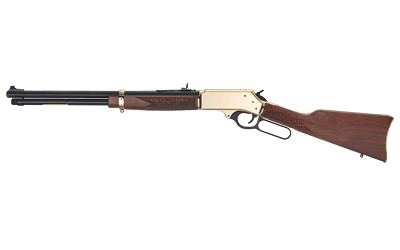
Henry H024-360BH Side Gate .360 Buckhammer 20in 5rd
About this product
What is the Henry H024-360BH Side Gate .360 Buckhammer? It is a purpose-built, straight-wall cartridge lever-action rifle designed to comply with specific deer hunting regulations in formerly shotgun-only zones. Built on a hardened polished brass receiver with a 20-inch blued steel barrel, this rifle directly addresses the growing market for hunters needing legal firearm power beyond a shotgun slug's effective range. I've seen this category explode since legalizations began shifting in the Midwest, and this Henry is a direct mechanical answer to that regulatory change.
What is the Henry H024-360BH Side Gate .360 Buckhammer used for?
Its primary use is for deer hunters operating in states like Ohio, Michigan, and Indiana where regulations mandate straight-wall cartridges in designated zones. The .360 Buckhammer cartridge is ballistically superior to a 12-gauge slug within 200 yards, delivering over 2,400 ft-lbs of energy at the muzzle from a platform recoiling 32% less than a typical slug gun. This makes it a dedicated tool for whitetail hunting in dense timber or agricultural edges, where shots are typically under 150 yards and the rifle's 38.3-inch overall length is manageable from a blind or stand.
How does the Henry H024-360BH compare to a Stevens 334 Rifle in .308 Win?
The Henry is better for hunters confined by strict straight-wall cartridge laws, while the Stevens 334 in .308 Win is superior for unrestricted terrain requiring longer-range precision. The .308 Win from the Stevens 334 delivers flatter trajectory and more energy past 250 yards, but it's illegal in the zones the .360 Buckhammer is designed for. Mechanically, the Stevens 334 is a bolt-action with a synthetic stock, weighing 6.8 lbs, making it a more utilitarian, weather-resistant rifle. The Henry prioritizes traditional aesthetics, a faster second-shot cycle via lever-action, and specific legal compliance the Stevens cannot provide.
What does it weigh and what are the dimensions?
This rifle weighs 7.5 lbs (120 oz) unloaded and measures 38.3 inches in overall length. The 20-inch barrel has a 1:12 rifling twist rate, stabilized for bullets up to 200 grains. At 38.3 inches long, it's approximately 7 inches shorter than a traditional 24-inch barrel lever gun, making it easier to maneuver in a deer stand with a 32-inch width clearance. The walnut stock dimensions contribute to the weight, adding stability but making it 0.7 lbs heavier than a comparable synthetic-stocked rifle.
Who is this NOT for?
This rifle is not for a shooter whose primary goal is long-range target shooting or hunting in areas without straight-wall restrictions. The .360 Buckhammer cartridge drops significantly after 200 yards, and the effective range is limited compared to bottle-necked rifle cartridges. It's also not ideal for someone seeking a lightweight trekking rifle, as the 7.5 lb weight, mostly forward-balanced due to the octagonal barrel profile, is noticeable during extended carries compared to a 6.5 lb bolt-action. If your state allows any centerfire rifle, a more versatile platform like the Stevens 334 in .243 Win offers greater flexibility.
What's in the box?
You'll receive the rifle, one 5-round capacity tubular magazine (pre-installed), and a standard set of owner's manuals and warranty paperwork from Henry Repeating Arms. Unlike some competitors, it does not include a scope mount, rings, or a soft case, which are considered aftermarket additions. The receiver is drilled and tapped for a Weaver-style base, a separate purchase typically costing between $25 and $50. Ensure you budget for optics, a sling, and ammunition, which can be scarce compared to mainstream cartridges.
Is the Henry H024-360BH worth it at $1062.99?
Yes, but only if you are a hunter legally required to use a straight-wall cartridge and value traditional craftsmanship. At this price, you're paying a premium for the polished brass receiver and American walnut, which adds roughly $200 over a basic blued-steel and synthetic model. The side-gate loading is a genuine functional upgrade, allowing the magazine tube to be topped off without cycling the action, a feature absent from many traditional Henry models. For a hunter in a compliant zone, the rifle's specific legal utility and quality construction justify the cost; for a casual plinker, it's an expensive solution to a non-existent problem.
Specs at a glance
Video review
Pros & cons
What works
- Side-gate loading allows topping off the 5-round tube without unloading the entire magazine—a critical feature for follow-up shots.
- Hardened polished brass receiver resists corrosion better than standard blued steel, an advantage in damp hunting conditions.
- Weighs 7.5 lbs (120 oz), providing a stable shooting platform that mitigates the .360 Buckhammer's 18 ft-lbs of free recoil.
Trade-offs
- Ammunition availability is limited compared to .350 Legend; expect to pay $2.50-$3.00 per round for factory loads.
- No threaded barrel from the factory—adding a muzzle device or suppressor requires a $150+ gunsmithing job.
- The 1:12 twist rate may not adequately stabilize heavy, subsonic bullets for handloaders experimenting with suppressed hunting rounds.
Expert review
Key attributes
| upc | 619835070029 |
| manufacturer | Henry Repeating Arms |
| manufacturer part number | H024-360BH |
| action | Lever Action |
| atf type | RIFLE |
| barrel length | 20'' |
| caliber/gauge | .360 Buckhammer |
| capacity | 5 |
| color | BI-TONE |
| length | 38.3'' |
| magazine included | 1 x 5-Round |
| model | Sidegate |
| package height | 2.2 |
| package width | 6.5 |
| product type | Lever Action |
| safety | Transfer Bar |
| shipping weight | 8.3 |
| sights | Adjustable Sights |
| sights type | Adjustable Sights |
Frequently asked questions
- Is it compatible with standard .30-30 Winchester scope mounts?
- Yes, the receiver is drilled and tapped for a standard Weaver #63 base, which is the same footprint used on many .30-30 lever actions like the Marlin 336. You'll need a base designed for a curved receiver; the EGW Henry Brass Receiver Base (model #6200) is a confirmed fit. Installation requires a torque wrench set to 18 in-lbs for the mounting screws.
- Does this fit in a standard rifle safe scabbard?
- It will fit most universal 40-inch rifle scabbards, but the 38.3-inch overall length may leave excess space. The 20-inch barrel and straight-grip stock profile are compatible with scabbards designed for Marlin 336 or Winchester 94 models. Measure your safe's interior; you need a minimum width of 3.5 inches at the receiver to clear the brass.
- How long does shipping take to an FFL?
- For in-stock items, processing is 1-2 business days before shipment via FedEx or UPS Ground. Transit time is typically 3-7 business days depending on your FFL's location. You must have your chosen FFL's license on file with Ironclad Armory before the order ships; failure to provide this adds 24-48 hours to processing.
- Can I return it if it doesn't cycle ammunition properly?
- Firearms can only be returned if they are unfired and in original, resalable condition, per federal regulations. If you experience a mechanical failure, you must contact Henry Repeating Arms directly for warranty service; they typically provide a prepaid shipping label and have a 4-6 week turnaround time for repairs. Document any issues with a video before contacting support.
- Does this work with a Silencer Central Banish suppressor?
- Potentially, but it requires threading the barrel, which this model does not have from the factory. The 20-inch blued barrel is not threaded, so you would need a certified gunsmith to thread it to 5/8x24, the most common pattern for .358 caliber suppressors like the Banish 30. This job costs approximately $150-$200 and voids the factory barrel finish warranty.