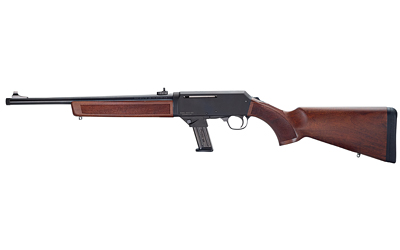
Henry Homesteader H027-H9S 9mm 16.37in Threaded Barrel Walnut
About this product
The Henry Homesteader H027-H9S is a 9mm Luger blowback-operated semi-automatic carbine that blends traditional American walnut rifle aesthetics with modern accessory compatibility via its 16.37-inch threaded barrel. It was designed to answer a specific market gap for a straightforward, legally hassle-free, manually-cycling 9mm carbine suitable for utilitarian roles on managed land. Its design philosophy prioritizes accessible function over tactical complication, using a simple reciprocating bar mechanism that Henry states operates from a sealed, oiled steel housing inside the receiver.
What is the Henry Homesteader H027-H9S used for?
Its primary role is as a compact, low-recoil utility rifle for close-range pest control, dispatching small game up to approximately 100 yards with proper ammunition selection, and general use on rural properties where a centerfire rifle is excessive. The 9mm Luger cartridge, threaded 1/2x28 barrel, and overall length of 35.75 inches make it an ideal host for a rimfire-style suppressor for noise-conscious varmint management, while the 6.6-pound unloaded weight is manageable for all-day carrying. Its magazine compatibility, extended via the included SIG/S&W adapter, also makes it a cost-effective companion for pistol-caliber carbine (PCC) training sessions on private land, though it is not designed for high-round-count tactical drills.
How does the Henry Homesteader compare to the Ruger PC Carbine?
The Henry Homesteader is better for shooters prioritizing traditional rifle aesthetics and a simpler mechanical manual of arms, while the Ruger PC Carbine is better for those requiring rapid takedown, aftermarket support, and a more proven track record in competitive PCC environments. Mechanically, the Ruger uses an inertia-driven or standard blowback bolt and a modular system capable of switching between Glock, Sig, and Ruger magwells with external swaps, whereas the Homesteader's blowback system is enclosed and operates with a reciprocating bar system, and its magazine well adapter requires a full disassembly of the lower receiver to change. The Henry's American walnut stock sets it apart from the Ruger's synthetic M-LOK offerings, placing it closer in spirit to something like the Stevens 334 in .308, but chambered in a pistol calibre.
What does it weigh and what are the dimensions?
The carbine weighs 6.6 pounds (105 ounces or approximately 2,994 grams) unloaded, with an overall length of 35.75 inches and a 16.37-inch barrel that threads 1/2x28 at the muzzle end. This makes its footprint similar to many .22 LR lever-action rifles, like the Henry Classic, but its mass distribution is slightly more forward due to the enclosed blowback bolt system housed within the 4-inch-long, hard-anodized aluminum receiver. The stock length of pull is a standard 13.5 inches, and the distance from the trigger to the end of the threaded portion of the barrel is precisely 16.25 inches—a critical measurement for NFA overall length (OAL) compliance if a permanent suppressor mount is ever considered.
Who is this NOT for?
This rifle is not for the shooter chasing the latest modular, accessory-ready tactical platform or the competitive USPSA PCC shooter who measures their split times in hundredths of a second. The traditional walnut stock cannot accept modern vertical foregrips or M-LOK panels, the optic mounting system is limited to the proprietary, drilled-and-tapped receiver set up for a Weaver 63B rail, and the action, while smooth, is not designed for the kind of high-volume, rapid-fire abuse that a purpose-built competition carbine endures. It is also a poor choice if your firearm collection leans entirely towards synthetic-stocked, box-fed platforms like the Stevens 555 Sporting O/U 12 Gauge, as this Henry occupies a different ethos entirely.
What's in the box?
Beyond the rifle itself, Henry ships a 10-round and a 5-round Henry-specific magazine, a SIG/S&W magazine well adapter block, a Weaver 63B rail section for optics, a standard 1/2x28 thread protector, and a basic owner's manual. The adapter block must be installed to use the more common P320 or M&P magazines; this requires removing the two lower receiver takedown pins and sliding the existing block out—a process that takes about 5 minutes with proper roll pin punches. The optic rail attaches via four 6-48 screws torqued to 15 in/lbs, and the manual includes specific warnings about ammunition pressure ceilings for the blowback system and proper cleaning protocols for the bar mechanism.
Is the Henry Homesteader worth it at $760.99?
At this price point, it is worth it for the shooter who specifically values the classic Henry rifle look in a 9mm carbine and is willing to trade modularity for that aesthetic and a well-machined, straightforward action. You are paying for the American walnut stock, the precision-machined adapter, and the Henry name delivering a product built to a specific, albeit niche, vision. If your need is purely functional—a reliable, accurate 9mm carbine for general use—you may find better cost-to-feature ratios in more established polymer-stocked PCCs. However, for a range of specific utility tasks and aesthetic cohesion with a classic rifle collection, the Homesteader provides a compliant, capable answer.
Specs at a glance
Video review
Pros & cons
What works
- Threaded 16.37-inch barrel with standard 1/2x28 pitch allows for direct suppressor attachment without an adapter.
- Includes SIG/S&W magazine well adapter, expanding magazine compatibility beyond the included 10-round and 5-round Henry mags.
- American walnut stock with a 13.5-inch length of pull provides a classic aesthetic and stable platform.
- Weighs 6.6 lbs (2,994 g)—lighter than many all-steel 9mm carbines like the older Marlin Camp 9.
Trade-offs
- Walnut stock lacks modern accessory mounting points—no M-LOK, Picatinny, or sling swivel studs pre-installed.
- Optic mounting is limited to the proprietary, drilled-and-tapped receiver requiring the included Weaver 63B rail section.
- Proprietary Henry magazines are required if the SIG/S&W adapter is not installed, limiting immediate magazine sourcing options.
- Blowback action is simple but not designed for high-volume rapid fire; sustained strings can heat the receiver faster than a delayed-blowback system.
Expert review
Key attributes
| upc | 619835020031 |
| manufacturer | Henry Repeating Arms |
| manufacturer part number | H027-H9S |
| action | Semi-Auto |
| atf type | RIFLE |
| barrel length | 16" |
| caliber/gauge | 9mm |
| capacity | 10 |
| color | Black |
| length | 35.75'' |
| magazine included | Yes |
| model | Homesteader |
| number of magazines | 2 (1) 10rd. & (1) 5rd. |
| package height | 1.9 |
| package width | 6.6 |
| product type | Rifle |
| safety | Thumb |
| shipping weight | 7.65 |
| sights | FS:Screw-On Post/RS:Adjustable |
| sights type | Adjustable Sights |
Frequently asked questions
- Is the threaded barrel compatible with standard 1/2x28 suppressors?
- Yes, the 16.37-inch barrel is threaded 1/2x28 at the muzzle, making it directly compatible with the vast majority of 9mm pistol suppressors and many .22 LR suppressors rated for the cartridge. Ensure any suppressor you attach has a 9mm or larger bore diameter and can handle standard 9mm Luger pressures, as the barrel's thread length is a standard .40 inches. We recommend verifying concentricity with an alignment rod before first use.
- Does this rifle accept Glock magazines?
- No, it does not accept Glock magazines directly. The carbine ships configured for proprietary Henry 10-round or 5-round magazines. However, the included SIG/S&W magazine well adapter must be installed to use magazines from SIG Sauer P320 series or Smith & Wesson M&P 9mm series. The adapter change requires disassembling the lower receiver, a process detailed in the manual that takes about 5 minutes with basic gunsmithing tools.
- What is the overall length for NFA compliance checks?
- The carbine's overall length (OAL) from the end of the buttstock to the end of the permanently attached threaded muzzle (with thread protector removed) is 35.75 inches. This is well above the 26-inch federal minimum for a 'rifle' classification under the National Firearms Act (NFA). If you permanently attach a suppressor, this new OAL is what is measured for compliance, not the OAL with a quick-detach device attached.
- How long does shipping take?
- Standard ground shipping for firearms to a licensed FFL dealer from our facility typically takes 5 to 7 business days once the order is processed and background checks are initiated. Processing the order and coordinating with your selected FFL for transfer paperwork adds an additional 2 to 3 business days to the timeline. You must contact your chosen FFL to arrange the transfer before we can ship.