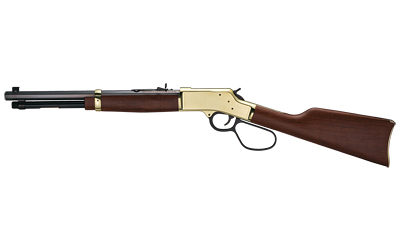
Henry Big Boy Brass Carbine .44 Mag 16.5in 7rd
Video review
Expert review
About this product
What is the Henry Big Boy Brass Carbine .44 Mag 16.5in 7rd? It's a compact, side-gate-loading lever-action rifle chambered in .44 Magnum, designed specifically for maneuverable field use and close-quarters situations where its 35-inch overall length and 6.9-pound unloaded weight become significant advantages. This carbine-length version of Henry's classic Big Boy platform retains the polished brass receiver and octagon barrel profile while cutting barrel length from the standard 20 inches to 16.5 inches, prioritizing handling speed over long-range ballistics. The .44 Magnum cartridge, from this barrel length, delivers terminal ballistics sufficient for deer-sized game inside 125 yards, but you're sacrificing approximately 200-250 feet-per-second (fps) compared to a 20-inch barrel, which matters when calculating maximum effective range.
What is the Henry Big Boy Brass Carbine used for?
This rifle is primarily for woods hunting, brush-country use, or as a truck/ranch gun where its 35-inch overall length allows for easy storage and quick deployment. Its 16.5-inch barrel makes it notably handier than full-length lever guns in thick cover, while the .44 Magnum cartridge offers enough energy for ethical shots on whitetail deer within 100-125 yards. It's not a target rifle – the practical accuracy limit for most shooters will be 3-4 Minute of Angle (MOA) groups with quality ammunition, adequate for its intended role.
How does the Henry Big Boy Brass Carbine compare to the Stevens 334 .308 Win?
The Big Boy is better for fast, close-range follow-up shots and classic manual-of-arms, while the Stevens 334 in .308 Win dominates in effective range and terminal energy. The .308 Winchester from a 20-inch barrel delivers over 1,000 ft-lbs more energy at 200 yards than a .44 Magnum from this carbine, making it suitable for larger game like elk at extended distances. The trade-off is the Stevens is a bolt-action, slower for a second shot, and lacks the immediate nostalgia and handling of the lever gun.
What does it weigh and what are the dimensions?
Unloaded, the rifle weighs 6.9 pounds (110.4 oz) and measures 35 inches from buttpad to muzzle, with a 16.5-inch octagon barrel. The barrel itself has a 1:38-inch twist rate, optimized for stabilizing heavier .44 caliber bullets commonly used in hunting loads. The tubular magazine holds 7 rounds of .44 Magnum or 8 rounds of shorter .44 Special, and loading through the side gate takes approximately 12-15 seconds for a full tube.
Who is this NOT for?
This carbine is not for precision shooters, long-range hunters, or anyone prioritizing maximum ballistic performance from the .44 Magnum cartridge. The 16.5-inch barrel robs significant velocity; expect around 1,250-1,300 fps with 240-grain factory ammo versus 1,450+ fps from a 20-inch tube. It's also not ideal for new shooters on a tight budget, as quality .44 Magnum ammunition costs roughly $1.25-$1.75 per round – practice with .44 Special helps, but the manual of arms for a lever gun has a steeper initial learning curve than a modern bolt-action like the Stevens 334 in .243 Win.
What's in the box?
You receive the rifle, one tubular magazine loaded via side gate, and a basic owner's manual covering disassembly and warranty. Henry does not include a case, sling, or optics mounts – the receiver is drilled and tapped for a standard scope base, but that's a separate purchase. The manual correctly emphasizes using SAAMI-spec .44 Magnum ammunition, a critical detail as some handloads or 'Ruger-only' listed loads can generate unsafe pressures in this action.
Is the Henry Big Boy Brass Carbine worth it at $1001.99?
Yes, if you value classic craftsmanship, fast handling, and a specific nostalgic mechanical experience over pure ballistic efficiency. You're paying a premium for the polished brass receiver, octagon barrel machining, and American walnut stock – materials and labor that don't exist on a synthetic-stocked bolt action. The price is justified for the intended user who wants a functional heirloom-quality brush gun, not just the cheapest tool for the job.
Specs at a glance
Pros & cons
What works
- 16.5-inch barrel yields a 35-inch overall length – 4.5 inches shorter than the 20-inch Big Boy for tight quarters.
- Side loading gate allows topping off the 7-round magazine without removing the rifle from the shoulder.
- Polished brass receiver and American walnut stock provide heirloom-grade aesthetics not found on synthetic rifles.
- Lever throw cycle time is approximately 1.8 seconds for a trained shooter, enabling rapid follow-up shots.
Trade-offs
- 6.9-pound weight is 1.2 pounds heavier than a synthetic-stocked bolt action of similar length, like the Stevens 334.
- Barrel length sacrifices 200+ fps velocity compared to 20-inch .44 Magnum barrels, reducing maximum ethical range.
- .44 Magnum ammunition costs average $1.50/round – a 50-round practice session costs $75 in ammo alone.
- No optics mounting solution included; requires purchasing and installing a separate base ($30-$60).
Key attributes
| upc | 619835060679 |
| manufacturer | Henry Repeating Arms |
| manufacturer part number | H006GR |
| action | Lever Action |
| atf type | RIFLE |
| barrel length | 16.5" |
| caliber/gauge | .44 Magnum |
| capacity | 7 |
| color | Brass |
| length | 35'' |
| magazine included | 1 x 7 Round |
| model | Big Boy |
| package height | 2.0 |
| package width | 7.0 |
| product type | Lever Action |
| safety | Transfer Bar |
| shipping weight | 8.0 |
| sights | Adjustable Sights |
| sights type | Adjustable Sights |
Frequently asked questions
- Is it compatible with a suppressor?
- No, the 16.5-inch barrel with its fixed front sight and magazine tube design is not readily adaptable for direct-thread or quick-detach suppressors. The front sight is integrated with the barrel band, and modifying it for threading would require specialized gunsmithing, costing $250+ and potentially voiding the warranty. Henry does not offer a factory-threaded version of this model.
- Does it fit in a standard rifle case?
- Yes, its 35-inch overall length fits comfortably in most 38-inch or longer soft or hard rifle cases. The octagon barrel profile adds minimal width; just ensure the case interior width exceeds 3.5 inches to accommodate the lever and brass receiver without pressure. I use and recommend a Plano All-Weather case for transport.
- How long does shipping take to an FFL?
- Ironclad Armory processes and ships in-stock firearms within 2-3 business days after FFL verification. Transit time depends on the carrier and destination, typically 3-7 additional business days. You will receive a tracking number once the shipment is scanned by the carrier, but you must contact your chosen FFL dealer to coordinate pickup upon arrival.
- Can I return it if there's a mechanical issue?
- Yes, but directly to Henry Repeating Arms under their lifetime warranty, not to Ironclad Armory for a full refund after transfer. Ironclad offers a 3-day inspection period post-FFL transfer for immediate, obvious damage or incorrect shipment. For any function issues discovered later, you must initiate a warranty claim with Henry, which typically involves shipping the firearm to their New Jersey facility for repair, a process taking 4-6 weeks.
- Does this work with .44 Magnum speed loaders?
- No, the tubular magazine design precludes the use of any cartridge speed loaders. Reloading is done one round at a time through the side gate or by fully removing the magazine tube inner rod, a process requiring about 20-25 seconds for a full 7-round reload compared to a detachable box magazine swap in under 5 seconds.