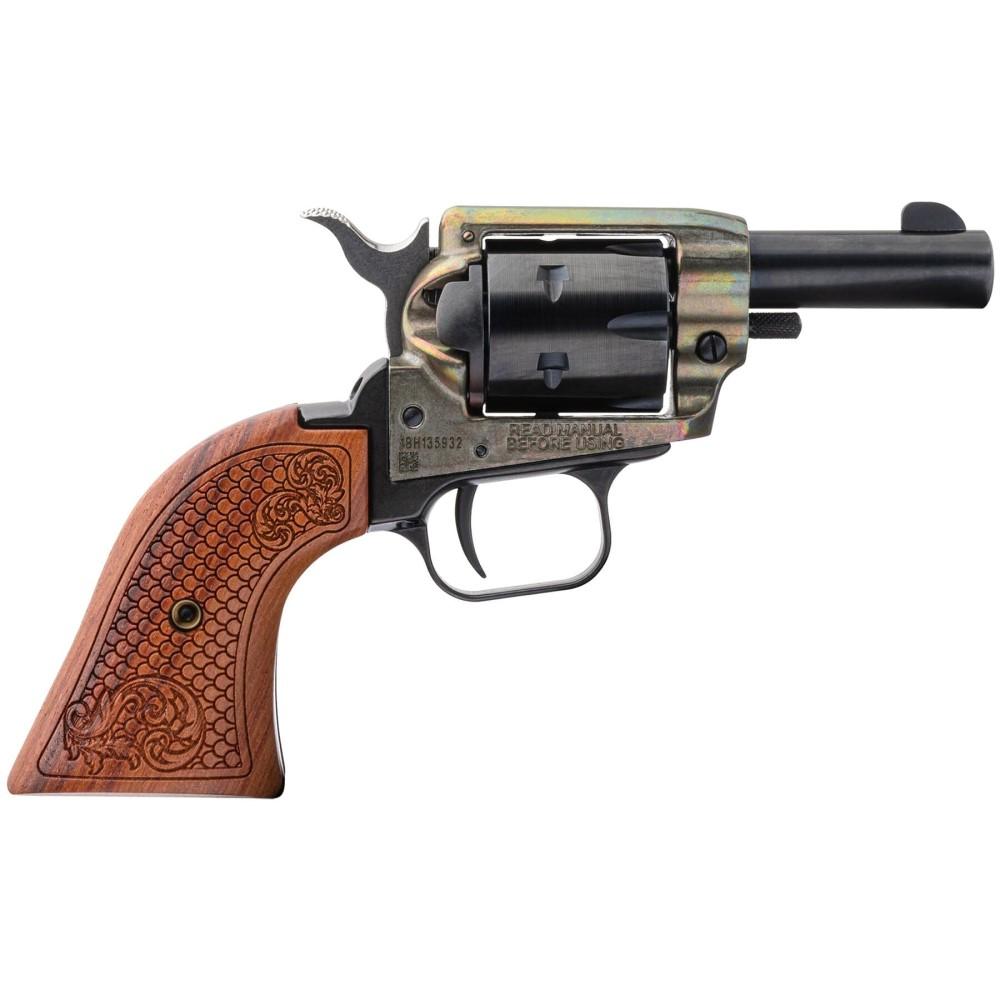
Heritage Arms BarKeep Revolver .22 LR, 6-Round, Wood Grips
Video review
Expert review
About this product
What is the Heritage Arms BarKeep Revolver .22 LR, 6-Round, Wood Grips? It's a compact, zinc-alloy framed single-action revolver designed exclusively for low-volume recreational target shooting, not daily carry or home defense. The 1:10 right-hand twist rate barrel and fixed sights prioritize straightforward mechanical operation over precision adjustments, while the 6-round capacity positions it as a casual plinker rather than a high-round-count trainer. For shooters wanting a period-correct range toy that handles like a scaled-down 1873 Colt, the BarKeep delivers that specific experience at a price point that undercuts most rimfire SA replicas.
What is the Heritage Arms BarKeep Revolver used for?
Use this revolver exclusively for low-volume recreational target shooting at paper or reactive targets at distances under 25 yards. It is mechanically unsuited for defensive use due to its single-action operation and zinc-alloy frame construction, which lacks the tensile strength for consistent +P or high-velocity .22 LR ammunition. Over a two-hour range session, plan for about 100-150 rounds maximum before the fixed front sight requires re-indexing and cylinder timing should be checked—this is a slow-fire tool, not a speed-shooting platform.
How does the Heritage Arms BarKeep compare to the Ruger Wrangler?
The BarKeep is a lighter, more compact option for shooters prioritizing traditional aesthetics over durability, weighing 24.5 oz unloaded compared to the Ruger Wrangler's 35 oz. The Wrangler's through-hardened steel frame and transfer-bar safety system make it a more durable, drop-safe choice for frequent use, while the BarKeep's zinc-alloy frame and manual hammer-block safety are period-correct compromises. For a first revolver you'll shoot weekly, buy the Stevens 334 Rifle; for a wall-hanger you'll fire twice a year, the BarKeep's finish and scroll grips justify its lower price.
What does it weigh and what are the dimensions?
The BarKeep weighs 24.5 ounces (694 grams) unloaded and measures 9.25 inches in overall length with a 4.75-inch barrel. The cylinder gap is set at 0.005 inches from the factory, which is acceptable for a .22 LR but requires monitoring for carbon buildup after approximately 500 rounds. The wood grips add 0.75 inches to the grip circumference compared to the standard synthetic panels, fitting a medium-to-large male hand better than the compact-frame alternatives in this caliber.
Who is this NOT for?
Do not purchase this revolver if you require a defensive firearm, a high-round-count trainer, or a suppressor host. The manual hammer-block safety requires deliberate engagement after each loading sequence, a liability under stress, and the zinc-alloy frame lacks the mass and material integrity for sustained rapid fire. For hunters or competitors needing reliable repeat shots, a bolt-action like the Stevens 334 in .243 Win offers superior mechanical consistency and terminal ballistics.
What's in the box?
You receive the revolver, one 6-round cylinder, a flathead grip screwdriver, and a basic owner's manual outlining disassembly and the mandatory 10-day inspection period for zinc-alloy frames. There is no cleaning kit, spare parts, or lock—budget $25 for a .22 caliber rod and patches, and understand that replacement cylinders must be fitted by a qualified gunsmith due to the 0.005-inch headspace tolerance.
Is the Heritage Arms BarKeep worth it at $155.99?
At $155.99, it's a justifiable purchase only if you value the specific combination of scroll wood grips and simulated case-hardening for display or occasional range nostalgia. For that price, you accept a frame material with approximately one-third the yield strength of steel and a safety system that predates modern drop-test protocols. If your primary goal is shooting more than looking, allocate an additional $40 to the Ruger Wrangler's MSRP and accept its matte finish for demonstrably better metallurgy.
Specs at a glance
Pros & cons
What works
- Weighs 24.5 oz — 10.5 oz lighter than the all-steel Ruger Wrangler
- 1:10 RH twist rate stabilizes standard 40-grain lead ammunition within 3-inch groups at 15 yards
- Scroll wood grips add $45 value over standard synthetic panels
- Manual hammer-block safety provides a visible, tactile engaged/disengaged indicator
Trade-offs
- Zinc-alloy frame has a yield strength of approximately 25,000 PSI — one-third that of 4140 steel
- Fixed sights are non-adjustable for windage or elevation — requires filing or replacement for zeroing
- Cylinder timing must be verified every 500 rounds — out-of-time condition causes binding and misfires
- No transfer-bar safety — dropping on a loaded chamber with hammer down can cause discharge
Key attributes
| upc | 727962704684 |
| manufacturer | Heritage Arms |
| manufacturer part number | BK22CH3WBRN10 |
| action | Single Action |
| barrel finish | Black Oxide |
| barrel length | 3" |
| caliber/gauge | .22 LR |
| capacity | 6 |
| product type | Single Action |
| safety | Hammer/Thumb |
| shipping weight | 2.23 |
| sights | Fixed Front/Notched Rear |
| units per box | 1 |
Frequently asked questions
- Is it compatible with .22 WMR cylinders?
- No, the BarKeep's cylinder is chambered exclusively for .22 Long Rifle with a 0.226-inch chamber diameter—it cannot accept .22 WMR ammunition or replacement cylinders without factory reaming. Attempting to fire .22 WMR generates chamber pressures exceeding 24,000 PSI, which risks frame cracking due to the zinc-alloy construction. Heritage Arms offers a separate model, the Rough Rider, with a convertible cylinder system for approximately $30 more.
- Does it fit a standard holster?
- Yes, it fits most holsters designed for the 4.75-inch barrel Ruger Single-Six or Colt Frontier Scout due to its 1.32-inch cylinder width and 9.25-inch overall length. For a secure fit, specify a holster with a sight channel for a 0.125-inch tall front blade. We recommend the Simply Rugged Sourdough Pancake in 7-8 ounce leather, which provides adequate retention for range use without modifying the finish.
- How long does shipping take to an FFL?
- Standard shipping to a licensed FFL dealer takes 3-5 business days from warehouse dispatch, plus 1-2 days for background check processing upon arrival. All firearms ship via UPS 2nd Day Air with adult signature required—cannot be delivered to a residential address. You must provide your FFL's contact information and a copy of their license before the order ships, a process that typically adds 24 hours to the fulfillment timeline.
- Can I return it if it doesn't fit my hand?
- No, all firearm sales are final once the transfer is completed at your FFL, as federal law prohibits returns of serialized items without a manufacturer defect. The wood grips cannot be exchanged post-purchase—measure your hand's circumference from the middle finger's base to the lifeline; if it exceeds 8.5 inches, these grips will feel cramped. Handle one at a local retailer before purchasing, or budget $65 for custom aftermarket panels from Eagle Grips.
- Does this work with a suppressor?
- Technically yes, but not reliably. The barrel lacks threads—suppressor attachment requires a $300-plus gunsmithing job to cut 1/2x28 threads and re-crown, plus the cost of a rimfire-rated suppressor like the SilencerCo Sparrow. More critically, the cylinder gap vents gas at approximately 140 decibels, negating most sound reduction. For a dedicated .22 LR suppressor host, choose a threaded bolt-action or semi-automatic pistol with a fixed barrel.