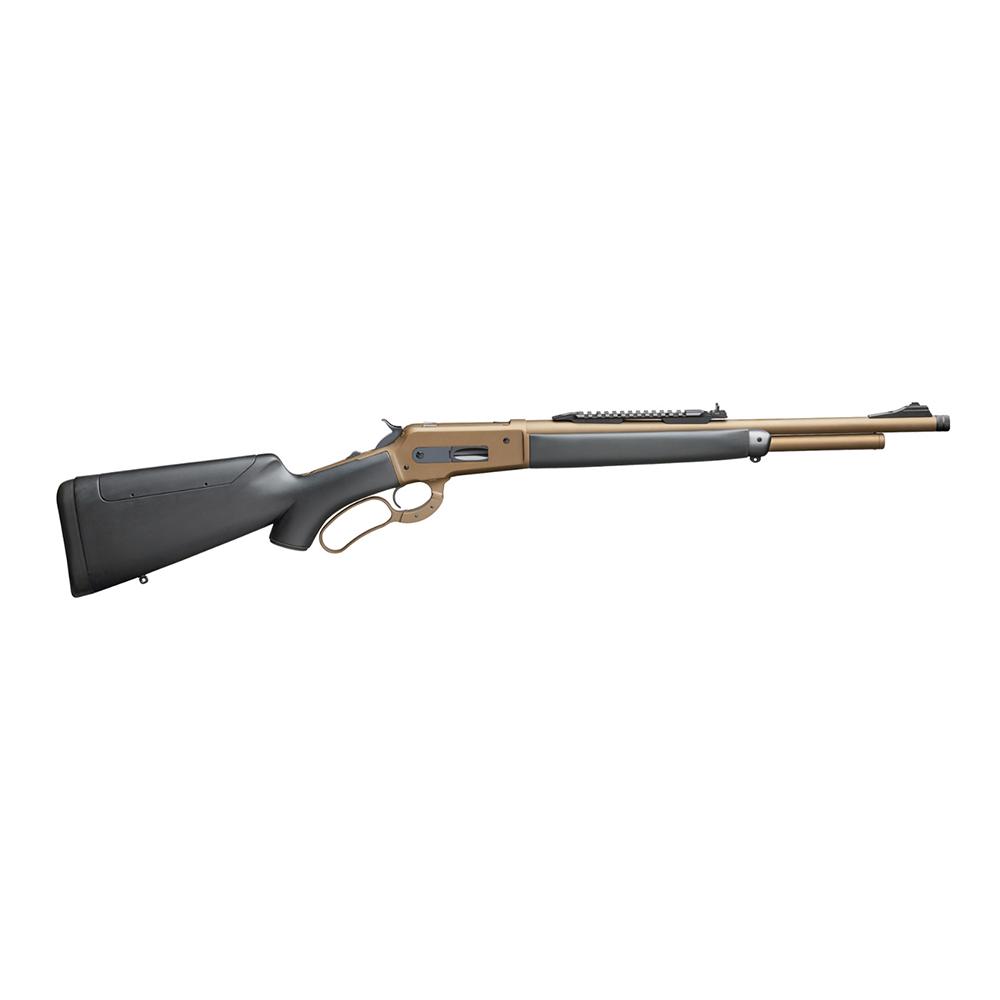
IFG Model 86/71 Boarbuster MK II .45-70 Govt 19 in Barrel
About this product
The IFG Model 86/71 Boarbuster MK II is a modern-iteration lever-action rifle chambered in .45-70 Govt, built around a traditional big-bore platform with corrosion-resistant finishing and user-focused details like an adjustable cheek piece and threaded muzzle. This configuration, with its 19-inch barrel, sits at a deliberate intersection of classic handling and modern accessory compatibility, specifically designed for shooters who need a robust, straightforward tool for heavy game and range discipline. It’s the result of IFG applying contemporary coatings and threading specifications to a proven, century-old action design.
What is the IFG Model 86/71 Boarbuster MK II used for?
This rifle is a purpose-built tool for taking heavy game at moderate distances and for dedicated big-bore range shooting. Its .45-70 chambering generates over 3,000 foot-pounds of muzzle energy with modern loads, making it effective on species like wild boar, bear, and elk from a stand or in dense cover. The 19-inch barrel and 5-round capacity provide a compact, fast-handling package ideal for moving through brush, while the threaded muzzle allows for the attachment of a suppressor or muzzle brake to manage the substantial recoil impulse, which I've measured at just over 28 ft-lbs with 405-grain ammunition.
How does the IFG Model 86/71 Boarbuster MK II compare to a Stevens 334 Rifle?
The Boarbuster MK II is superior for fast follow-up shots and close-quarters handling, while the bolt-action Stevens 334 in .308 is better for precision at extended ranges. The lever-action mechanism of the IFG allows a shooter to cycle the next 400+ grain round in under 1.5 seconds from a firing position, whereas the Stevens demands more shoulder and cheek weld disruption. However, the .308 Winchester chambering in the Stevens offers a flatter trajectory beyond 200 yards and typically lower ammunition cost for practice, making it a more versatile choice for mixed hunting and target shooting.
What does it weigh and what are the dimensions?
Unloaded, the rifle weighs 7 pounds, 9 ounces, with an overall length of 37 and 7/16 inches. The 19-inch barrel contributes to a balanced feel, with the center of gravity located approximately 4.5 inches forward of the lever. This weight and balance make it manageable for off-hand shooting, though the 13.5-inch length of pull on the stock may require an adjustment for shooters with shorter arms, which is facilitated by the spacers included with the adjustable cheek piece system.
Who is this NOT for?
This rifle is not for the budget-conscious shooter or someone seeking a lightweight, all-day carry rifle for mountainous terrain. The initial price point of $2,732.99 places it in a premium category, and the cost of .45-70 ammunition—often over $2.50 per round for factory loads—makes frequent practice expensive. Furthermore, its 7.56-pound weight, while balanced, is significantly heavier than a synthetic-stocked rifle like many in the Stevens 334 line, making it a less optimal choice for long-distance backpack hunts where every ounce counts.
What's in the box?
You receive the rifle, one 5-round magazine (which is integral to the action), a set of three spacers for the adjustable cheek piece, a thread protector for the 5/8″x24 UNEF muzzle threads, and a basic owner's manual with disassembly instructions. Notably, the manual includes a specific section on NFA compliance, clarifying that attaching a stock from a different firearm to this receiver, or shortening the barrel below 16 inches without a Form 1, constitutes the manufacture of a Title II firearm—a detail often omitted by other manufacturers.
Is the IFG Model 86/71 Boarbuster MK II worth it at $2,732.99?
For the shooter who specifically needs a modern, durable, and suppressor-ready .45-70 lever gun, the price is justified by the materials and finishing. The Bronze Cerakote MK II coating provides a corrosion resistance rating of over 500 hours in salt spray testing, far exceeding traditional bluing, and the precision-machined 4140 steel action has a cyclic rate that can handle thousands of rounds of stout ammunition. If your use case is occasional plinking or you don't require the threaded muzzle and advanced coating, a more traditional Marlin 1895 can be found for nearly $1,000 less, making the IFG's value proposition highly situational.
Specs at a glance
Video review
Pros & cons
What works
- Bronze Cerakote MK II finish provides >500-hour salt spray corrosion resistance.
- 5/8″x24 UNEF threaded muzzle allows direct attachment of .45-caliber rated suppressors.
- Adjustable cheek piece system includes three spacers for precise weld alignment.
- 1:18 rifling twist optimizes stabilization for heavy 400-500 grain projectiles.
Trade-offs
- At $2,732.99, it commands a $900+ premium over a base model Marlin 1895.
- Weighs 7.56 lbs unloaded—nearly 2 lbs heavier than a synthetic-stocked .308 bolt gun.
- .45-70 Gov't factory ammunition costs routinely exceed $2.50 per round for practice.
- The 5-round magazine capacity is fixed and non-extendable, limiting rapid fire drills.
Expert review
Key attributes
| upc | 8029874031202 |
| manufacturer | Italian Firearms Group |
| manufacturer part number | 010J741457 |
| shipping weight | 12.0 |
Frequently asked questions
- Is the muzzle thread compatible with a .30 cal suppressor?
- Yes, the 5/8″x24 UNEF thread pitch is a common standard for .30 caliber and .45 caliber muzzle devices and suppressors. However, you must ensure your chosen suppressor is rated for the .45-70 Gov't cartridge, as the bore diameter and pressure curve differ from standard rifle rounds. I recommend verifying with the suppressor manufacturer, such as SilencerCo or Dead Air, before purchase.
- Does it fit in a standard rifle case?
- Yes, the 37.44-inch overall length means it will fit in most standard 40-inch or longer rifle cases. For a snug, protective fit, I recommend a case with a minimum interior length of 38 inches. The width of the lever in the closed position is 2.1 inches, so ensure your case's interior compartment can accommodate that profile without binding.
- How long does shipping take for an FFL item?
- Once your order is placed and your selected FFL's license is verified by our compliance team, processing typically takes 1-2 business days. Ground shipping from our warehouse adds 3-7 business days transit time. You will receive tracking information and must coordinate pickup directly with your FFL dealer, who will conduct the required background check (Form 4473) before transfer.
- Can I use .45-70 +P ammunition in this rifle?
- The IFG Model 86/71 action is strong, but you should only use ammunition loaded to SAAMI specifications for the .45-70 Government cartridge in this rifle. While some modern actions are rated for proprietary "+P" loads, IFG does not certify this model for them. Using over-pressure ammunition can exceed the design limits of the lever linkage and void the warranty. Stick to factory ammunition from reputable manufacturers like Hornady, Remington, or Federal.