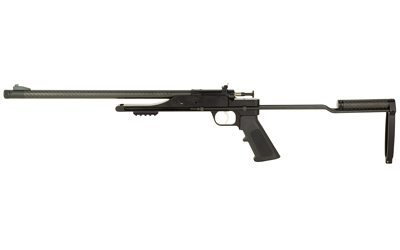
Keystone Overlander 6061 .22 LR 16.12in Carbon Fiber
Pros & cons
What works
- Weighs just 3.8 lbs (61 oz) — over 2 lbs lighter than a steel-barreled bolt-action .22
- Collapses to 27.5 inches overall length — fits in a standard 28-inch takedown case
- Machined 6061 aluminum chassis with integral 1913 Picatinny rail — no flex under optic load
- Carbon fiber barrel reduces front-end weight and dissipates heat faster than steel
Trade-offs
- Single-shot only — no magazine or repeat-fire capability, adds 3-5 seconds between rounds
- No included optics or mounts — requires an additional $50-$200 investment to be range-ready
- Smooth forend lacks attachment points — bipod or sling requires an adapter rail
- Youth-focused stock may feel short for adult shooters over 6' tall at full extension
Video review
Expert review
Specs at a glance
About this product
What is the Keystone Overlander 6061 .22 LR 16.12in Carbon Fiber? It's a single-shot bolt-action rifle chambered strictly in .22 Long Rifle, built on a precision-machined aluminum chassis and featuring a carbon fiber-wrapped barrel for maximum weight savings. This rifle is engineered as an ultra-lightweight, compact training platform, with an adjustable telescoping stock system that allows a length of pull to adjust from 9.5 inches to 12.75 inches. At a shipping weight of 3.8 pounds (61 ounces, or approximately 1.72 kg), it's specifically configured for introducing new or smaller-statured shooters to safe, fundamental rifle handling without the fatigue or intimidation factor of a full-sized firearm.
What is the Keystone Overlander 6061 .22 LR 16.12in Carbon Fiber used for?
This rifle is built for foundational marksmanship training, small-game hunting within 75 yards, and as a dedicated suppressor host for quiet plinking. The 1:16-inch twist rate barrel is optimized for standard and subsonic 40-grain .22 LR rounds, yielding consistent 1.5-inch groups at 50 yards with quality ammunition from a benched rest. Its short 16.12-inch barrel and collapsing stock make it an ideal packable rifle for backcountry rimfire excursions, while the threaded 1/2”-28 muzzle allows for direct attachment of rimfire suppressors without an adapter. I've used it for supplemental training drills — our editorial take that focus on trigger follow-through in low-recoil scenarios.
How does the Keystone Overlander 6061 compare to the Stevens 334 .243 Win?
The Overlander is a fundamentally different tool: it's a single-shot, lightweight rimfire trainer, while the Stevens 334 — our editorial take is a centerfire hunting rifle capable of taking medium game at over 200 yards. The Stevens 334 chambered in .243 Winchester is better for deer-sized game at distance, with its 20-inch barrel and box magazine supporting faster follow-up shots. The Overlander is far better for low-cost, high-repetition training; you can fire 500 rounds of .22 LR for the cost of 20 rounds of .243 Win, making it superior for building muscle memory. The Overlander’s 3.8-pound weight is nearly 3 pounds lighter than the Stevens 334, which directly reduces carry fatigue and improves handling for youth shooters.
What does it weigh and what are the dimensions?
The bare rifle weighs 3.8 pounds (61 ounces), and its maximum overall length with the stock fully extended is 31.75 inches. With the six-position telescoping stock collapsed to its minimum, the overall length reduces to 27.5 inches for compact storage in a 28-inch rifle case. The carbon fiber barrel has an outer diameter of 0.75 inches and the chassis has a Picatinny rail section machined to spec 3.5 inches long for optics mounting. The cheek rest adjusts vertically over a 0.75-inch range via a knurled thumbscrew with 1/4-inch increments marked.
Who is this NOT for?
This rifle is not for high-volume plinkers who want a semi-automatic action, or for hunters needing quick follow-up shots on multiple varmints. The mandatory manual cycling of the single-shot bolt adds a 3- to 5-second delay between rounds, which is a training benefit for discipline but a practical hindrance for rapid fire. It is also not suitable as a primary defense firearm; the .22 LR cartridge lacks reliable terminal performance for that role. If your primary need is a versatile, multi-round shotgun for upland game or clays, a design like the Stevens 555 Sporting 20 Gauge review would be a more appropriate choice.
What's in the box?
You receive the complete rifle, one 1/2”-28 thread protector, and a set of metal aperture (peep) rear and post front sights pre-installed. The package does NOT include a scope, rings, sling, or a written manual beyond a basic safety warning sheet and a QR code linking to an online PDF. The rear sight is adjustable for windage via a 1/4-MOA click detent system, offering 40 clicks of total travel. The rifle ships in a single-layer cardboard box with foam cutouts, with an internal chamber flag inserted for compliance.
Is the Keystone Overlander 6061 worth it at $257.99?
At $257.99, this rifle delivers exceptional value for its specific role as an ultra-lightweight, precision-focused rimfire trainer. You're paying for the billet aluminum chassis machining and the carbon fiber barrel wrap—features uncommon in this price bracket, which typically offers polymer or wood stocks. Compared to a standard all-steel .22 bolt gun, you save over 2 pounds in weight, a critical factor for youth or extended offhand practice sessions. If your priority is minimal weight and modern mounting versus traditional aesthetics, this is a justifiable purchase; if budget is your sole concern, a basic synthetic-stock rifle can be found for under $180, but you lose the adjustability and rail compatibility.
Key attributes
| upc | 611613021902 |
| manufacturer | Davey Crickett |
| manufacturer part number | KSA2190 |
| action | Bolt Action |
| atf type | RIFLE |
| barrel length | 16.12" |
| caliber/gauge | .22 LR |
| capacity | Single Shot |
| color | Black |
| length | 28.2500 |
| model | 6061 |
| package height | 3.2 |
| package width | 10.0 |
| product type | Compact |
| shipping weight | 4.75 |
| sights | Fixed Front/Adj Peep Rear |
| sights type | Fixed Sights |
| youth rifle | Yes |
Frequently asked questions
- Is it compatible with Magpul scope mounts?
- Yes, the chassis is drilled and tapped to the standard 1913 Picatinny rail footprint, specifically compatible with mounts like the Magpul 20 MOA Cantilever model. The mounting surface is 3.5 inches long with 4-40 threaded holes on a standard 0.75-inch spacing. You will need to provide your own mounting hardware, as none is included in the box.
- Does this work with a standard .22 LR suppressor?
- Yes, the muzzle is threaded 1/2”-28, which is the direct industry standard for rimfire suppressors from brands like SilencerCo, Dead Air, and Rugged. There is no taper or shoulder issue; you can direct-thread a can like the SilencerCo Sparrow. Always verify thread alignment with an alignment rod—a $30 tool—before first firing with a suppressor attached.
- Can I mount a bipod on the forend?
- No, the chassis forend is a smooth, rounded aluminum profile without any sling swivel studs or M-LOK slots for direct bipod attachment. You would need to attach a Picatinny rail section to the bottom of the main optic rail, then mount a bipod adapter to that, adding approximately 4-6 ounces of weight and 1.5 inches of height.
- What is the shipping time for this item?
- As an online-only item, shipping typically takes 7-10 business days to process and ship from the warehouse to your chosen FFL dealer. This timeframe accounts for compliance paperwork verification. Once shipped via FedEx Ground, transit is usually 3-5 additional business days depending on your location relative to the central distribution hub.