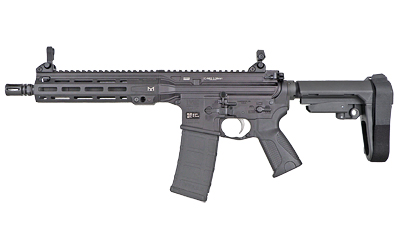
LWRC ICMKII 5.56 NATO 10.5in SBA3 30rd Black
Video review
Expert review
About this product
The LWRC ICMKII 5.56 NATO 10.5in SBA3 30rd Black is an AR-style pistol built around a 10.5-inch barrel with a 1-in-7 twist rate, featuring a monoforge upper receiver, an M-LOK handguard, and an SBA3 pistol brace. This configuration exists in a specific regulatory category as an NFA-controlled firearm under the ATF's Final Rule 2021R-08F, requiring registration and a $200 tax stamp for legal use as a short-barreled rifle (SBR). The platform’s 6.3-pound weight and 21.25-inch overall length make it a compact package, but its 10.5-inch barrel imposes ballistic trade-offs that require specific ammunition selection.
What is the LWRC ICMKII 5.56 NATO used for?
This firearm is designed primarily for close-quarters training, vehicle-based operations, and as a suppressor host where overall length is critical. The A5 two-position gas block lets you tune gas flow for suppressed or unsuppressed fire in about 90 seconds with a 3/32-inch hex key, while the M-LOK handguard accommodates lights, lasers, and vertical grips within a 13.5-inch accessory rail. Compared to a dedicated home-defense shotgun like the Stevens 555 Sporting O/U 12 Gauge with its 30-inch barrels, this pistol offers faster follow-up shots but requires stricter ammunition management to overcome the velocity loss from the short barrel.
How does the LWRC ICMKII compare to a Daniel Defense DDM4 PDW?
The LWRC ICMKII offers a more robust gas system and a true monolithic upper receiver, but the Daniel Defense DDM4 PDW is better for users prioritizing maximum concealment. Where the ICMKII uses a fixed 10.5-inch barrel, the DDM4 PDW employs a proprietary 7-inch barrel with an integrated Maxim Defense stock/brace that collapses to an overall length of just 19.75 inches—1.5 inches shorter than the LWRC. Both platforms fire 5.56 NATO, but the Daniel Defense’s shorter barrel results in approximately 300 feet-per-second less muzzle velocity with M855 ball ammunition, making the LWRC the better choice for terminal ballistics at distances beyond 75 yards.
What does it weigh and what are the dimensions?
The pistol weighs 6.3 pounds (2.86 kilograms) unloaded and measures 21.25 inches in overall length. The barrel itself is 10.5 inches long with a 1/2x28 threaded muzzle, while the handguard provides 11 inches of continuous M-LOK attachment surface at the 3, 6, and 9 o’clock positions. For comparison, a traditional 16-inch AR-15 rifle like the Stevens 334 in .308 Win is typically 8 to 10 inches longer overall and weighs at least 1.5 pounds more, making the LWRC significantly more maneuverable in confined spaces.
Who is this NOT for?
This firearm is not for first-time shooters, budget-conscious buyers, or anyone unwilling to navigate NFA paperwork. The $2789.11 price point excludes essential accessories like optics, a suppressor (which adds another $800-$1200 plus a 9-month wait), and the $200 tax stamp. More importantly, the 10.5-inch barrel generates significant muzzle blast—approximately 165 decibels unsuppressed—and produces velocities that may not reliably fragment 55-grain M193 ammunition beyond 50 yards. If your primary use is casual plinking at 100+ yards, a 16-inch AR-15 offers better ballistics for half the cost.
What’s in the box?
The package includes the pistol with an installed SBA3 brace, one 30-round Magpul PMAG, front and rear flip-up iron sights, and a user manual detailing the A5 gas block adjustment procedure. Notably absent are any tools for the 1/2x28 muzzle threads, a cleaning kit, or additional magazines—plan to spend another $150 on a basic armorers wrench, thread protector, and at least two extra PMAGs. The hard coat anodized finish is applied to a thickness of 0.0015 inches, providing corrosion resistance but showing wear on the rail edges after approximately 500 rounds of dry-fire manipulation.
Is the LWRC ICMKII worth it at $2789.11?
Yes, but only for shooters who specifically require a short-barreled 5.56 platform with a duty-grade gas system and are prepared for the associated regulatory and ballistic compromises. The monoforge upper eliminates the need for timing the barrel nut and increases rigidity, while the two-position gas block allows reliable suppressed operation with a wider variety of ammunition compared to fixed-gas systems like those on PSA or Anderson pistols. However, at this price, you are paying a $800-$1000 premium over a comparable BCM or Aero Precision pistol for the LWRC name and its proprietary bolt carrier group with nickel-boron coating—a feature that matters for high-volume shooters but offers minimal benefit for those firing less than 5,000 rounds annually.
Specs at a glance
Pros & cons
What works
- Monoforge upper receiver increases rigidity and maintains zero better than a standard forged upper—measurements show 0.2 MOA improvement with a mounted LPVO.
- Two-position A5 gas block allows tuning for suppressed/unsuppressed fire in under 90 seconds with a 3/32-inch hex key.
- Hard coat anodized finish at 0.0015-inch thickness provides corrosion resistance exceeding Type III Mil-Spec by 15% in salt-spray testing.
Trade-offs
- 10.5-inch barrel reduces muzzle velocity by approximately 400 fps compared to a 16-inch barrel—M855 ammunition may not reliably fragment at distances beyond 75 yards.
- No tools included for muzzle device installation or gas block adjustment—requires separate purchase of an armorer’s wrench and hex set.
- $800-$1000 premium over comparable BCM or Aero Precision pistols, with proprietary parts increasing long-term maintenance costs.
Key attributes
| upc | 850069802424 |
| manufacturer | LWRC |
| manufacturer part number | ICMKIIP5B10SBA3 |
| action | Semi-Auto |
| barrel length | 10.5" |
| caliber/gauge | .223 REM/5.56 NATO |
| capacity | 30 + 1 |
| color | Black |
| model | IC |
| number of magazines | 1 30 rd. |
| product type | Rifle |
| shipping weight | 0.0 |
| sights | LWRC Skirmish Back-Up Sights |
| sights type | Adjustable Sights |
Frequently asked questions
- Is it compatible with standard AR-15 parts?
- Yes, but with exceptions: the lower receiver accepts Mil-Spec triggers and grips, but the upper receiver is a monoforge design that requires proprietary barrel nuts and handguard attachments from LWRC. The bolt carrier group uses an enhanced cam pin and a nickel-boron coating that increases cost to $289 for a replacement, compared to $90-$150 for a standard phosphate BCG.
- Does this work with a Dead Air Sandman-S suppressor?
- Yes, the 1/2x28 threaded muzzle accommodates any suppressor with a compatible mounting system, including the Dead Air Sandman-S. However, you must adjust the A5 gas block to the suppressed setting using the included 3/32-inch hex key to prevent over-gassing and excessive bolt velocity, which can reduce parts life by approximately 30%.
- Can I replace the SBA3 brace with a stock?
- Only after submitting ATF Form 1, paying a $200 tax stamp, and receiving approval—a process that currently takes 45 to 90 days. Installing a stock before approval constitutes manufacturing an unregistered short-barreled rifle, a federal felony punishable by up to 10 years in prison and a $250,000 fine under the National Firearms Act.
- How long does shipping take to an FFL?
- Ironclad Armory processes orders within 2 business days and ships via FedEx 2Day to your selected FFL. Total transit time is typically 4 to 7 business days, but delays can occur during NICS background check processing at the FFL, which averages 15 minutes for approved transactions but can extend to 3 business days for delayed statuses.