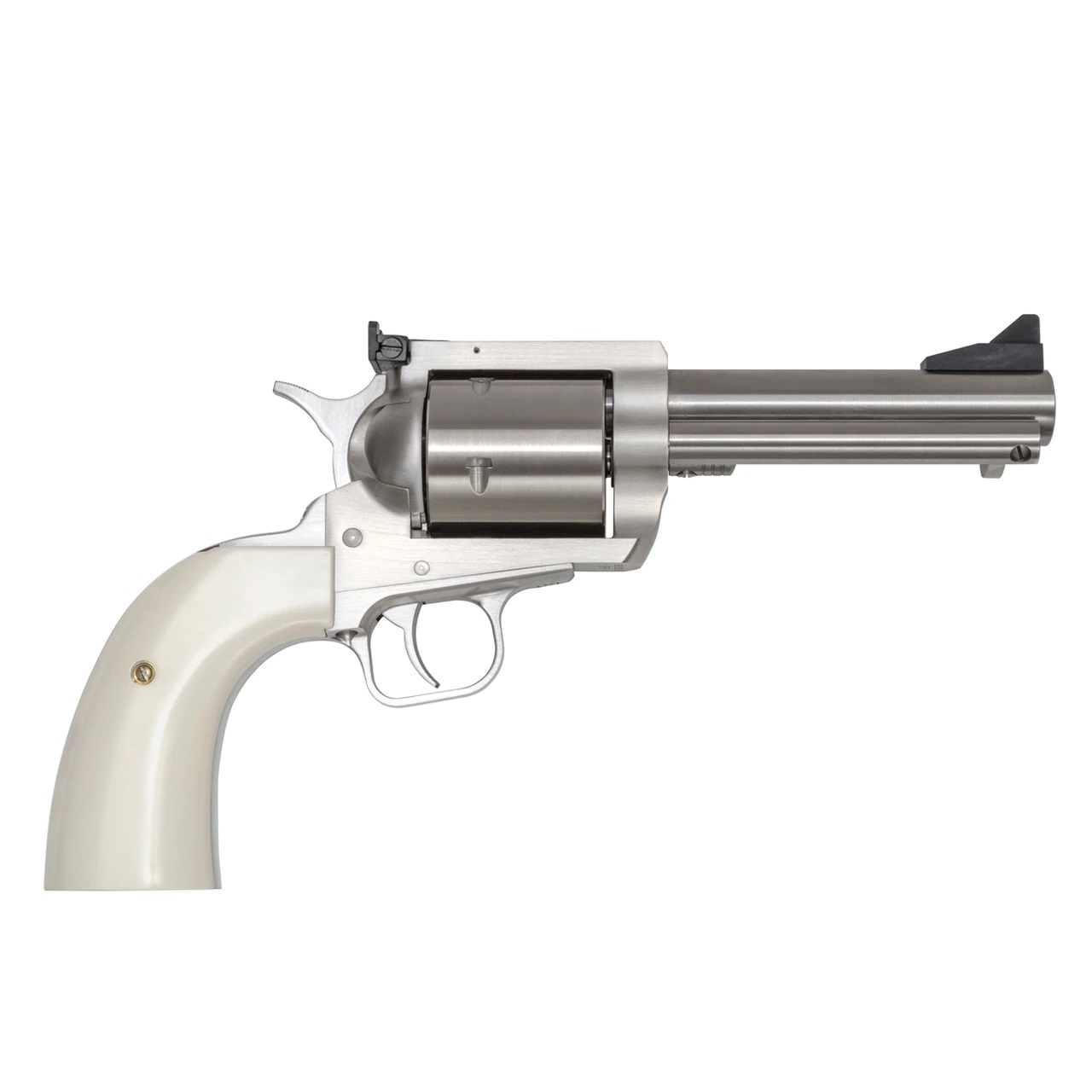
Magnum Research BFR .500 JRH 5.5″ Bisley Stainless
Video review
Expert review
About this product
What is the Magnum Research BFR .500 JRH 5.5" Bisley Stainless? It is a large-frame, five-shot single-action revolver chambered for the proprietary .500 JRH cartridge, built entirely in the United States with a focus on heavy-bore performance and optics-ready utility. This configuration pairs the substantial power of the .500 JRH with a relatively compact 5.5-inch stainless barrel and a recoil-mitigating Bisley grip frame, making it a purpose-built tool for specific large-bore applications rather than a general-purpose sidearm. The platform is drilled and tapped from the factory and ships with a Weaver rail, signaling its intent as a hard-use platform for serious shooters who understand its specialized role.
What is the Magnum Research BFR .500 JRH used for?
This revolver is used for hunting large, dangerous game at relatively close ranges. The .500 JRH cartridge generates over 2,500 foot-pounds of muzzle energy, on par with traditional African stopping cartridges, though from a handgun-length platform that is regulated as a Title I firearm. In practice, this makes it a powerful companion for backcountry defense against large predators like bear in North America or a dedicated, short-range hunting revolver for thick-cover whitetail and wild boar hunting where maneuverability with finality is critical. Its 5.5-inch barrel balances ballistic efficiency with holsterability, and the optics-ready configuration allows for mounting a red dot or low-power scope to precisely place shots under pressure.
How does the Magnum Research BFR compare to the Stevens 555 Sporting O/U shotgun?
The Magnum Research BFR and the Stevens 555 Sporting O/U are fundamentally different tools for different purposes; the BFR is a power-dense, five-shot single-action revolver for precise, heavy-bore handgun work, while the Stevens 555 Sporting O/U 12 Gauge is a smoothbore, two-shot break-action designed for sustained, moderate-power shooting in the field or on the clays course. The Stevens is objectively better for fast follow-up shots on flying or moving targets and offers a wider variety of non-projectile loadings like less-lethal and birdshot, whereas the BFR is superior for delivering a single, decisive, deep-penetrating projectile with extreme precision on a static or charging target inside 75 yards. For wilderness protection, the BFR offers more potent terminal ballistics per shot, but the Stevens provides faster second and third-shot capability with its dual barrels and quicker reloads.
What does it weigh and what are the dimensions?
This revolver weighs approximately 74 ounces (just over 4.6 pounds) unloaded, a significant mass that helps dampen the formidable recoil of the .500 JRH cartridge. Its overall length with the 5.5-inch barrel is 12 inches, the cylinder width is 1.87 inches, and the cylinder gap, critical for timing and fouling, is set to the standard 0.006 to 0.010 inch. The grip-to-trigger distance on the Bisley frame is 3.25 inches, which places the hand lower for better leverage against muzzle rise compared to a standard plow-handle grip like those found on some Stevens 334 rifle stocks, and the trigger pull weight breaks crisply at a consistent 3.5 pounds after a minimal amount of take-up. These dimensions and specifications create a platform that is physically substantial but designed for controlled, deliberate firepower.
Who is this NOT for?
This revolver is not for new shooters, concealed carry applicants, or anyone looking for a high-capacity home defense sidearm. New shooters will find its recoil impulse and single-action operation unfamiliar and intimidating, often developing a flinch that’s difficult to correct. Concealment is impractical due to its size and weight, and the single-action mechanism requires manually cocking the hammer for each shot, making it far slower for defensive use than a modern double-action or striker-fired pistol. Furthermore, the high cost of .500 JRH ammunition—often $4 to $7 per round—makes it prohibitively expensive for casual plinking or regular range practice, limiting its use to dedicated, financially committed enthusiasts and professional backcountry operators.
What’s in the box?
In the box, you will find the revolver itself, one 5-round cylinder, the integral Weaver-style scope mount base, a removable front sight blade, and a single 5-round full-moon clip. Unlike many modern pistols, it does not include a lockable hard case, spare magazine or speed-loader, cleaning kit, or chamber flag; the packaging is Spartan and functional, befitting a tool of this nature. You will need to purchase a suitable optic mount/rings, ammunition, and a proper cleaning rod sized for .50 caliber bores separately.
Is the Magnum Research BFR worth it at $1,574.99?
At $1,574.99, the BFR is worth it only for the specific shooter who requires a durable, American-made, optics-ready platform for the proprietary .500 JRH cartridge and has no intention of using it for anything else. You are paying a premium for a purpose-built, limited-production tool that fills a niche that more common .44 Magnum and .454 Casull revolvers cannot, offering a significant step up in energy without requiring a special NFA tax stamp like a short-barreled rifle (SBR). If your goal is simply a powerful hunting revolver, a used Ruger Super Redhawk in .454 Casull at around $1,200 will offer comparable performance with a double-action option and cheaper, more widely available ammunition. However, if you specifically need the terminal ballistics of the .500 JRH and value the clean, robust single-action design and stainless durability, this is one of the few viable production options, and its price reflects its specialized nature.
Specs at a glance
Pros & cons
What works
- Generates over 2,500 ft-lbs of muzzle energy—a 40% increase over typical .44 Magnum loads.
- Stainless steel construction offers superior corrosion resistance compared to blued finishes for backcountry use.
- Optics-ready from factory with included Weaver base and 3.5 lb trigger pull for precise shot placement.
- Weighs 74 oz (4.6 lbs) unloaded—mass that helps control substantial recoil.
Trade-offs
- Single-action only requires manually cocking the hammer for each shot—slower than double-action revolvers for follow-ups.
- .500 JRH ammunition costs $4-7 per round—prohibitively expensive for high-volume practice.
- No recoil-absorbing muzzle device—felt recoil is sharp and requires proper technique to manage.
- Spartan packaging lacks a hard case or cleaning kit—expect additional $80-120 for proper storage and maintenance tools.
Key attributes
| upc | 761226088301 |
| manufacturer | Magnum Research |
| manufacturer part number | BFR500JRH5B |
| action | Single Action |
| atf type | Revolver |
| caliber/gauge | .500 JRH |
| barrel length | 5.5" |
| capacity | 5 |
| sights | Adjustable Rear |
| sights type | Adjustable Sights |
| product type | Revolver |
| shipping weight | 4.8 |
| package width | 9.4 |
| length | 12.75 |
| package height | 2.8 |
Frequently asked questions
- Is it compatible with .500 S&W Magnum ammunition?
- No, it is not compatible; the .500 JRH is a proprietary cartridge developed by J.D. Jones of SSK Industries. The .500 S&W Magnum is longer and operates at higher pressures, and attempting to chamber it would be dangerous. Only use ammunition specifically marked as .500 JRH, which is offered by specialized manufacturers like Buffalo Bore and Underwood Ammunition.
- Does it fit in a standard large-frame revolver holster?
- It does not; its frame and cylinder dimensions require a purpose-built holster. For the 5.5-inch barrel and Bisley grip configuration, you will need a holster designed specifically for the large-frame BFR, such as models from Diamond D Custom Leather or Simply Rugged Holsters. Expect a lead time of 6-8 weeks for custom leather fabrication.
- Can I mount a holographic sight directly to the included mount?
- Yes, the drilled and tapped frame accepts the included Weaver-style base, which then accepts standard Weaver or Picatinny rings. For a holographic sight like an Aimpoint Micro, you would need a set of low-profile 1-inch rings to achieve proper cheek weld and sight alignment. The mount is robust and designed to handle heavy recoil from the .500 JRH cartridge.
- What is the return policy if it doesn't fit my needs?
- All firearm sales are final and non-returnable due to federal regulations, unless the item is received damaged or defective. Before purchase, ensure your local FFL is willing to accept the transfer and that you understand the ballistics and application of the .500 JRH. If there is a manufacturer defect, Ironclad Armory will facilitate a repair or replacement through Magnum Research's warranty process, which typically takes 2-3 weeks for evaluation.
- Does this work with a suppressor?
- No, this revolver is not designed for suppressor attachment. The cylinder gap inherent to all revolvers would allow gas and sound to escape forward, negating most of a suppressor's effect. For suppressed large-bore work, you would need a sealed breech firearm like a bolt-action pistol or a single-shot like the Thompson/Center Encore, which can be configured with a threaded barrel.