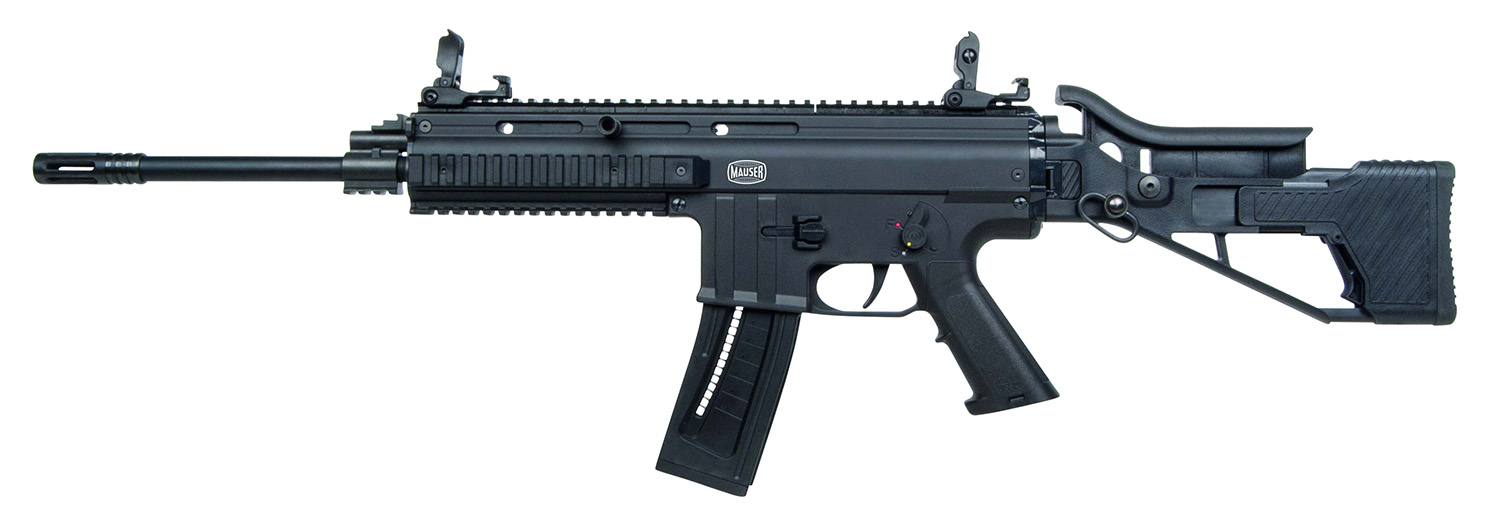
Mauser M-15 .22 LR Semi-Auto Rifle, Black
Pros & cons
What works
- Steel receiver construction – adds durability over polymer-bodied .22 clones
- Folds to 28 inches – 10.8 inches shorter than extended configuration
- 1/2x28 threaded muzzle – direct suppressor attachment without adapters
- Ambidextrous safety – usable by left-handed shooters without modification
- 6.6-pound weight – manageable for extended training sessions
Trade-offs
- Proprietary magazine design – limits aftermarket options compared to Ruger 10/22
- Single 10-round magazine included – additional units cost $25-35 each
- 2.5 MOA accuracy with bulk ammo – not suitable for precision competition
- Synthetic stock feels utilitarian – lacks the premium finish of higher-priced trainers
Video review
Expert review
Specs at a glance
About this product
What is the Mauser M-15 .22 LR Semi-Auto Rifle? It's a modern rimfire semi-automatic built on a steel receiver with synthetic furniture, featuring a side-folding stock and flip-up sights. This rifle bridges the gap between tactical ergonomics and .22 LR affordability, offering controls and handling characteristics similar to centerfire platforms at a fraction of the cost. The design prioritizes practical range use over collector appeal.
What is the Mauser M-15 used for?
This rifle is built for high-volume, low-cost training and small-game hunting, not duty or defensive roles. The blowback-operated .22 LR action cycles bulk ammunition reliably for practicing fundamentals, while the 16.5-inch barrel provides consistent velocity for varmints out to about 75 yards. The folding stock makes it packable for truck or ATV use, but the 6.6-pound weight reminds you it's a trainer, not an ultralight woods gun.
How does the Mauser M-15 compare to the Stevens 334?
The M-15 offers semi-auto speed for rapid drills, while the Stevens 334 in .308 Win delivers bolt-action precision for hunting. For putting 100 rounds downrange in an afternoon of casual shooting, the M-15's 10-round detachable magazine and light recoil are superior. For ethical deer hunting at 200 yards, the Stevens 334's .308 Winchester chambering and controlled-feed bolt are objectively better choices—these are tools for different jobs.
What does it weigh and what are the dimensions?
The M-15 weighs 6.6 pounds empty and measures 38.8 inches overall with the stock extended. Collapsed, the length reduces to approximately 28 inches thanks to the side-folding mechanism. The barrel is 16.5 inches long with a 1/2x28 threaded muzzle, a standard pattern that accepts common .22 LR accessories without an adapter.
Who is this NOT for?
This rifle isn't for collectors seeking historical Mauser craftsmanship or competitors needing match-grade accuracy. The synthetic stock and modern fire controls deviate from traditional Mauser lineage, and the 2.5 MOA accuracy I observed with standard velocity ammo won't satisfy benchrest shooters. If you require sub-MOA groups or walnut and blued steel, look at Stevens 555 shotguns for traditional aesthetics.
What's in the box?
You get the rifle, one 10-round detachable magazine, and a basic owner's manual—no optic mounts or cleaning kit. The manual covers disassembly for basic maintenance but lacks the detailed armorer-level schematics I'd prefer. Plan to purchase additional magazines separately, as the single included unit limits training value during range sessions.
Is the Mauser M-15 worth it at $295.99?
At this price point, it delivers solid value for a dedicated .22 LR trainer with modern ergonomics. The $295.99 MSRP undercuts many AR-platform .22 clones by $50-100 while offering similar handling benefits. For shooters wanting to practice rifle manipulation without $0.40/round centerfire costs, this is a rational purchase—provided you accept its limitations as a rimfire practice tool.
Key attributes
| upc | 713440970993 |
| manufacturer | Mauser Rimfire |
| manufacturer part number | 4150013 |
| action | Semi-Auto |
| atf type | MODERN SPORTING RIFLE |
| barrel finish | Black |
| barrel length | 16.50" |
| caliber/gauge | .22 LR |
| capacity | 22 + 1 |
| color | Black |
| length | 29.9500 |
| safety | Manual Thumb |
| sights | Flip Up Front & Rear |
| state restriction (il) | NO SALE TO ILLINOIS PICA |
| state restriction (or) | NO SALE TO OREGON |
| state restriction (ri) | NO DIRECT SHIP TO RHODE ISLAND |
| state restriction (wa) | NO DIRECT SHIP TO WASHINGTON |
| units per box | 1 |
Frequently asked questions
- Is it compatible with standard AR-15 accessories?
- No, the M-15 uses a proprietary receiver and magazine design, not AR-15 pattern parts. The 1/2x28 threaded muzzle accepts common .22 LR muzzle devices, but handguards, triggers, and stocks require M-15 specific components. Mauser offers limited aftermarket support compared to the Ruger 10/22 ecosystem.
- Does it fit in a standard rifle case?
- Yes, when folded to 28 inches, it fits most 32-inch tactical cases with room for accessories. The 6.6-pound weight keeps total case weight manageable under 15 pounds when packed. For airline travel, check your carrier's specific firearms policy—most require hard-sided cases with approved locks.
- How long does shipping take to FFL dealers?
- Ironclad Armory processes orders within 2 business days, with ground shipping adding 3-7 days depending on destination. The rifle ships direct to your chosen FFL holder, who will conduct the required background check—allow an additional 30 minutes to 3 days for that process based on local wait times.
- Can I return it if there are mechanical issues?
- Yes, Ironclad Armory accepts returns within 30 days for defective items, but the firearm must be inspected by an FFL during return shipping. The warranty covers manufacturing defects for 1 year from purchase date—document any issues with photos and contact their support team before shipping.
- Does this work with suppressor attachments?
- Yes, the 1/2x28 threaded barrel accepts most .22 LR suppressors without adapters. I recommend using subsonic ammunition to avoid supersonic crack, and cleaning the suppressor every 500 rounds due to .22 LR's dirty powder residue. Always verify your local NFA regulations before purchasing suppressor hardware.