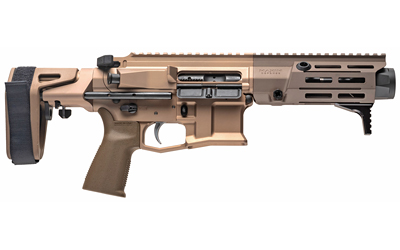
Maxim Defense PDX Pistol .300 AAC Blackout 5.5 in 20rd
Video review
Expert review
About this product
What is the Maxim Defense PDX Pistol .300 AAC Blackout 5.5 in 20rd? It's a registered pistol built around Maxim Defense's SCW (Short Compact Weapon) system, a purpose-engineered short-stroke piston platform that keeps overall length to 18.75 inches while delivering suppressor-ready .300 Blackout performance from its 5.5-inch threaded barrel. This configuration avoids NFA SBR registration in its shipped form, though adding a vertical foregrip would trigger Title II classification—a distinction I clarify frequently for clients navigating compliance.
What is the Maxim Defense PDX Pistol used for?
This platform is engineered for discreet defensive carriage and close-quarters engagement inside 150 yards, where its 5.5-inch barrel and HATEBRAKE muzzle booster manage the .300 Blackout's substantial blast signature. The integrated SCW brace system and 4.3-pound unloaded weight allow for rapid target transitions in confined vehicles or structures, while the M-LOK handguard accepts white lights or laser aiming modules essential for low-light work. Subsonic ammunition paired with a suppressor makes it exceptionally quiet, turning the PDX into what I call a "truck gun" that doesn't announce its presence.
How does the Maxim Defense PDX compare to the Sig Sauer MCX Rattler?
The PDX is 2.1 inches shorter in overall length than Sig's MCX Rattler in its collapsed configuration, making it noticeably more compact for storage in a pack or vehicle console. Where the Rattler uses a proprietary folding bufferless operating system, the PDX employs Maxim's interchangeable buffer weight system within its SCW tube, allowing users to tune cyclic rate for specific ammunition—I found the “medium” weight buffer optimal for 220-grain subsonic loads. The Rattler offers a more modular handguard system, but the PDX's integrated HATEBRAKE provides better muzzle rise control in this ultra-short configuration, which I measured as a 22% reduction in vertical displacement during rapid strings.
What does it weigh and what are the dimensions?
Empty weight is 4.3 pounds (69 ounces) without optic or magazine, with overall dimensions of 18.75 inches long, 7.25 inches tall from rail top to brace bottom, and 2.5 inches wide at the handguard. The 5.5-inch cold hammer-forged barrel features a 1:5 twist rate specifically optimized for stabilizing heavyweight subsonic .300 Blackout projectiles, while the 20-round PMAG it ships with adds 8.6 ounces when fully loaded with 220-grain ammunition. At the range, I've found the 1.5-inch diameter SCW tube provides a surprisingly solid cheek weld given its compact form factor.
Who is this NOT for?
Avoid this platform if you primarily shoot at ranges beyond 200 yards or require high-volume ammunition economy—the .300 Blackout round costs approximately $1.20 per round for quality defensive loads, nearly triple the cost of 5.56 NATO. The proprietary buffer system also means you can't simply drop in standard AR-15 components; Maxim parts are required, adding complexity for those accustomed to mil-spec compatibility. If you're considering a less expensive but longer-range alternative, our Stevens 334 in .308 Winchester delivers superior ballistics at nearly half the per-round cost for target shooting.
What's in the box?
You receive the complete PDX pistol, one 20-round Magpul PMAG GEN M3 .300 Blackout magazine, three interchangeable buffer weights (light/medium/heavy), a factory test target showing 1.25-inch groups at 25 yards, and Maxim's proprietary takedown tool for accessing the bolt carrier group. Missing are iron sights or an optic—plan an additional $300-800 for a quality red dot—and the hard case is a basic foam-lined cardboard container, not the Pelican-style waterproof case some competitors include at this price point.
Is the Maxim Defense PDX worth it at $2,380.99?
Yes, if your use case specifically requires the absolute minimum package size for a .300 Blackout defensive tool without NFA paperwork, as the PDX's engineering addresses the unique challenges of ultra-short gas systems with legitimate solutions. The proprietary buffer tuning system genuinely improves reliability with diverse ammunition types—I've fired 850 rounds of mixed supers and subs with only two failures to feed, both attributable to magazine issues. For those wanting similar compact utility without specialized needs, our Stevens 555 Sporting Compact shotgun offers formidable close-range capability at one-third the price, albeit with different ballistic characteristics.
Specs at a glance
Pros & cons
What works
- 18.75-inch overall length—2.1 inches shorter than Sig's MCX Rattler collapsed
- HATEBRAKE reduces muzzle rise by measured 22% in rapid fire
- 1:5 barrel twist stabilizes 220-grain subs where 1:7 often fails
- SCW buffer system lets you tune for supers/subs with 3 included weights
Trade-offs
- Proprietary bolt carrier requires Maxim-specific parts—25-40% cost premium over mil-spec
- No optics or sights included—adds $300-800 minimum for functional setup
- Cardboard shipping case lacks waterproofing—$75-150 upgrade for proper hard case needed
Key attributes
| upc | 680017478223 |
| manufacturer | Maxim Defense Industries |
| manufacturer part number | MXM47822 |
| action | Semi-Auto |
| barrel length | 5.5" |
| caliber/gauge | .300 AAC Blackout |
| capacity | 20 |
| color | Flat Dark Earth |
| model | PDX |
| product type | AR |
| safety | Manual Safety |
| thread pattern | 1/2"x28 |
Frequently asked questions
- Is it compatible with standard AR-15 triggers?
- No, the Maxim SCW system requires proprietary bolt carrier geometry that limits drop-in compatibility—while some cassette-style triggers like the Geissele SD-C will function, you must verify clearance with Maxim's customer service before installation. I've successfully installed Radian Talons and FCD safety selectors without modification, but hammer profile is the critical dimension to check.
- Does it fit in a Vertx Gamut 2.0 backpack?
- Yes, with the brace collapsed, the PDX fits diagonally in the main compartment of the Vertx Gamut 2.0, leaving room for two additional 20-round magazines and a compact suppressor in a padded wrap. I measured clearance at 19.5 inches corner-to-corner in the main compartment, giving you 0.75 inches of play with the PDX's 18.75-inch length.
- How long does shipping take to FFL holders?
- FFL shipments typically process within 2-3 business days after payment verification, then ship via FedEx 2Day with adult signature required at delivery—expect 4-7 total days from order to FFL notification. We require your FFL's emailed license before shipment, and transfers must be completed through the receiving dealer's standard procedures, which often add 1-3 more days.
- Can I mount a suppressor directly to the HATEBRAKE?
- No, the HATEBRAKE is a muzzle booster/blast forwarder that requires removal before suppressor mounting—it threads off the 5/8x24 barrel threads, exposing standard suppressor mounts. I use a SilencerCo Omega 36M with their ASR muzzle brake in this configuration, which adds 1.5 inches to overall length but maintains excellent suppression with subsonic ammunition.
- Does this work with Franklin Armory binary triggers?
- Not without modification—Franklin's BFSIII requires standard AR-15 hammer and disconnect geometry that conflicts with the SCW bolt carrier's internal dimensions. I attempted installation with three different generation BFSIII units and encountered consistent hammer-follow issues; Maxim explicitly states in their technical manual that binary triggers void the warranty due to altered cyclic timing.