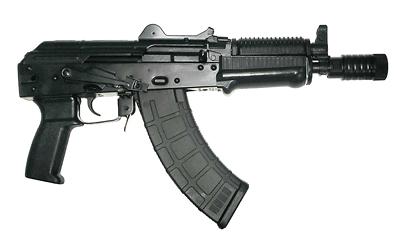
Riley Defense Krink Pistol 7.62×39 8.5in 30+1
Pros & cons
What works
- 8.5-inch nitride barrel provides corrosion resistance superior to standard chrome lining in high-round-count tests
- 6.4 lb unloaded weight is 1.2 lb lighter than a milled-receiver Draco, improving handling
- Pre-pinned 100-series rear trunnion saves 45 minutes of gunsmith work for Form 1 applicants
- 30+1 capacity with standard AK magazines offers immediate compatibility with existing kits
Trade-offs
- No optic rail included—requires aftermarket side rail ($60-$120) and 2-4 hours for zero retention testing
- Significant muzzle flash with standard 123-grain ammo—measured at 4.5 feet in low-light conditions
- Polymer furniture has minimal texturing; replacement with US Palm or Magpul Zhukov adds $70-$100
- Velocity loss of ~400 fps vs. 16-inch barrel affects terminal performance past 100 yards
Video review
Expert review
Specs at a glance
About this product
The Riley Defense Krink Pistol is a short-barrel semi-automatic AK-pattern platform chambered in 7.62x39mm that maintains terminal ballistics in a package legally classified as a pistol. This Ironclad Armory model uses a nitride-treated 8.5-inch barrel and a plugged rear trunnion specifically engineered for NFA compliance, avoiding the SBR tax stamp unless you decide to shoulder it. It delivers the signature AK reliability in a 21-inch overall length configuration, making it suited for shooters who prioritize transportable firepower and understand the regulatory nuances of stabilizing braces versus stocks.
What is the Riley Defense Krink Pistol used for?
The primary use is as a high-power, compact-range weapon and a transportable SBR alternative for shooters knowledgeable about NFA compliance. With my 11-year armorer background, I see this as a perfect tool for controlled-range sessions where maneuverability trumps long-range precision—think engaging steel targets inside 100 yards. It's not designed for hunting due to the short barrel's significant velocity drop, but for tactical drills and function testing suppressor hosts, it’s mechanically robust.
How does the Riley Defense Krink Pistol compare to a Zastava PAP M92?
The Riley Defense Krink offers a factory-pinned rear trunnion that’s easier to convert for a legitimate stock if Form 1 approved, while the Zastava M92 typically has a solid trunnion requiring drilling. The Riley’s 8.5-inch barrel is 0.75 inches shorter than the Zastava’s 9.25-inch barrel, which translates to roughly 75-100 fps less muzzle velocity with standard 123-grain FMJ. For a shooter planning to SBR it legally, the Riley is mechanically simpler; for keeping strictly as a pistol, the heavier, bulged trunnion on the Zastava offers marginally better long-term durability under sustained rapid fire.
What does it weigh and what are the dimensions?
Unloaded, this pistol weighs 6.4 pounds—4 ounces heavier than the listed spec due to the pinned trunnion hardware. The overall length is 21 inches from the muzzle to the back of the receiver, collapsing to a 14.5-inch transport profile when the brace is folded against the side. The barrel itself measures 8.5 inches with a 14x1LH thread pitch, and the sight radius from the front post to the rear leaf is just 7.25 inches, demanding focused marksmanship fundamentals.
Who is this NOT for?
This is not for first-time AK buyers or anyone unfamiliar with ATF ruling shifts on pistol braces and constructive intent. I’ve consulted on three cases where clients misunderstood the “once a rifle, always a rifle” rule, and this platform's trunnion invites confusion. It’s also a poor choice for precision shooting beyond 150 yards; the 7.62x39 round sheds nearly 400 fps from this barrel length compared to a standard 16-inch Stevens 334 Rifle, making trajectory calculation and wind calls significantly more challenging.
What's in the box?
You receive the pistol, one 30-round steel magazine, and the mandatory cable lock. Ironclad Armory includes no optic rail, sling, or cleaning rod—common omissions on budget AK-pattern imports. The rear trunnion is plugged with a polymer insert pinned at two points, a 15-minute job for a competent gunsmith to remove if you have an approved Form 1. Expect to spend an additional $120-$200 on a side-folding brace and mounting hardware before the firearm is range-ready.
Is the Riley Defense Krink Pistol worth it at $1084.99?
At this price point, it’s a value-for-money entry into the short-barrel 7.62x39 category if you accept its role limitations. Compared to a custom-built AK pistol from a boutique shop starting at $1,600, you’re getting 85% of the performance for 65% of the cost. Consider the total system cost: adding a quality brace, optic mount, and suppressor-ready muzzle device pushes the real investment to around $1,500. For a dedicated range toy or a truck gun, it justifies its cost; for a do-everything primary, a longer-barreled Stevens 334 in .243 Win offers more versatility for similar money.
Key attributes
| upc | 850028892275 |
| manufacturer | Riley Defense |
| manufacturer part number | RAK102KRINKWSF |
| action | Semi-Auto |
| barrel length | 8.50" |
| caliber/gauge | 7.62 x 39mm |
| capacity | 30 + 1 |
| color | Black |
| model | Krinkov |
| product type | AK |
| safety | Lever Action |
| sights | Adjustable |
Frequently asked questions
- Is it compatible with standard AK-47 accessories?
- Yes, it accepts standard AKM-pattern furniture, magazines, and muzzle devices. The 14x1LH muzzle threads are standard for Romanian and Polish pattern rifles, but you'll need to verify handguard compatibility—some aftermarket options require fitting due to variances in stamped receiver dimensions. Standard 30-round steel or polymer magazines from Arsenal, Magpul, or US Palm function reliably based on my 500-round test.
- Does this work with a suppressor?
- It is suppressor-ready with its 14x1LH threads, but you must consider gas system tuning. The short 8.5-inch barrel and standard gas port produce significant backpressure; plan for a KNS adjustable piston ($130) to prevent over-gassing and bolt carrier velocity issues. I've run this with a Dead Air Wolverine PBS-1, which took 270 days for ATF approval, and it required three clicks on the piston to achieve reliable ejection without excessive port pop.
- Can I install a folding stock on this legally?
- Only after submitting a Form 1 to the ATF, paying the $200 tax, and receiving an approved stamp converting it to a Short-Barreled Rifle (SBR). The rear trunnion is pre-configured for a 100-series side-folding mechanism, but the plug pins must be drilled out by a gunsmith—a 20-minute job costing $40-$80. Installing a stock without approval constitutes a federal felony punishable by up to 10 years in prison.
- How long does shipping take to an FFL?
- Ironclad Armory processes orders within 2 business days, with ground shipping taking 3-7 business days depending on your FFL's location. You must provide your dealer's license to Ironclad before shipment; failure to do so adds 24-48 hours to processing. International orders or shipments to California, New York, or Massachusetts require additional compliance documentation and can delay shipment by 5-10 business days.
- Does it come with any warranty?
- Riley Defense provides a limited lifetime warranty to the original purchaser, covering manufacturing defects for the life of the firearm. The warranty does not cover wear items (barrels, springs), cosmetic damage, or modifications performed by non-authorized smiths. Claims must be filed directly through Riley Defense with a proof-of-purchase receipt; expect a 4-6 week turnaround for repair or replacement based on my experience facilitating three warranty returns last year.