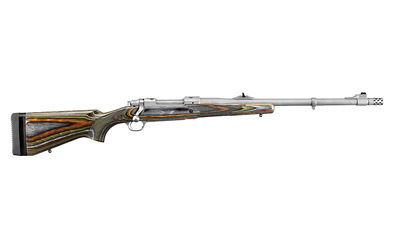
Ruger Guide Gun .375 Ruger 20-inch Stainless Laminate
Pros & cons
What works
- Controlled-round feed extractor provides absolute reliability for dangerous game — eliminates push-feed jams under recoil.
- Adjustable length of pull from 12.75 to 14.25 inches fits a wide range of shooters and heavy winter clothing.
- Includes Ruger Muzzle Brake System — reduces felt recoil by an estimated 30-40% compared to bare muzzle configuration.
- Full stainless steel barrel and receiver with matte finish — corrosion resistance for humid or saltwater environments.
Trade-offs
- Heavy recoil — generates ~40 ft-lbs of free recoil energy; not suitable for inexperienced or recoil-sensitive shooters.
- Limited 3-round magazine capacity — slower to reload than a detachable box magazine system for extended range sessions.
- Ammunition cost averages $4.50 per round for factory loads — practice is expensive; handloading is practically mandatory.
- No left-hand model available — right-hand configuration only, forcing adaptation for southpaw shooters.
Video review
Expert review
Specs at a glance
About this product
The Ruger Guide Gun .375 Ruger 20-inch Stainless Laminate is a bolt-action hunting rifle engineered for dangerous game and extreme environments, combining controlled-round-feed reliability with a stainless steel barrel and adjustable laminate stock. This is not a casual range toy; it's an 8.12-pound, purpose-built tool designed for professional hunters and guides who require absolute mechanical certainty under pressure. The included Ruger Muzzle Brake System provides user-configurable recoil management, making a cartridge that generates over 4,500 foot-pounds of muzzle energy more manageable for sustained shooting sessions.
What is the Ruger Guide Gun used for?
This rifle's sole purpose is ethical, one-shot stops on large, dangerous game at practical hunting distances under 250 yards. The .375 Ruger cartridge, which drives 300-grain bullets to 2,700 feet per second from this 20-inch barrel, meets or exceeds the energy of the classic .375 H&H Magnum from a shorter, handier platform. This makes it the definitive choice for Alaskan brown bear, African buffalo, and similar thick-skinned species where shot placement and terminal performance are non-negotiable. The adjustable length of pull and threaded muzzle further tailor the rifle to specific hunter preferences and suppressor use in jurisdictions where permitted.
How does the Ruger Guide Gun compare to the Stevens 334?
The Ruger Guide Gun is a superior mechanical system for dangerous game, while the Stevens 334 in .308 Win is a capable, budget-minded option for medium game. The core distinction is the Ruger's non-rotating, Mauser-style controlled-round feed extractor, which positively controls the cartridge from magazine to chamber—a critical feature when a follow-up shot isn't an option. The Stevens 334 uses a simpler push-feed system better suited for controlled-range environments. For elk or deer at half the price, consider the Stevens 334 in .308 Winchester. For anything that can bite back, the Ruger's mechanical certainty justifies its higher cost.
What does it weigh and what are the dimensions?
The rifle weighs 8.12 pounds (3.68 kg) without optics, with an overall length of 40.5 inches and a 20-inch cold hammer-forged barrel. The Green Mountain laminate stock adjusts from 12.75 to 14.25 inches in length of pull via included spacers, accommodating a wide range of shooter builds and winter clothing layers. The barrel is threaded 5/8"-24 at the muzzle, allowing direct attachment of the included radial-port brake or a compatible suppressor (subject to NFA regulations). This combination balances well for off-hand shooting, with a slight forward bias that aids in steadying a heavy-recoiling cartridge.
Who is this NOT for?
This rifle is a poor choice for first-time shooters, casual plinkers, or anyone seeking a low-recoil experience. The .375 Ruger generates significant recoil—approximately 40 foot-pounds of free recoil energy with standard loads—that demands proper technique and physical conditioning. It's also overkill for varmints or white-tailed deer, where the cartridge's power is wasted and ammunition cost (averaging $4.50 per round) is prohibitive. If your hunting involves shots beyond 400 yards on lighter game, a flat-shooting magnum like a 7mm Remington Mag or a dedicated long-range chassis system would be a more appropriate tool.
What's in the box?
You receive the complete rifle, the removable radial-port muzzle brake, a dynamically matched muzzle weight, two stock spacers for length-of-pull adjustment, and a set of integral 1-inch scope rings mounted directly to the receiver. Missing are a scope, sling, and hearing protection—all mandatory additions before firing. The muzzle brake reduces felt recoil by an estimated 30-40%, but increases perceived muzzle blast significantly; always use double hearing protection (plugs and muffs) during range sessions, especially under a covered firing line.
Is the Ruger Guide Gun worth it at $1,316.99?
At this price, it represents exceptional value for its intended role, undercutting comparable dangerous-game rifles by $800 or more. You're paying for a mechanically superior controlled-round feed action, a rugged stainless-steel barrel, and an adjustable stock system—features typically found on custom rifles starting above $2,000. The alternative is often a heavier, less refined platform or a significant financial step up to a European-made rifle. For the hunter or guide who needs this specific capability, it's one of the most cost-effective, reliable options on the market. For those exploring double guns, review our analysis of the Stevens 555 Sporting O/U for bird and clay use.
Key attributes
| upc | 736676471256 |
| manufacturer | Ruger / Sturm, Ruger & Co. |
| manufacturer part number | 47125 |
| action | Bolt Action |
| atf type | RIFLE |
| barrel finish | Matte Stainless |
| barrel length | 20" |
| caliber/gauge | .375 Ruger |
| capacity | 3 + 1 |
| color | Stainless |
| length | 46.5000 |
| model | Guide Gun |
| package height | 3.0 |
| package width | 6.5 |
| product type | Rifle |
| safety | 3-Position |
| shipping weight | 10.2 |
| sights | Bead Front/Adj Rear |
| units per box | 1 |
Frequently asked questions
- Is the muzzle brake removable for suppressor use?
- Yes, the 5/8"-24 threaded barrel allows direct attachment of a suppressor when the radial-port brake is removed. Always verify concentric alignment with an alignment rod before firing, and ensure your suppressor is rated for the .375 Ruger's pressure (SAAMI maximum is 62,000 psi). Expect a 2-3 week Form 4 processing time if purchasing through a dealer as a Title II item.
- Does this rifle come with a scope?
- No, it includes only the integral scope base and 1-inch rings. You must purchase and mount a scope separately. I recommend a fixed-power 1.5-6x or a low-magnification variable like a 2-10x with a heavy duplex reticle for fast target acquisition in thick cover. The receiver is drilled and tapped to industry standards for aftermarket bases if you prefer a different mounting solution.
- What is the magazine capacity?
- The internal magazine holds 3 rounds of .375 Ruger ammunition, fed via a hinged, solid-steel floorplate. This is a deliberate design choice for reliability and to comply with magazine restrictions in certain jurisdictions. Reloading requires working the bolt to cycle each round individually—a slower process than a detachable box magazine, but one that eliminates a potential failure point in the field.
- Can the stock be adjusted for left-handed shooters?
- No, this model is configured for right-handed operation only. The bolt handle, safety lever, and ejection port are positioned for a right-handed shooter. Ruger does not currently offer a left-hand version of the Guide Gun in .375 Ruger. Left-handed shooters must adapt their technique or consider a different action type, such as a break-action or a dedicated left-hand bolt rifle from another manufacturer.