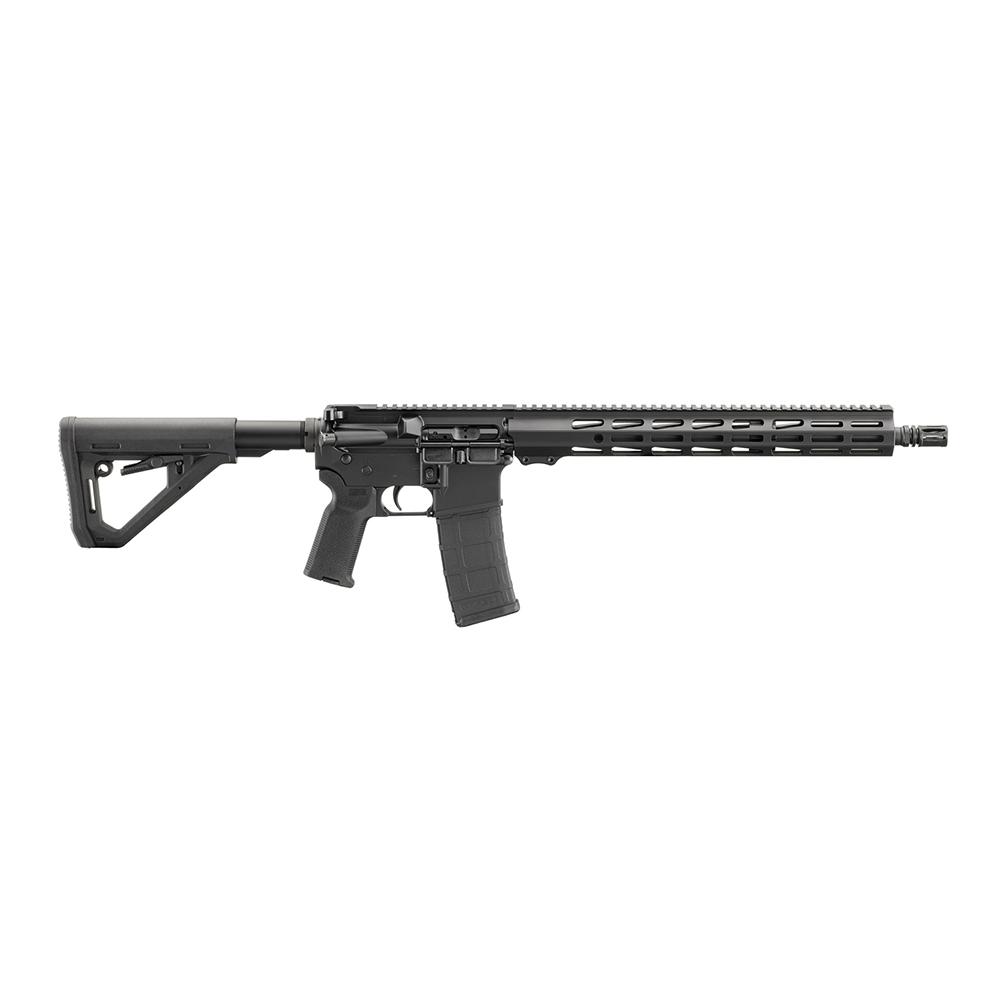
Ruger Harrier Rifle 5.56 NATO 30rd Magazine 16.1″ 1/2×28 Threaded Barrel Black Magpul MOE-K2
Pros & cons
What works
- Nitrided 16.1" barrel with 1:8 twist — provides corrosion resistance and versatile ammo stabilization.
- Includes Magpul MOE-K2 grip and PMAG — proven, ergonomic components valued at ~$40 separately.
- Weighs ~6.4 lbs — balances well for off-hand shooting and maneuverability in tight spaces.
- Free-float M-LOK handguard — allows direct accessory mounting without affecting barrel harmonics.
Trade-offs
- GI-spec single-stage trigger — heavy 6-7.5 lb pull is not ideal for precision work without an upgrade.
- No sights included — requires immediate additional investment of $80+ for a basic sighting system.
- Government profile barrel — slightly heavier under the handguard than a modern pencil profile.
Video review
Expert review
Specs at a glance
About this product
The Ruger Harrier Rifle is a direct-impingement AR-15 platform rifle chambered in 5.56 NATO, featuring a 16.1-inch nitrided barrel, a free-float M-LOK handguard, and Magpul furniture configured for an optimized, modern shooting platform. It's built to a functional mil-spec standard with several quality-of-life upgrades out of the box, making it a straightforward entry into a modular rifle system. This configuration offers a solid baseline for both home defense and range-use applications.
What is the Ruger Harrier Rifle used for?
The Harrier is primarily used for home defense, carbine training courses, and as a versatile general-purpose rifle. Its 16.1-inch barrel with a 1:8 twist rate stabilizes both lightweight 55-grain range ammo and heavier 77-grain defensive loads effectively, making it suitable for diverse ammo types. The inclusion of the Magpul MOE-K2 grip and free-float handguard prioritizes ergonomic control and accessory mounting for lights or foregrips, which is critical for defensive setups.
How does the Ruger Harrier Rifle compare to the Stevens 334?
The Ruger Harrier is a semi-automatic rifle for rapid follow-up shots, while the Stevens 334 bolt-action rifle is a fundamentally different tool for precision or hunting. The Harrier fires from a 30-round detachable magazine and is built for dynamic shooting, whereas the Stevens 334 in .308 Winchester is better suited for hitting a single target at longer ranges with higher energy. You choose the Harrier for volume and modularity, and the Stevens for deliberate, precise shots.
What does the Ruger Harrier Rifle weigh and what are the dimensions?
This rifle weighs approximately 6.4 pounds unloaded, with an overall length of 35.5 inches with the stock fully collapsed. The 16.1-inch barrel keeps it under the 26-inch minimum OAL for NFA-regulated short-barreled rifles, while the slim-profile free-float handguard has a diameter of 1.5 inches for a solid grip. At this weight and balance point, it handles quicker than many piston-driven alternatives that can push over 7.5 pounds.
Who is the Ruger Harrier Rifle NOT for?
This rifle is not for shooters seeking a lightweight ultralight "pistol" build or those requiring a sub-MOA guaranteed accuracy rifle out of the box. The GI-spec single-stage trigger has a predictable but heavy pull weight, usually around 6 to 7.5 pounds, which isn't ideal for precision benchrest shooting. If your primary use is competitive shooting where trigger feel is paramount, you'll likely want to budget for an aftermarket trigger upgrade immediately.
What's in the box with the Ruger Harrier Rifle?
You receive the complete rifle, one 30-round Magpul PMAG, an A2 flash hider already installed on the 1/2x28 threaded muzzle, and the factory manual. The rifle ships with all critical components—including the carbine buffer and spring—installed and headspaced from the factory. No tools, optic, or sling are included, so plan for those purchases separately.
Is the Ruger Harrier Rifle worth it at $582.99?
Yes, at $582.99, the Harrier offers strong baseline value for a ready-to-shoot rifle with reputable Magpul components and a nitrided barrel. It saves you the assembly time and potential headspace gauges required for a true build-from-parts kit, which often starts at a similar price before adding a grip, stock, and handguard. For comparison, a basic Stevens 334 bolt-action starts lower, but you're paying here for the semi-automatic action and the modular AR-15 ecosystem compatibility, which justifies the price point for its intended use.
Key attributes
| upc | 736676286003 |
| manufacturer | Ruger / Sturm, Ruger & Co. |
| manufacturer part number | 28600 |
| action | Semi-Auto |
| barrel length | 16.10" |
| caliber/gauge | .223 REM/5.56 NATO |
| capacity | 30 + 1 |
| color | Black |
| model | Harrier |
| product type | AR |
| shipping weight | 8.8 |
Frequently asked questions
- Is the barrel threaded for a suppressor?
- Yes, the barrel has a standard 1/2x28 thread pattern under the installed A2 flash hider, which is directly compatible with most .223/5.56 muzzle devices and suppressors. You will need a proper armorer's wrench to remove the factory flash hider, which is torqued to approximately 25-30 foot-pounds. Always verify concentricity with an alignment rod before attaching a suppressor.
- Does it come with iron sights?
- No, this rifle ships without any iron sights or optics, as indicated by the clear, unobstructed Picatinny rail on the upper receiver. You must purchase and zero your own backup iron sights or optic. Plan to spend an additional $80-$400 for a reliable sighting system from brands like Magpul, Vortex, or Holosun to make the rifle functional.
- Is the trigger mil-spec?
- Yes, it uses a standard single-stage mil-spec trigger group with an estimated pull weight of 6 to 7.5 pounds. This provides reliable, heavy ignition under adverse conditions but lacks the crisp break of a match-grade trigger. The lower receiver is compatible with any drop-in aftermarket AR-15 trigger if you wish to upgrade, such as units from LaRue or Geissele.
- What is the barrel twist rate?
- The 16.1-inch Government profile barrel has a 1:8 twist rate, which is a versatile middle-ground twist. This twist will adequately stabilize common 55-grain FMJ range ammunition as well as heavier 62-grain M855 and 77-grain OTM match rounds. It's not the fastest 1:7 twist, but it provides excellent all-around performance for the vast majority of commercially available 5.56 ammunition.