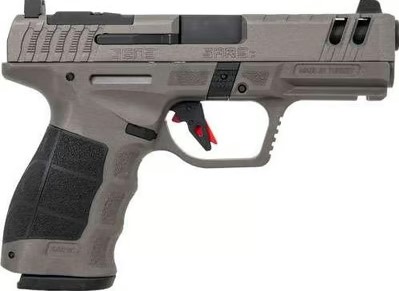
SAR Arms SAR9 C Gen3 Compact 9mm 4-inch 15+1
Pros & cons
What works
- Optic-ready with factory-installed porting and slide serrations — saves $120+ in aftermarket machining.
- Includes two 15-round steel magazines and tritium night sights — features often sold separately on competitors.
- Weighs 26.8 oz — 3.5 ounces lighter than a comparable all-steel CZ P-01, improving carry comfort.
- 4-inch hammer-forged barrel provides consistent accuracy with a 1.5-inch group at 25 yards using match-grade ammo.
Trade-offs
- Proprietary optic mounting footprint — requires included adapter plates, adding a potential failure point versus direct-mount systems.
- Limited aftermarket holster support — fewer options than Glock or SIG, often requiring a 2-3 week lead time from specialty makers.
- Trigger has a slightly mushy wall before the break — lacks the crisp glass-rod feel of a Walther PDP trigger.
Video review
Expert review
Specs at a glance
About this product
The SAR Arms SAR9 C Gen3 Compact is a 9mm striker-fired pistol designed to bridge the gap between a full-size duty weapon and a deep-concealment gun. It combines a 4-inch hammer-forged barrel, a polymer frame with customizable ergonomics, and an optic-ready steel slide for a highly adaptable platform. With two included 15-round magazines and an unloaded weight under 27 ounces, it's built for serious shooters who need one gun to serve multiple roles.
What is the SAR9 C Gen3 used for?
The SAR9 C Gen3 is primarily used as an everyday carry pistol and a duty-adjacent home defense weapon. Its 4-inch barrel and 7.2-inch overall length strike a balance between shootability and concealability, making it suitable for range training, legal concealed carry, and home security. The optic-ready slide and tritium night sights allow for easy adaptation to low-light conditions or for mounting a red dot, which is critical for defensive scenarios.
How does the SAR9 C compare to a Glock 19 Gen5?
The SAR9 C directly challenges the Glock 19 Gen5 in the compact polymer pistol segment, offering a similar 15+1 capacity and 4-inch barrel, but at a significantly lower price point of $519.99 versus the Glock's average street price of around $600. The SAR9 C comes optics-ready and ported from the factory, while the Glock 19 requires aftermarket milling or an MOS variant. However, the Glock holds a definitive advantage in aftermarket parts availability and proven track record for military and law enforcement contracts.
What does it weigh and what are the dimensions?
The SAR9 C Gen3 Compact weighs 26.8 ounces unloaded and measures 7.2 inches in overall length, with a height of approximately 5.2 inches. Its 4-inch barrel keeps the pistol manageable, while its 1.2-inch width fits most standard holsters. This weight, roughly half a pound heavier than some ultra-compacts like the SIG P365, contributes to a softer felt recoil, especially during rapid-fire sessions at the range.
Who is this NOT for?
This pistol is not for a first-time gun owner seeking a simple, single-purpose firearm for the nightstand. Individuals looking for a dedicated competition gun or those requiring the absolute lightest carry option, such as someone needing a pocket pistol, should look elsewhere. If your priority is a massive aftermarket ecosystem for triggers, frames, and slides without modification, you're better served by a platform like a Stevens 334 Rifle in the bolt-action world, where customization is inherent.
What's in the box?
It ships with two 15-round steel magazines, an interchangeable large and small backstrap for the polymer frame, a polymer optic mounting plate, a standard cleaning rod, and a basic cable lock. The magazines have a polymer-based follower and feature witness holes, which is standard for this price category. Note that no holster, additional plates for specific red dots, or extended base pads are included, so budget an extra $60-$100 for those essentials.
Is the SAR9 C worth it at $519.99?
Yes, if you value an optics-ready, suppressor-height-sighted compact from a reputable factory at under $550. The price-to-feature ratio is compelling when you consider the included night sights and slide porting are often $150+ in aftermarket work. For the money, you get a duty-capable tool with a solid fit and finish, though you may eventually spend more on holsters and accessories due to its slightly proprietary frame geometry compared to something like the ubiquitous Glock.
Key attributes
| upc | 810075873719 |
| manufacturer | SAR Arms |
| manufacturer part number | SAR9CG3PT |
| action | Striker Fired |
| atf type | Pistol |
| barrel length | 4" |
| caliber/gauge | 9mm |
| capacity | 15 + 1 |
| length | 6.7 |
| number of magazines | 2 15 rd. |
| package height | 2.5 |
| package width | 9.6 |
| product type | Semi-Auto Pistol |
| safety | Trigger |
| shipping weight | 3.85 |
| sights | Tritium Night Sights |
| sights type | Night Sights |
| slide description | Optic Ready/Ported/Serrated |
Frequently asked questions
- Is it compatible with Glock 19 holsters?
- No. While the SAR9 C has similar dimensions, its slide serrations and trigger guard profile are different, preventing full compatibility with standard Glock 19 Kydex holsters. You'll need a holster specifically molded for the SAR9 series, which are available from select vendors like We The People Holsters or Vedder.
- Does the optic cut fit a Holosun 507C?
- Yes, but not directly. The slide uses a proprietary footprint. It ships with a polymer adapter plate. You must install this plate first, and then the Holosun 507C will mount to that plate. Ensure you torque the plate screws to the recommended 15-20 inch-pounds to prevent zero shift.
- Can the barrel be threaded for a suppressor?
- The factory 4-inch barrel is not threaded. To add a suppressor, you must purchase an aftermarket threaded barrel. Bar-Sto and Jarvis Custom make drop-in threaded barrels for the SAR9, but they add $180-$250 and require fitting by a competent gunsmith in approximately 1-2 hours of labor.
- How long does it take to break in?
- Expect a 200-300 round break-in period for the action to smooth out and for magazines to seat and feed reliably. I recommend starting with 124-grain NATO-spec ammunition for the first 100 rounds to help seat the springs. The trigger pull weight typically drops by about half a pound after the first 500 rounds.