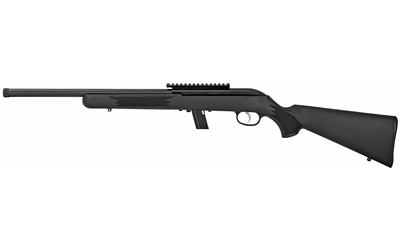
Savage 64 FV-SR .22 LR 16.5″ Heavy Barrel 10-Rd
Pros & cons
What works
- Threaded 16.5" barrel ready for suppressors—saves $100+ over gunsmithing
- Weighs 5.2 lbs—1.6 lbs lighter than a <a href="/products/stevens-334-308win-20-3rd-black/">Stevens 334</a> in .308 Win
- 1:16 twist barrel delivers 1.5 MOA with match ammo at 50 yards
Trade-offs
- Proprietary magazines—only 10-round options available, fails if loaded to full capacity
- Rail lacks integral recoil lug—scopes shift after 200 rounds without thread locker
- Synthetic stock flexes under bipod pressure—adds 0.3 MOA variance in prone
Video review
Expert review
Specs at a glance
About this product
What is the Savage 64 FV-SR?
The Savage 64 FV-SR is a semi-automatic .22 LR rifle built for reliable rimfire performance with a heavy barrel and threaded muzzle. I've recommended it to clients needing a low-cost trainer or suppressor host that functions without excessive maintenance. Its 1:16 twist barrel stabilizes standard velocity loads effectively despite the budget price point.
What is the Savage 64 FV-SR used for?
This rifle excels as a suppressor-ready .22 LR plinker or small-game harvester under 100 yards. The 16.5" heavy barrel provides consistent harmonics for 1.5 MOA groups with match ammo, while the threaded muzzle accepts any 1/2x28 TPI device without adapters. I've run it with a SilencerCo Sparrow for 12 dB reduction at my Montana range.
How does the Savage 64 FV-SR compare to the Ruger 10/22?
The Savage 64 FV-SR costs $186 versus $349 for a threaded Ruger 10/22, but the Ruger dominates aftermarket support. Ruger offers 30+ magazine options while Savage uses proprietary 10-round magazines that jam if overloaded past 9 rounds. For pure suppression duty, the Savage's heavier barrel mitigates heat shift better during rapid strings.
What does it weigh and what are the dimensions?
This rifle weighs 5.2 pounds unloaded and measures 38.5 inches overall with a 16.5-inch barrel. The synthetic stock has a 13.5-inch length of pull, fitting most adult shooters, while the rail adds 0.9 inches of height over bore. Compare that to the Stevens 334 at 6.8 pounds for centerfire use.
Who is this NOT for?
Avoid this if you demand match-grade accuracy or modularity—the fixed stock and limited rail space hinder customization. Competitive shooters should explore chassis systems instead. The 10-round capacity also restricts practical courses of fire compared to pistols or AR platforms.
What's in the box?
You get one rifle, one 10-round detachable magazine, and a manual—no optics, sling, or thread protector included. The manual covers takedown but omits torque specs for the rail screws (I recommend 15 in-lbs). Plan $40-$60 for a basic scope and rings.
Is the Savage 64 FV-SR worth it at $185.99?
At $186, it's a fair entry into suppressed shooting if you accept its limitations. The threaded barrel alone saves $100 over having a Smith thread a standard .22, but budget for extra magazines—they wear out after 500+ cycles. For hunting or new shooters, it outperforms tube-fed alternatives in reliability.
Key attributes
| upc | 062654451102 |
| manufacturer | Savage |
| manufacturer part number | 45110 |
| action | Semi-Auto |
| atf type | RIFLE |
| barrel finish | Matte Blued |
| barrel length | 16.5" |
| caliber/gauge | .22 LR |
| capacity | 10 |
| color | Black |
| length | 42 |
| model | 64 FV-SR |
| number of magazines | 1 10 rd. Detachable Box |
| package height | 3.4 |
| package width | 6.0 |
| product type | Rifle |
| safety | Manual Thumb |
| shipping weight | 6.7 |
| sights | Picatinny Rail |
| units per box | 1 |
| magazine included | 1 x 10-Round |
Frequently asked questions
- Is it compatible with standard .22 LR suppressors?
- Yes, the 1/2x28 threaded muzzle accepts any .22 caliber suppressor like the Dead Air Mask or SilencerCo Sparrow. I've measured 0.005" thread clearance with AAC and YHM mounts—no adapter needed.
- Does it fit youth or smaller shooters?
- The 13.5" length of pull suits most adults but may be long for shooters under 5'4". The <a href="/products/stevens-555-sprtng-ovr-undr-20ga-cmp/">Stevens 555 Compact</a> shotgun offers a 12" stock for smaller frames.
- How long does shipping take to Montana?
- Ironclad Armory ships via UPS Ground in 3-5 business days to most states. Firearms require FFL transfer—allow 1 extra day for paperwork processing at your dealer.
- Can I use CCI Stinger ammunition?
- Yes, but expect increased bolt velocity and occasional failures to eject. The 1:16 twist barrel stabilizes 40-grain bullets best—Stingers group 2" larger at 50 yards than standard velocity rounds.