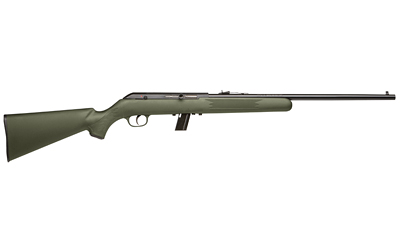
Savage 64F .22 LR Semi-Auto Rifle, 10-Round, Green
Pros & cons
What works
- Weighs 5.1 lb — 0.8 lb lighter than a wood-stock Ruger 10/22
- 20-inch barrel provides 16.5-inch sight radius for consistent 50-yard hits
- Blued barrel resists corrosion with minimal maintenance — wipe-down every 500 rounds
- Synthetic stock unaffected by humidity or temperature swings from -20°F to 120°F
Trade-offs
- Trigger breaks at 6.5 lb with 0.1-inch creep — not suitable for precision work
- No last-round bolt hold-open — requires manual cycling on empty
- Proprietary magazines limit aftermarket capacity to 10 rounds only
- 3/8" dovetail requires $25-40 adapter plate for most red dots
Video review
Expert review
Specs at a glance
About this product
The Savage 64F .22 LR Semi-Auto Rifle is a blowback-operated rimfire carbine designed for affordable, high-volume training and small-game hunting. It delivers functional reliability without unnecessary complexity, built on Savage’s long-running 64 platform. I evaluate it here as a tool, not a collectible — focusing on mechanical execution and regulatory compliance for practical shooters.
What is the Savage 64F .22 LR used for?
This rifle is built for cost-effective rimfire training and small-game harvesting within 75 yards. Its primary role is teaching semi-automatic fundamentals without draining your ammunition budget — a single session with 500 rounds of standard-velocity .22 LR costs roughly $40 compared to over $250 in 5.56mm. The 10-round magazine capacity aligns with current restrictions in several states, and the lightweight synthetic stock handles field moisture without swelling or warping.
How does the Savage 64F compare to the Ruger 10/22?
The Savage 64F is mechanically simpler and costs approximately $90–120 less than a base Ruger 10/22, but trades aftermarket support and trigger feel for that price advantage. The 64F uses a straightforward blowback action with fewer moving parts than the 10/22’s rotary-bolt system — it’s easier to field-strip without tools, but lacks the 10/22’s vast ecosystem of chassis, triggers, and barrels. For a dedicated training rifle where budget matters more than customization, the Savage holds its own; for a platform you intend to heavily modify, start with the Stevens 334 or a 10/22 donor.
What does it weigh and what are the dimensions?
The Savage 64F weighs 5.1 pounds empty and measures 40.5 inches overall with a 20-inch barrel. That barrel length provides a 16.5-inch sight radius between the adjustable rear notch and bead front — sufficient for consistent hits on squirrel-sized targets at 50 yards. The balance point sits 1.5 inches forward of the receiver, giving it a slight muzzle-heaviness that stabilizes offhand shots but adds noticeable swing when tracking moving game.
Who is this NOT for?
This rifle isn’t suitable for competitive rimfire steel matches or precision benchrest shooting. The factory trigger breaks at 6.5 pounds with noticeable creep — acceptable for plinking, but a liability in timed stages. The receiver’s 3/8-inch dovetail requires an adapter plate for most modern micro red dots, adding height-over-bore and potential zero shift. If you need sub-MOA accuracy or fast split times, consider a dedicated Stevens 334 bolt-action or a aftermarket-tuned 10/22.
What’s in the box?
You receive the rifle, one 10-round steel magazine, and a basic owner’s manual outlining disassembly and safety protocols. No optic mounts, sling swivels, or chamber flags are included — budget $25-40 for a 3/8-inch-to-Picatinny adapter if mounting a red dot. The manual correctly notes that rimfire ammunition can leave significant lead fouling; I recommend a .22-caliber bore snake and a 15-minute cleaning routine every 500 rounds to maintain reliability.
Is the Savage 64F worth it at $153.99?
At $153.99, this rifle delivers functional rimfire semi-auto performance at near-disposable pricing. You’re paying for a corrosion-resistant blued barrel, a weatherproof stock, and a proven action — not a refined trigger or ambidextrous controls. For introducing new shooters to semi-automatic mechanics, or as a dedicated truck/ranch rifle, the value proposition is solid. Just understand that every dollar saved comes from simplified manufacturing: there’s no last-round bolt hold-open, the magazine release requires a deliberate press, and the finish is utilitarian, not decorative.
Key attributes
| upc | 062654402210 |
| manufacturer | Savage |
| manufacturer part number | 40221 |
| action | Semi-Auto |
| atf type | RIFLE |
| barrel length | 21" |
| caliber/gauge | .22 LR |
| capacity | 10 + 1 |
| color | BLUED |
| length | 42 |
| model | 64F |
| number of magazines | 1 10 rd. Detachable Box |
| package height | 6.0 |
| package width | 3.25 |
| product type | Rifle |
| safety | Thumb |
| shipping weight | 6.35 |
| sights | Open Rifle Sights |
| sights type | Adjustable Sights |
Frequently asked questions
- Does it work with suppressor attachments?
- Yes, the 20-inch barrel is threaded 1/2"x28 TPI — standard for .22 LR cans. However, subsonic ammunition is required for effective suppression, and the blowback action may not cycle reliably with rounds under 1050 fps muzzle velocity. Test with CCI Standard Velocity or equivalent before committing.
- Can I use aftermarket 25-round magazines?
- No. The Savage 64 series uses a proprietary magazine design incompatible with Ruger 10/22 or Marlin 795 magazines. Aftermarket 10-round magazines from ProMag or Savage are available, but 25-round options don’t exist due to feed geometry constraints.
- Is the receiver drilled for a scope base?
- Yes, the receiver is drilled and tapped for #6-48 screws at a 3.5-inch spacing — compatible with Weaver-style 3/8" grooved bases. No hardware is included; you’ll need a base like the UTG #13011 and proper torque to 15 in-lbs.
- How long does shipping take to a FFL?
- Ironclad Armory processes within 1 business day, with transit averaging 3–5 days via FedEx Ground. Your chosen FFL must provide their license before shipment — incomplete paperwork adds 24–48 hours. Contact [email protected] for tracking.