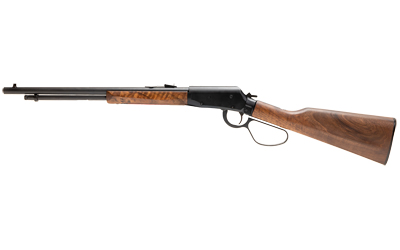
Savage Revel Classic Lever .17 HMR 18″ Walnut
Video review
Expert review
About this product
The Savage Revel Classic Lever .17 HMR 18″ Walnut is a modern takedown lever-action rimfire rifle chambered for the flat-shooting .17 HMR cartridge. It represents a deliberate fusion of traditional walnut-and-steel aesthetics with contemporary engineering solutions aimed at practical field transport. This is not a replica or a retro design—it’s a purpose-built tool for shooters who need a compact, precise small-game rifle that doesn’t sacrifice classic handling.
What is the Savage Revel Classic used for?
The Revel Classic is primarily a small-game and varmint hunting rifle, engineered for shots out to 150 yards where shot placement and minimal pelt damage are critical. Its .17 HMR chambering delivers consistent, high-velocity performance on animals like prairie dogs and raccoons, while the 18″ medium-profile barrel balances maneuverability in brush with the necessary sight radius for off-hand shots. The toolless takedown function cuts the overall length by roughly 12 inches, making it packable for hunters on the move.
How does it compare to a Henry Golden Boy .17 HMR?
The Revel Classic prioritizes modern utility and packability, while the Henry Golden Boy emphasizes traditional craftsmanship and heft. Where the Henry uses a solid steel receiver and a 20″ octagonal barrel for classic looks and a smoother action, the Revel Classic employs an aluminum receiver and an 18″ round profile barrel to achieve a weight savings of over 1.5 pounds for easier carry. For a hunter needing a truck or ATV gun that breaks down fast, the Revel is better; for a shooter wanting a heirloom-quality plinker, the Henry is superior. For another modern, lightweight hunting option, consider the Stevens 334 in .308 Win.
What does it weigh and what are the dimensions?
The rifle weighs 6.1 pounds (98 ounces or 2.77 kg) and measures 36.5 inches in overall length. The 18-inch carbon steel barrel has a 1:9″ twist rate, which is the standard for stabilizing the 17- and 20-grain .17 HMR projectiles. When disassembled via the toolless takedown, the two main components are roughly 24 inches and 18 inches long, allowing it to fit into a standard backpack or a compact gun case.
Who is this NOT for?
This rifle is not for the shooter seeking a high-volume, rapid-fire plinking experience or a dedicated suppressor host. The .17 HMR cartridge is relatively expensive compared to .22 LR, making sustained fire cost-prohibitive. Furthermore, while the receiver is drilled and tapped, its aluminum construction means repeated scope mounting and removal could eventually compromise thread integrity more readily than a steel receiver would—a critical consideration for those who frequently swap optics.
What's in the box?
You receive the rifle in a single configuration: the barreled action is mated to the satin walnut stock. Ironclad Armory ships it with the factory-installed adjustable iron sights zeroed from the factory at 50 yards. The box includes a standard owner's manual and a warranty card, but does not include any optics, mounting hardware, or a case—those are separate purchases. Plan for an additional $50-$100 for a basic scope and rings.
Is the Savage Revel Classic worth it at $443.99?
At $443.99, the Revel Classic occupies a competitive mid-point between budget bolt-actions and premium lever guns, justifying its price with the unique takedown feature and walnut stock. You are paying for the engineering of a reliable, tool-free takedown mechanism, which adds approximately $75-$100 over a fixed-structure lever gun. If your primary use case involves frequent packing into a blind or a vehicle storage box, this feature alone makes it worth the price. For those who mostly shoot from a bench, a standard bolt-action like the Stevens 334 in .243 Win may offer better inherent accuracy for less money.
Specs at a glance
Pros & cons
What works
- Toolless takedown design reduces overall length by 12+ inches for pack storage
- Weighs 6.1 lbs — over 1.5 lbs lighter than a comparable Henry Golden Boy .17 HMR
- 18" barrel with 1:9" twist perfectly stabilizes standard 17- and 20-grain .17 HMR loads
- Drilled and tapped aluminum receiver accepts optics without aftermarket machining
Trade-offs
- Aluminum receiver is less durable for repeated scope mount/dismount than steel
- No factory threading for suppressors — adds $150-$200+ for gunsmithing
- .17 HMR ammunition costs ~$0.25/round vs. $0.08 for .22 LR, raising practice costs
- Action is functional but not as slick or refined as a higher-end lever gun like a Marlin
Key attributes
| upc | 062654462009 |
| manufacturer | Savage |
| manufacturer part number | 46200 |
| action | Lever Action |
| atf type | SPORTING RIFLE |
| barrel finish | Black |
| barrel length | 18" |
| caliber/gauge | .17 HM2 |
| capacity | 9 + 1 |
| color | Black |
| model | Revel |
| package height | 3.3 |
| package width | 8.3 |
| product type | Rifle |
| safety | Crossbolt |
| shipping weight | 0.0 |
| sights | Adj Iron |
Frequently asked questions
- Is it compatible with Picatinny/Weaver scope mounts?
- Yes, the aluminum receiver is drilled and tapped with a standard 6-48 thread pattern, which is compatible with most Weaver- and Picatinny-spec scope bases for small-frame rifles. You will need separate base rings; I recommend a one-piece base from EGW or Warne for maximum stability on the aluminum receiver.
- Does it fit in a standard rifle case?
- When assembled (36.5" long), it requires a case with an internal length of at least 38 inches. When disassembled via the takedown, the two main components can fit in a compact 26-inch case or a large backpack, reducing its storage footprint by nearly 40%.
- How long does shipping take?
- Ironclad Armory processes all firearm orders within 2 business days for FFL verification. Once shipped, ground transit typically takes 3-5 business days to your selected FFL holder. The total timeline from order to FFL pickup is usually 7-10 business days, barring any state-specific waiting periods.
- Can I return it if there's a mechanical issue?
- Ironclad Armory accepts returns for factory defects within 30 days of your FFL pickup, but the firearm must be unfired and in original packaging. For any mechanical issues discovered after firing, you must contact Savage Arms directly for warranty service, which typically involves a 4-6 week turnaround for evaluation and repair.
- Does this work with a .17 HMR suppressor?
- The barrel is not threaded from the factory, so direct suppressor attachment is not possible without aftermarket gunsmithing. You would need to have the barrel professionally threaded, which costs approximately $150-$200 and could affect warranty coverage, making it a poor candidate as a dedicated suppressor host compared to factory-threaded options.