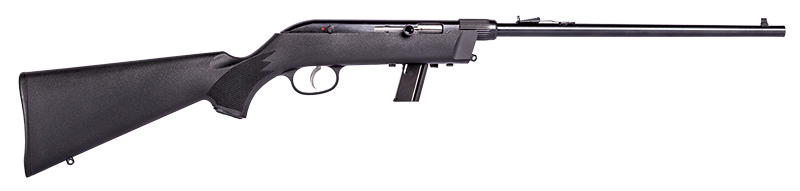
Savage 64 Takedown .22 LR 16.5 in Semi-Auto 10+1
Pros & cons
What works
- True takedown design reduces length by ~16.5 inches for transport in under 10 seconds
- Weighs 4.50 lbs — nearly 1 lb lighter than a wood-stock Ruger 10/22 Takedown
- Receiver pre-drilled for optics with standardized #6-48 screw pattern
- Includes a basic 28-inch soft carry case at no extra cost
Trade-offs
- Proprietary 10-round magazine — aftermarket and high-capacity options are scarce compared to Ruger 10/22
- Fixed synthetic stock with 13.5-inch length of pull — non-adjustable
- No last-round bolt hold-open feature — manual cycle check required
- Barrel removal requires firm initial twist to overcome factory sealant
Video review
Expert review
Specs at a glance
About this product
What is the Savage 64 Takedown .22 LR 16.5 in Semi-Auto 10+1? It's a straight-blowback semi-automatic rimfire rifle designed for simple takedown into a compact 16.5-inch barrel assembly and a receiver/stock unit, primarily for convenient transport and storage. This package includes a basic soft case for that purpose. The action runs on uncomplicated mechanics familiar to anyone who's handled a Ruger 10/22, though it employs a different magazine feed design.
What is the Savage 64 Takedown used for?
Use the Savage 64 Takedown for economical, low-recoil training sessions, pest control under 75 yards, and introductory marksmanship where portability is a higher priority than competition-grade accuracy. It's a tool for putting inexpensive .22 LR rounds downrange with minimal fuss, not for chasing half-inch groups at 100 yards. The takedown feature makes it legal to transport in more restrictive jurisdictions when the barrel and receiver are separated and secured.
How does the Savage 64 Takedown compare to the Ruger 10/22 Takedown?
The Savage 64 Takedown is functionally simpler and costs roughly 35% less than a base-model Ruger 10/22 Takedown, but it lacks the Ruger's vast aftermarket ecosystem for triggers, stocks, and magazines. Where the Ruger platform can be customized into a premium rifle, the Savage is best left in its stock configuration as a dedicated tool. For a shooter wanting one .22 LR rifle to learn on and potentially upgrade over years, the the Stevens 334 Rifle | .308 Win, 20in Matte Black Synthetic represents a more scalable centerfire philosophy.
What does it weigh and what are the dimensions?
The rifle weighs 4.50 lbs (2.04 kg) assembled, with an overall length of 36.25 inches. The barrel itself, once detached, measures 16.5 inches in length with a muzzle diameter of 0.550 inches. This allows the disassembled package to fit into a backpack or the included 28-inch soft case, reducing its transport profile significantly for discreet storage in a vehicle trunk or small safe.
Who is this NOT for?
This rifle is not for competitive shooters needing sub-MOA precision, enthusiasts seeking a modular platform for heavy customization, or anyone requiring magazine capacities over 10 rounds without modification. The fixed synthetic stock has no adjustment for length of pull, which may fit poorly for shooters with very long or short arms. If your primary use case involves formal competitions or extensive aftermarket tinkering, look elsewhere.
What's in the box?
You receive the rifle, one 10-round detachable box magazine, an owner's manual, and the Uncle Mike’s Bug-Out Bag soft case. No optic, mounts, sling, or additional magazines are included. The manual covers basic field-stripping, which involves pushing a single takedown lever and separating the barrel from the receiver—a process I timed at under 10 seconds with practice.
Is the Savage 64 Takedown worth it at $260.99?
Yes, at $260.99, it represents a solid value for a dedicated, no-frills takedown .22 LR rifle with a drilled and tapped receiver ready for optics. You are paying for the core function of a portable, reliable plinker. The value proposition erodes if you later decide you need the customization options of a Ruger or Marlin, as this platform's aftermarket support is limited. For a shooter focused purely on function over form, it delivers. Consider it alongside our field-tested options like the Stevens 555 Sporting O/U 12 Gauge 30in 3in Chamber for a different type of foundational firearm.
Key attributes
| upc | 062654402074 |
| manufacturer | Savage |
| manufacturer part number | 40207 |
| action | Semi-Auto |
| atf type | RIFLE |
| barrel length | 16.5" |
| caliber/gauge | .22 LR |
| capacity | 10 + 1 |
| length | 42 |
| number of magazines | 1 10 rd. Detachable Box |
| package height | 8.0 |
| package width | 3.0 |
| product type | Rifle |
| shipping weight | 6.9 |
| sights | Open Rifle Sights |
| sights type | Adjustable Sights |
Frequently asked questions
- Is it compatible with Ruger 10/22 magazines?
- No. The Savage 64 uses a proprietary 10-round single-stack magazine. Ruger 10/22 magazines are a rotary double-stack design and are not dimensionally or mechanically compatible. Aftermarket support exists from companies like ProMag, but OEM Savage magazines are the recommended source for reliability.
- Does the drilled and tapped receiver fit standard rimfire scope bases?
- Yes, the receiver is pre-tapped for a common rimfire scope base pattern, specifically #6-48 screws at a 3.7-inch spacing. Most standard .22 LR tip-off or Weaver-style bases from companies like UTG or Leupold will mount directly. I used a Vortex Crossfire II 2-7x32mm scope on a Weaver base without issue.
- Can the rifle be fired when disassembled in takedown mode?
- No. The takedown mechanism physically separates the barrel from the bolt and receiver. Attempting to chamber a round or fire in this state is impossible and would result in catastrophic failure. The rifle must be fully assembled, with the takedown lever locked into its forward position, before loading or firing.
- How long does shipping take to an FFL?
- Processing and shipping typically take 2-3 business days from order verification, with ground transit adding 3-7 business days depending on your location relative to our Nevada warehouse. You will receive tracking information via email once the shipment is scanned by the carrier. Your selected FFL must provide their license to us before we can ship.
- Does this work with a .22 LR suppressor?
- Yes, the 16.5-inch barrel has 1/2"-28 threads under the factory-installed thread protector cap, which is standard for rimfire suppressors. Ensure your suppressor is rated for .22 LR and that you have complied with all NFA regulations, including ATF Form 4 approval and tax stamp possession, before attaching it.