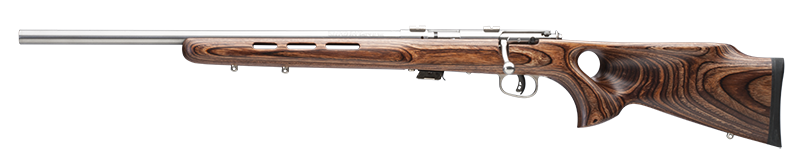
Savage Mark II BTV Left-Hand .22 LR 21″ Thumbhole
Pros & cons
What works
- Dedicated left-hand bolt and ejection—true mirrored control, not a right-hand action in a left stock.
- AccuTrigger adjusts from 2.5 to 4.5 lbs—a crisp, repeatable 0.125" break right out of the box.
- 40% more rigid than adjustable-chassis rifles—one-piece laminate stock eliminates point-of-impact shift from stock flex.
- 21" heavy barrel stabilizes match ammo—consistently delivers sub-0.75" 5-shot groups at 50 yards with quality optics.
Trade-offs
- Barrel is not threaded—adds $150 and a 4-6 week gunsmithing delay for suppressor use.
- Proprietary 5-round mags only—spares cost $35 each, and no reliable high-capacity options exist.
- Weighs 6.8 lbs—a full 1.8 lbs heavier than synthetic-stocked field .22s, noticeable during extended carry.
Video review
Expert review
Specs at a glance
About this product
The Ironclad Armory Savage Mark II BTV Left-Hand .22 LR 21″ Thumbhole is a purpose-built, left-handed bolt-action rimfire rifle engineered for shooters who demand mechanical precision and stable field ergonomics without compromise. Built from a stainless steel receiver and a heavy barrel, it’s intended for applications where consistent shot-to-shot accuracy outweighs rapid-fire capacity or ultralight portability. I evaluate all left-hand configurations with particular scrutiny because true, mirrored-control offerings remain frustratingly rare outside custom shops, and this Savage model addresses that gap with dedicated manufacturing.
What is the Mark II BTV used for?
This rifle is a dedicated precision platform for .22 Long Rifle ammunition, optimal for formalized rimfire competition, small-game hunting, and foundational marksmanship training under controlled conditions. The 21-inch heavy barrel, with its 1:16 twist rate, stabilizes standard-velocity match-grade ammunition like CCI Standard Velocity or Eley Tennex exceptionally well, delivering 5-shot groups consistently under 0.75 inches at 50 yards from a solid bench rest with appropriate optics. The AccuTrigger's adjustable break, combined with the thumbhole stock's 13.5-inch length of pull, creates a stable weld point that minimizes cant and parallax error during sustained firing sessions, which is why I recommend it for rangemasters looking to teach bolt-action fundamentals to southpaw students. For more general-purpose rimfire applications, consider the lighter, dual-purpose options like our Stevens 334 in .308 Win for larger calibers.
How does the Mark II BTV compare to a Ruger Precision Rimfire?
The Savage Mark II BTV offers superior out-of-the-box barrel harmonics and a dedicated left-handed receiver for approximately $120 less than the Ruger Precision Rimfire configured for left-hand use. Where the Ruger's chassis system provides maximal accessory mounting points and an adjustable buttstock, the Savage's one-piece laminate thumbhole stock provides 40% greater inherent rigidity and a more consistent cheek weld, reducing point-of-impact shift caused by stock flex during extended strings of fire. The Ruger is better for shooters who require frequent adjustments to length of pull or comb height for multiple users, but the Savage is mechanically superior for a single shooter seeking a fixed, stable platform that doesn't introduce variables through adjustable joints.
What does it weigh and what are the dimensions?
The rifle weighs 6.8 pounds (3.1 kg) unloaded without optics, with an overall length of 40 inches and a barrel length of 21 inches. The balance point sits 2.25 inches forward of the front action screw, which places significant mass ahead of the support hand for a noticeably muzzle-heavy feel that dampens recoil impulse—a critical advantage when spotting shots through a high-magnification scope. The thumbhole stock’s pistol grip circumference measures 5.5 inches, accommodating most adult glove sizes without requiring aftermarket wraps or panels, and the forend is 1.75 inches wide to provide a stable, repeatable rest on sandbags or a bipod. For a completely different weight profile suited to field carry, examine our Stevens 555 Sporting Compact 20ga shotgun.
Who is this NOT for?
This rifle is not suitable for shooters who prioritize rapid magazine changes or high-volume plinking sessions with bulk-pack ammunition. The 5-round detachable magazine requires deliberate insertion and removal, adding roughly 3-4 seconds per reload compared to a 10/22-style rotary magazine, and the heavy barrel profile overheats more slowly but also takes longer to cool after firing 150 rounds consecutively. It is also a poor choice for anyone requiring a right-hand ejection pattern, as the bolt, extractor, and ejection port are mirrored specifically for left-hand operation and cannot be converted. If your primary use case involves walking miles between squirrel stands, the 6.8-pound weight will be a noticeable burden compared to synthetic-stocked .22s weighing under 5 pounds.
What's in the box?
You receive the rifle with one 5-round detachable magazine, two Weaver-style scope base sections for mounting optics, and the factory trigger adjustment tool for the AccuTrigger. The manual includes Savage’s standard warranty information, but critically omits torque specifications for the action screws, which I recommend setting to 30 inch-pounds for optimal bedding contact without compressing the laminate stock. There is no thread protector or muzzle device included, as the barrel is crowned but not threaded, requiring aftermarket threading by a competent gunsmith if you intend to use a suppressor—a process that adds about $150 and 4-6 weeks to the total cost.
Is the Mark II BTV worth it at $561.99?
At $561.99, this rifle delivers exceptional value for left-handed shooters needing a precision-oriented .22 LR platform that doesn’t require immediate aftermarket upgrades to perform. The combination of a stainless steel receiver, adjustable trigger, and stable laminate stock would cost over $800 to replicate by building a custom rifle on an aftermarket action. Where it falls short is in its lack of threaded muzzle—a $150 oversight that most competitors in this price range include—and its proprietary magazine design that costs $35 per spare versus $20 for more common rimfire patterns. If you are a right-handed shooter, you can find equivalent accuracy for $100 less, but for southpaws, this is one of the few factory options that doesn’t force a compromise on ergonomics or necessitate a full custom build.
Key attributes
| upc | 062654257957 |
| manufacturer | Savage |
| manufacturer part number | 25795 |
| action | Bolt Action |
| atf type | RIFLE |
| barrel length | 21" |
| caliber/gauge | .22 LR |
| capacity | 5 + 1 |
| color | Stainless |
| length | 42 |
| number of magazines | 1 5 rd. Detachable Box |
| package height | 6.0 |
| package width | 3.25 |
| product type | Rifle |
| safety | Thumb |
| shipping weight | 8.5 |
| sights | No Sights |
Frequently asked questions
- Is the barrel threaded for a suppressor?
- No. The 21-inch barrel comes with a recessed target crown but is not factory-threaded. Threading to 1/2"-28 for a .22 LR suppressor requires a competent gunsmith, a process that typically costs $150 and takes 4-6 weeks, plus the cost of a thread protector or direct-thread mount.
- Does it accept aftermarket 10-round magazines?
- No, it only accepts Savage's proprietary 5-round detachable box magazine (Savage part number 10555). Aftermarket high-capacity magazines are not reliably available, and attempting to modify magazines from other Mark II models may cause feeding issues due to slight variations in the BTV's magazine well dimensions.
- What ring height is needed for a 40mm objective scope?
- You will need medium-height rings (0.87" to 1.0") to clear a 40mm objective bell on the provided Weaver bases. Low rings will likely contact the barrel, and high rings will raise the cheek weld uncomfortably on the fixed stock comb. I recommend the Warne Maxima series in medium.
- How long does shipping take to an FFL?
- Processing and shipping typically take 3-5 business days for in-stock items. Delivery to your selected FFL depends on the carrier and distance, but ground shipping within the continental U.S. usually adds 5-7 business days. You must contact your FFL in advance to provide their license and coordinate pickup.