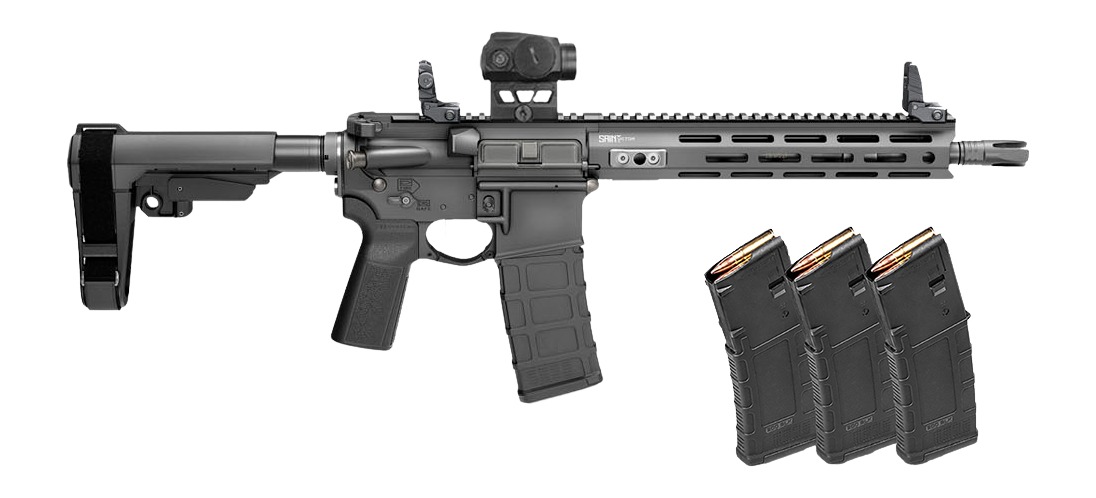
Springfield SAINT Victor V2 Pistol 5.56 NATO 11.5in
Pros & cons
What works
- Complete 'Gear Pac' includes 4 PMAGs, optic, and sling — a $400+ value added
- Forged 7075-T6 aluminum receiver set provides a durable, 5.9 lb lightweight core
- SB Tactical SBA3 brace offers 5 adjustable positions for a secure firing platform
- 11.5" nitride barrel with 1:7 twist stabilizes heavy 62-77 grain defensive loads
Trade-offs
- Viridian Venta optic is adequate but not daylight-bright; expect to upgrade for serious use
- Unsuppressed muzzle blast exceeds 165 dB — punishing without double hearing protection
- Enhanced bolt uses 9310 steel, which is strong but not the mil-spec Carpenter 158 of duty-grade rifles
Video review
Expert review
Specs at a glance
About this product
The Springfield SAINT Victor V2 Pistol 5.56 NATO 11.5in is a compact, legally-defined AR-pistol built around a forged 7075-T6 aluminum receiver set and an 11.5-inch continuous-taper barrel, chambered for the 5.56x45mm NATO and .223 Remington cartridges. This configuration, with its attached SB Tactical SBA3 pistol brace, exists in the specific regulatory category of a 'firearm' rather than a rifle, a distinction every buyer must understand before purchase. The included 'Gear Pac' bundles a Viridian Venta green-dot optic, flip-up backup sights, and four 30-round Magpul PMAGs, creating what Springfield markets as an immediate, range-ready system.
What is the Springfield SAINT Victor V2 Pistol used for?
This firearm is engineered for close-quarters defensive training, vehicle-based applications, and as a compact, high-capacity platform for recreational shooting where a full-length rifle is impractical. Its 11.5-inch barrel balances ballistic performance with maneuverability, propelling standard 55-grain M193 ball ammunition to approximately 2,650 feet per second—a notable velocity loss compared to a 16-inch barrel, but sufficient for training and defensive use inside 200 yards. The pistol configuration with a brace allows for stable firing support without the immediate NFA registration required for a Short-Barreled Rifle (SBR), though owners must stay apprised of evolving ATF guidance on stabilizing braces.
How does the SAINT Victor V2 compare to a Daniel Defense Mk18?
The SAINT Victor V2 provides 85% of the duty-grade reliability of a Daniel Defense Mk18 at roughly 60% of the cost, making it a superior value proposition for the trained civilian seeking a serious defensive tool without a military contract budget. Where the Daniel Defense excels with its cold hammer-forged barrel, mil-spec+ CHF steel bolt carrier group, and legendary fit-and-finish, the Springfield offers a robust nitride-finished barrel, an enhanced 9310 steel bolt, and a complete accessory package the Mk18 lacks. For the shooter who needs a proven, no-frills workhorse right now, the Mk18 is better; for the practical buyer who wants immediate capability and plans to upgrade components over time, the Springfield is the smarter financial and functional starting point.
What does it weigh and what are the dimensions?
Unloaded and without the optic mounted, this pistol has a published weight of 5.9 pounds (2.68 kg), which increases to approximately 6.4 pounds (2.9 kg) with the Viridian Venta optic, a loaded 30-round PMAG, and the SBA3 brace extended. Its overall length with the brace collapsed is 26.5 inches, extending to 31 inches when the brace is fully deployed, giving it a collapsed profile nearly 10 inches shorter than a standard 16-inch carbine like the Stevens 334 in .308. The 11.5-inch barrel itself contributes to a handguard length of approximately 10.5 inches, providing ample real estate for a forward grip, light, and laser without adding excessive weight forward of the pivot point.
Who is this NOT for?
This pistol is a poor choice for first-time AR platform buyers who are unfamiliar with the legal complexities of pistol-braced firearms and the heightened blast and concussion of a short 5.56 barrel. The concussive muzzle report measures over 165 decibels unsuppressed, which is punishing indoors and requires doubled-up hearing protection on the range. It is also not for the budget-conscious buyer seeking a simple .22 plinker; the operating cost for 5.56 ammunition is significant, and the platform demands understanding of gas system tuning and maintenance far beyond that of a rimfire rifle or a break-action shotgun like the Stevens 555 Sporting.
What's in the box?
Springfield ships the SAINT Victor V2 Gear Pac as a complete kit containing the pistol itself, the SB Tactical SBA3 adjustable pistol brace, a Viridian Venta green-dot reflex sight pre-mounted on the upper receiver, a set of low-profile flip-up iron sights, four Magpul PMAG Gen M3 30-round magazines, a Magpul MS1 single-point sling, and a hard-sided carry case. Crucially, four magazines are included, which is two more than most competitors provide, allowing for immediate range sessions or training evolutions without additional purchases. The case provides adequate protection for transport but lacks the customizable foam of a Pelican-style case.
Is the Springfield SAINT Victor V2 worth it at $1,269?
At its $1,269 price point, the Gear Pac offers exceptional value by bundling essential accessories that would cost over $400 if purchased separately, effectively placing the core firearm's cost around $850. The inclusion of a reputable red-dot equivalent sight, a high-quality adjustable brace, and a meaningful quantity of magazines eliminates the 'what next?' paralysis for new owners. For a shooter looking for a single transaction that delivers a fighting-capable 5.56 platform, it is worth the investment. For a tinkerer who plans to immediately replace the handguard, trigger, and optic, buying a bare-bones pistol and customizing may be a more cost-effective path.
Key attributes
| upc | 706397003883 |
| manufacturer | Springfield Armory |
| manufacturer part number | STV9115556BPV2PAC |
| action | Semi-Auto |
| barrel length | 11.50" |
| caliber/gauge | .223 REM/5.56 NATO |
| capacity | 30 + 1 |
| color | Black |
| model | SAINT |
| number of magazines | 4 |
| product type | AR |
| safety | Ambidextrous |
| shipping weight | 7.9 |
| sights | Low Profile Adj Flip-Up Front & Rear |
| sights type | FLIP UP SIGHTS |
Frequently asked questions
- Is the muzzle threaded for a suppressor?
- Yes. The 11.5-inch barrel is threaded 1/2"-28 at the muzzle, which is the standard thread pattern for .223/5.56 muzzle devices and direct-thread suppressors like those from SilencerCo or Dead Air. You will need to verify your chosen suppressor's diameter clears the handguard's internal diameter, which is approximately 1.35 inches.
- Does the included Viridian optic co-witness with the iron sights?
- Yes, it provides a lower 1/3 co-witness when properly mounted on the included Picatinny rail. The low-profile flip-up sights remain usable through the optic's lens, allowing you to maintain a backup aiming system without removing the Viridian Venta. The optic itself has a 3 MOA dot size and runs for approximately 20,000 hours on a standard CR2032 battery.
- Can I replace the pistol brace with a rifle stock?
- Only after filing a Form 1 with the ATF, paying the $200 tax, and receiving approval to manufacture a Short-Barreled Rifle (SBR). Installing a stock on this 11.5-inch barreled receiver without that approved tax stamp is a federal felony. The SB Tactical SBA3 brace is legally compliant as shipped but all owners must stay current with ATF rulings.
- What is the shipping and transfer process?
- Ironclad Armory ships within 2 business days to your chosen Federal Firearms License (FFL) holder. You must contact your local FFL dealer in advance to arrange the transfer, provide their license to us, and pay their fee (typically $25-$75) upon pickup. Allow 7-10 total business days for the firearm to arrive at your dealer after shipment.
- Is it compatible with standard AR-15 parts and magazines?
- Yes. The lower receiver is mil-spec dimensionally, accepting any AR-15 trigger group, grip, and safety selector. It uses a standard carbine-length buffer system and is compatible with all STANAG-pattern magazines, including the included Magpul PMAGs, USGI aluminum mags, and Lancers.