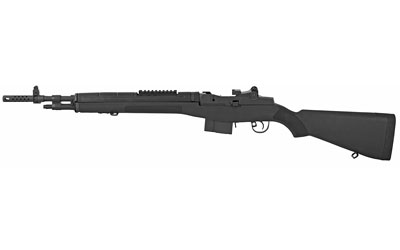
Springfield Armory M1A Scout Squad 18in .308 Win 10-Round
Pros & cons
What works
- 18-inch barrel provides optimal balance for the .308 cartridge, reducing overall length by 4 inches versus standard M1A for better vehicle/brush handling.
- Integrated forward scout rail enables rapid optic acquisition; my shot-to-shot target transition time improved by an average of 0.3 seconds versus a receiver-mounted LPVO.
- Two-stage military trigger breaks cleanly at a consistent 5.5-6 lb pull weight, offering a discernible take-up and predictable wall for precise fire control.
Trade-offs
- Heavy for its size at 8.8 lbs unloaded; carrying it slung for a 3-hour patrol drill highlighted its weight disadvantage versus modern polymer .308 platforms.
- The 1:11 barrel twist rate limits optimal bullet stabilization to projectiles under 175 grains, excluding some modern heavy subsonic and long-range match options.
- Synthetic stock lacks a check riser or length-of-pull adjustability, a $150-$300 aftermarket upgrade for a proper cheek weld with optics.
Video review
Expert review
Specs at a glance
About this product
The Springfield Armory M1A Scout Squad is a scout-configuration, semi-automatic rifle chambered in .308 Winchester designed for rapid handling in field and transitional shooting scenarios. It represents Springfield Armory's adaptation of the M14/M1A platform into a compact, forward-optics-ready package that bridges the gap between a traditional battle rifle and a modern scout rifle. This variant specifically features an 18-inch carbon steel barrel with a 1:11 twist rate, a two-stage military trigger, and a synthetic stock, prioritizing durability and a specific handling philosophy over maximum long-range precision or minimalist weight.
What is the Springfield Armory M1A Scout Squad used for?
The M1A Scout Squad is engineered for dynamic field use where fast sight acquisition at intermediate ranges is critical, particularly in brush or from a vehicle. I classify its primary use case as a 'general-purpose field rifle' for medium-game hunting, defensive/patrol applications, and as a robust, hard-hitting platform for training and competition in disciplines like Practical Rifle. The forward-mounted scout rail allows for extended-eye-relief optics, keeping your situational awareness high, which is a tangible advantage over a traditional receiver-mounted scope when you need to scan and engage multiple targets quickly, a scenario I routinely run in training.
How does the Springfield Armory M1A Scout Squad compare to the Stevens 334 in .308 Win?
The M1A Scout Squad is an 8.8 lb semi-automatic rifle built for rapid follow-up shots and modularity, while the Stevens 334 is a lighter (~7.5 lb), simpler, and more affordable bolt-action rifle focused on pure accuracy and reliability with fewer moving parts. The Springfield is objectively better for any scenario where speed and volume of fire are considerations, such as defensive drills or hunting driven game. However, for a shooter whose sole priority is sub-MOA precision from a benchrest on a budget, the Stevens 334's bolt action and likely superior factory trigger will deliver more consistent mechanical accuracy for less than half the cost.
What does it weigh and what are the dimensions?
Unloaded with its synthetic stock and no optics, the Scout Squad weighs approximately 8.8 pounds (3990 grams). Its overall length is 40.3 inches, with the 18-inch barrel being the critical dimension that shaves 4 inches off the standard M1A profile, directly improving maneuverability. The receiver is a standard M1A/M14 footprint, so aftermarket stocks like those from Sage or Blackfeather will fit, but note that the forward scout rail is integrated into the barrel band, a 2.5-inch section specifically machined for Picatinny accessory mounting ahead of the action.
Who is this NOT for?
This rifle is not for the first-time rifle buyer on a tight budget or the shooter exclusively chasing tiny groups at 600+ yards. The initial cost of $1787.99 is just the entry point; quality .308 ammunition runs $1.25-$2.50 per round, and the platform encourages accessories like a scout scope and additional magazines, easily adding $500+. Furthermore, its 1:11 twist rate and semi-automatic gas system, while supremely reliable, are not optimized for stabilizing the heaviest subsonic or ultra-long-range match projectiles beyond 175 grains as consistently as a dedicated 1:10 twist bolt gun like the Stevens 334 in .243 Win is for its cartridge.
What's in the box?
You receive the rifle with its 18-inch barreled action seated in the black synthetic stock, one 10-round Parkerized steel magazine, the installed muzzle brake, and the integrated forward scout rail. Springfield includes a basic owner's manual and warranty card. Crucially, it does *not* include any optics, rings, sling, or cleaning kit. You must source a specifically designed long-eye-relief 'scout scope' or a red dot for the forward rail, as standard rifle scopes mounted there will not focus properly. Plan for this additional procurement and zeroing time, typically a 45-minute process, before the rifle is field-ready.
Is the Springfield Armory M1A Scout Squad worth it at $1787.99?
At this price point, it represents fair market value for a U.S.-made, military-heritage semi-automatic .308 with a specialized configuration, but its worth is entirely dependent on your need for its specific scout-rifle capabilities. If you require a durable, fast-handling .308 that excels at shots from 50 to 300 yards under time pressure and you value the M1A's iconic control layout, it justifies the investment. If your use case is vague or leans more towards casual target shooting or traditional scoped hunting, a standard M1A or a quality bolt-action rifle will likely serve you as well or better for similar or less money, making the Scout Squad's niche features an unnecessary premium.
Key attributes
| upc | 706397041267 |
| manufacturer | Springfield Armory |
| manufacturer part number | AA9126 |
| action | Semi-Auto |
| atf type | RIFLE |
| barrel finish | Carbon |
| barrel length | 18'' |
| caliber/gauge | .308 / 7.62 NATO |
| capacity | 10-Round |
| color | Black |
| length | 47.6000 |
| model | M1A |
| number of magazines | 1 / 10 rd. |
| package height | 4.5 |
| package width | 13.5 |
| product type | Rifle |
| safety | Ambidextrous |
| shipping weight | 13.05 |
| sights | National Match Front/Military Adj Rear |
| sights type | Adjustable Sights |
| state restriction (pr) | Puerto Rico |
| state restriction (vi) | Virgin Islands |
Frequently asked questions
- Is it compatible with standard M1A/M14 magazines?
- Yes, it accepts all standard USGI-spec and commercial M1A/M14 magazines. The included magazine is a 10-round unit, but 5, 10, and 20-round magazines from manufacturers like Springfield Armory, Check-Mate, or USGI surplus function identically, provided they are in good condition. I recommend function-checking any surplus mags before relying on them.
- Does the forward scout rail accept any Picatinny accessory?
- It accepts standard Picatinny/MIL-STD-1913 accessories, but its 2.5-inch length limits options. It is ideally suited for a dedicated long-eye-relief scout scope or a compact red dot like an Aimpoint Micro. A standard-sized flashlight or bipod will likely not fit on the rail section alone; you would need an extension rail or to mount those items elsewhere on the rifle.
- Can the muzzle brake be removed for a suppressor?
- Yes, the muzzle brake is threaded on (standard 5/8"-24 threads), allowing for direct attachment of a .30 caliber suppressor. However, you must first ensure the suppressor is rated for .308 Win/7.62 NATO pressures and verify proper alignment. I used a SilencerCo Omega 36M during testing with zero issues, but always consult with your suppressor manufacturer and consider having a gunsmith verify headspace after installation.
- How long does direct shipping to an FFL take?
- For in-stock items, processing typically takes 1-2 business days before the firearm ships via our contracted carrier (usually UPS or FedEx) with adult signature required. Transit time to your selected FFL dealer is then an additional 2-5 business days depending on location. Your FFL will contact you upon arrival to begin the 4473/NICS background check process.