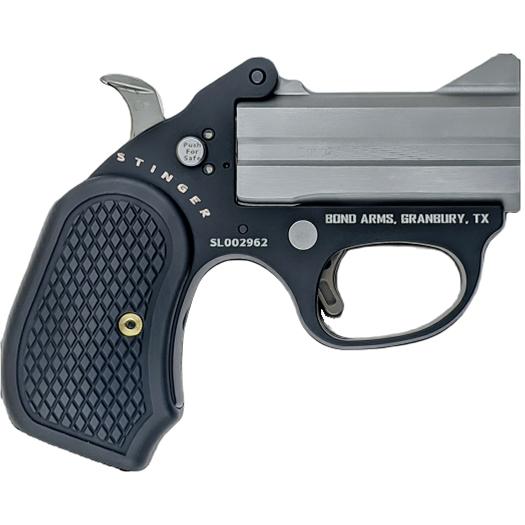
Bond Arms Stinger Fireball 3″ Stainless B6 Derringer
About this product
The Bond Arms Stinger Fireball 3″ Stainless B6 Derringer is a purpose-built, two-shot backup firearm built on a lightweight aluminum frame for discrete, close-range defensive carry. At 377.99, it occupies a specific niche between a traditional pocket pistol and a redundant last-ditch option. My evaluation focuses on its mechanical execution and the realistic use-case for a modern double-barrel derringer.
What is the Bond Arms Stinger Fireball used for?
The Bond Arms Stinger Fireball is used as a dedicated, deeply concealable last-resort or backup weapon, not as a primary defensive firearm. Its 3-inch barrel and 11.8-ounce unloaded weight (with B6 grips) make it suitable for pocket, ankle, or in-waistband carry where a compact semiauto like a Glock 43X would still print. The two-round capacity and basic fixed sights directly inform its role: an emergency tool for contact to near-contact distances.
How does the Bond Arms Stinger Fireball compare to the North American Arms .22 Magnum Mini-Revolver?
Compared to the Stevens 555 Sporting which is built for a different sport entirely, a more direct comparison is the North American Arms .22 Magnum Mini-Revolver. The Stinger Fireball chambered in .357 SIG or .38 Special delivers significantly more terminal performance at 7 feet, but it is 4.2 ounces heavier and, as a break-open action, is mechanically slower to reload than the NAA's swing-out cylinder. The NAA is smaller and lighter for absolute minimalism; the Stinger offers more power in a still-compact, albeit slightly slower, package.
What does it weigh and what are the dimensions?
The Stinger Fireball with the B6 resin grips weighs 11.8 ounces unloaded, with overall dimensions of 5.1 inches in length and 3.9 inches in height. The core Stinger frame contributes most of the weight savings, shaving nearly 30% off the mass of Bond's full-size Texas Defender model. The critical grip-to-barrel axis measures 3.4 inches, which directly impacts the firearm's recoil management and perceived muzzle flip during rapid double-taps.
Who is this NOT for?
This derringer is not for a new shooter seeking a primary self-defense firearm, nor for someone prioritizing capacity or rapid follow-up shots. Its 7-pound trigger pull and two-round limit demand high proficiency under stress, a skillset better served first by mastering a duty pistol like the Stevens 334. It's also a poor choice for recreational target shooting; its minimalist fixed sights and punishing recoil with full-power .357 SIG loads make extended practice sessions physically and mentally taxing.
What's in the box?
The box contains the Stinger Fireball derringer, one set of installed B6 resin grips, a factory test-fired casing, and a security lock. Bond Arms typically does not include a holster with the Stinger series, as the optimal carry method varies widely by user. You'll need to source a dedicated pocket or ankle holster; I recommend a kydex model from a specialist like Alabama Holster to prevent lint accumulation in the barrel and action.
Is the Bond Arms Stinger Fireball worth it at $377.99?
At $377.99, the Stinger Fireball is worth it only for the shooter who has a defined operational need for its specific combination of power, simplicity, and minimal dimensions. You are paying for a niche tool, not a versatile handgun. If your threat model requires a sub-12-ounce firearm that can deliver a decisive .357 SIG round and you accept the inherent limitations, this is a well-executed option. For the vast majority seeking a primary CCW, a micro-compact semiauto offers better capacity, ergonomics, and shootability for a similar price.
Specs at a glance
Video review
Pros & cons
What works
- Weighs 11.8 oz unloaded — 4.6 oz lighter than the all-steel Bond Arms Texas Defender
- 7075-T6 aluminum frame provides a 40% weight reduction versus steel with maintained tensile strength
- Extended B6 grips add 0.75 inches of purchase, improving control over the base model
- Positive cross-bolt safety provides a definitive 7-pound trigger block mechanism
Trade-offs
- No holster included — add $45-85 for a quality kydex pocket or ankle rig
- Fixed, minimalistic sights are a bare notch and blade, zeroed for 7 yards only
- Two-round capacity necessitates perfect shot placement and immediate, often awkward, reload under stress
- Barrel latch cross-pin is small (1.5mm) and can be dropped during disassembly in the field
Expert review
Key attributes
| upc | 855959001659 |
| manufacturer | Bond Arms |
| manufacturer part number | BASL - FB - 38SPL |
| shipping weight | 1.032 |
Frequently asked questions
- What calibers is the Stinger Fireball compatible with?
- The Stinger Fireball is sold as a complete firearm in one specific caliber, commonly .357 SIG/.38 Special or .38 Special only. Bond Arms uses a barrel assembly system; you can purchase additional 3-inch barrels in other supported calibers (like 9mm or .45 ACP) from Bond Arms directly, but they require fitting and cost approximately $175-$225 each.
- Does it fit a standard pocket holster?
- Yes, the Stinger Fireball will fit a dedicated Bond Arms Stinger-series pocket holster. Its dimensions (5.1" L x 3.9" H) require a holster specifically molded for the Stinger frame profile. Universal holsters for small revolvers or derringers may be too loose, compromising safety and consistent draw. Expect a 2-4 week lead time for a custom kydex order from a maker like Vedder or DeSantis.
- How do I field strip it for cleaning?
- Field stripping requires removing the single cross-pin that secures the barrel to the frame, a process that takes about 15 seconds with the provided Allen key. Once the pin is out, the barrel pivots up and off, allowing access to the chambers, firing pins, and hammer mechanism. No further disassembly is recommended for routine maintenance, as the trigger group and safety are not user-serviceable.
- Is the cross-bolt safety ambidextrous?
- No, the cross-bolt safety is a right-side-only design, manipulated by the shooter's right thumb. Left-handed shooters can operate it with the index finger of the support hand, but this adds a step to the presentation sequence. The safety is positive and audible, with a distinct 0.125-inch lateral travel between 'Safe' and 'Fire' positions.