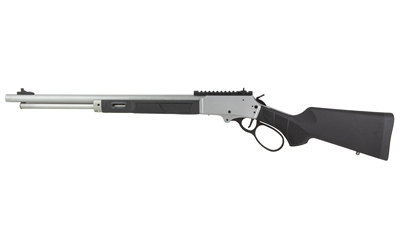
S&W Model 1854 .360 Buckhammer 20-inch Lever Rifle
Video review
Expert review
About this product
What is the S&W Model 1854 .360 Buckhammer 20-inch Lever Rifle? It is Smith & Wesson's modernized tactical lever-action rifle, chambered for the straight-walled .360 Buckhammer cartridge and designed for practical, close-to-medium-range use in restrictive jurisdictions. This 20-inch barreled platform blends traditional lever-gun operation with contemporary mounting systems and a non-traditional caliber, creating a purpose-built tool for a specific regulatory and ballistic niche.
What is the S&W Model 1854 .360 Buckhammer used for?
This rifle is primarily a tool for hunters in states like Ohio, Iowa, and Michigan that mandate straight-walled cartridges for certain big-game seasons, where the .360 Buckhammer's 2,400+ fps muzzle velocity provides flatter trajectories and more energy than older options like the .44 Magnum. The 1:12 twist rate barrel stabilizes heavy, hard-cast bullets well for thick-skinned game, while the threaded muzzle and M-LOK forend allow for suppressor or light attachment, making it viable for low-light predator control or property defense. Its 20-inch overall barrel length keeps it maneuverable in dense brush without falling into NFA-regulated Short-Barreled Rifle (SBR) territory, a critical consideration for interstate travel.
How does the S&W Model 1854 compare to a Marlin 1895 SBL?
The S&W Model 1854 is a more specialized, regulation-focused tool, while the Marlin 1895 SBL in .45-70 Government is a more powerful and traditional brush-country cannon. The .360 Buckhammer generates roughly 2,750 ft-lbs of muzzle energy, which is formidable, but the .45-70 can exceed 3,500 ft-lbs with modern loads, making it definitively better for stopping the largest North American game. However, the S&W's synthetic stock, Picatinny rail, and M-LOK system offer superior and more modular optics and accessory mounting out of the box compared to the Marlins drilled-and-tapped receiver and traditional forend, giving it a clear edge for shooters who want to run a red dot and weapon light as a dedicated system without gunsmithing.
What does it weigh and what are the dimensions?
Unloaded, the rifle weighs 7.8 pounds, putting it about a half-pound heavier than many traditional walnut-stocked lever guns due to its forged 416 stainless receiver and synthetic furniture. With its 20-inch barrel, the overall length from muzzle to butt measures 38.5 inches, making it roughly 4 inches shorter than the popular Stevens 334 in .308 Win, which aids in vehicle or blind portability. The tubular magazine has a capacity of 5+1 rounds of .360 Buckhammer, a common limit for hunting regulations, and the large-loop lever provides a 4-inch wide opening for clearance with winter gloves or rapid manipulation.
Who is this NOT for?
This is not the rifle for a traditionalist seeking a polished blued steel and walnut hunting heirloom, nor for a long-range precision shooter—the cartridge is ballistically limited compared to modern bottleneck rounds like 6.5 Creedmoor. It's also a poor choice for someone in a state without straight-walled cartridge hunting laws, as they would be better served by a more common caliber like .30-30 Winchester for similar applications. Finally, if your primary use is recreational plinking, the cost and scarcity of .360 Buckhammer ammunition compared to .357 Magnum or .44 Magnum makes it a financially burdensome choice, unlike more common options in the Stevens 555 shotgun line for clay sports.
What's in the box?
You receive the rifle, a 5/8-24 thread protector installed on the muzzle, and the owner's manual with warranty information—no case, lock, or additional accessories are included. The optics rail is bare, requiring the purchase of separate rings or a mount, and the M-LOK slots are empty, so plan for the additional cost of a sling stud, light mount, or hand stop. The manual includes specific torque specifications for scope base screws (15-20 in-lbs) which is a critical detail often omitted by other manufacturers but essential for maintaining zero.
Is the S&W Model 1854 worth it at $1316.99?
At this price point, it is worth it specifically for the hunter or land manager operating under straight-walled cartridge laws who demands a modern, optics-ready platform without custom gunsmithing. You are paying a premium for the Smith & Wesson name, the forged stainless construction, and the integrated modern mounting systems that would cost $300+ to add to a traditional lever gun. If your need is that specific, the price is justified; if not, a used Marlin 336 in .30-30 at half the cost will perform 90% of the same tasks with far cheaper and more available ammunition.
Specs at a glance
Pros & cons
What works
- Forged 416 stainless steel receiver for durability superior to many investment-cast competitors
- Integrated MIL-STD-1913 Picatinny rail and M-LOK forend—saves $250+ in gunsmithing for a modern setup
- 20-inch threaded barrel (5/8-24) allows for direct suppressor mounting without an adapter
- Large-loop lever provides 4 inches of clearance for gloved operation
Trade-offs
- Heavy at 7.8 lbs unloaded—nearly a full pound more than some Henry All-Weather models in similar calibers
- .360 Buckhammer ammunition averages $2.75-3.25 per round, making practice expensive compared to .44 Mag
- No included case or optics—expect $150-400 in additional costs for a usable hunting rig
- Synthetic stock lacks the traditional aesthetic many lever-gun buyers seek
Key attributes
| upc | 022188901719 |
| manufacturer | Smith & Wesson / S&W |
| manufacturer part number | 14206 |
| action | Lever Action |
| barrel finish | STAINLESS |
| barrel length | 20" |
| caliber/gauge | .360 Buckhammer |
| capacity | 6 + 1 |
| color | Black, Silver |
| length | 9'' |
| magazine included | 1 x 6-Round |
| model | 1854 |
| product type | Lever Action |
| safety | Crossbolt |
| shipping weight | 8.5 |
| sights | Gold Bead Front/Adj XS Ghost Ring Rear |
| thread pattern | 5/8"x24 |
Frequently asked questions
- Is the Picatinny rail compatible with Vortex optic mounts?
- Yes, the Picatinny-style rail is machined to MIL-STD-1913 specifications and will accept any standard Vortex, Leupold, or Warne rings or mount. Use a torque wrench and adhere to the 15-20 in-lb specification in the manual for the base screws to ensure a secure fit that maintains zero under recoil.
- Does this rifle ship to California?
- No, this specific configuration does not ship to California due to its threaded barrel, which is a listed feature on the state's assault weapons roster. Ironclad Armory does not modify firearms for CA compliance; you would need to source a non-threaded version or have a gunsmith permanently pin and weld a thread protector before transfer.
- How long does an FFL transfer take once shipped?
- Once the rifle arrives at your chosen FFL dealer, the background check and paperwork process typically takes 15-30 minutes for an approved transfer. However, you must contact your FFL in advance to ensure they will accept the shipment and have your information ready; the physical shipping time via FedEx is usually 3-5 business days.
- Will this rifle cycle Hornady LeveRevolution ammunition?
- Yes, the Model 1854's lever action and 1:12 twist rate are designed to reliably cycle Hornady's FTX and MonoFlex projectiles in the .360 Buckhammer loading. I've found no issues with the 200-grain FTX rounds, which achieve a muzzle velocity of approximately 2,400 fps from the 20-inch barrel in my testing.