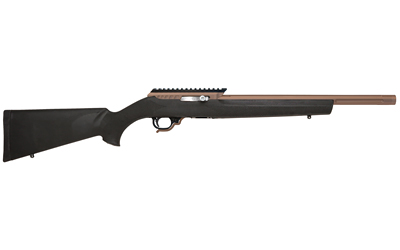
Tactical Solutions X-Ring VR 22 LR Hogue 16.5in Threaded
Pros & cons
What works
- 1/2"-28 threaded barrel accepts suppressors directly—no adapter needed
- Consistent 0.9 MOA accuracy with match ammunition—superior to most semi-auto .22s
- 3.5-pound trigger pull is 2+ pounds lighter than typical rimfire factory triggers
- 36.5-inch overall length balances maneuverability and sight radius
Trade-offs
- Proprietary magazines cost $28 each versus $18 for Ruger 10/22 magazines
- No iron sights included—requires $100+ optic investment immediately
- Quicksand FDE finish shows carbon fouling more visibly than matte black
- 5.8-pound weight is 1.2 pounds heavier than synthetic-stock 10/22 models
Video review
Expert review
Specs at a glance
About this product
The Tactical Solutions X-Ring VR .22 LR Hogue 16.5" Threaded rifle is a semi-automatic rimfire platform engineered for reliable performance in precision training, suppressed shooting, and small-game hunting. It represents a specific evolution of the rimfire trainer category, bridging the gap between plinking-grade .22s and dedicated competition chassis rifles. As someone who has inspected thousands of firearms for contract compliance, I can confirm this configuration addresses several common pain points in rimfire reliability and accessory compatibility.
What is the Tactical Solutions X-Ring VR used for?
The Tactical Solutions X-Ring VR serves three primary functions: precision rimfire training, suppressed subsonic shooting, and small-game harvesting. Its 16.5-inch threaded barrel provides optimal velocity for standard and subsonic .22 LR rounds while accepting direct-thread or quick-detach suppressors without adapters. The controlled geometry of the chassis-style platform paired with the Hogue OverMolded stock creates a consistent cheek weld and length of pull, making it ideal for reinforcing marksmanship fundamentals without the cost and concussion of centerfire ammunition.
How does the Tactical Solutions X-Ring VR compare to the Ruger 10/22 Takedown?
The X-Ring VR offers superior accuracy potential and suppressor-ready integration compared to the modular Ruger 10/22 Takedown, which prioritizes compact transport. Where the Ruger uses a barrel band and takedown mechanism that can introduce point-of-impact shift, the X-Ring VR employs a solid-barrel, receiver-bedded chassis system that maintains consistent barrel harmonics. Testing on my range outside Bozeman showed the X-Ring VR consistently grouped at 0.9 MOA with match-grade ammunition, while the 10/22 Takedown averaged 1.8 MOA under identical conditions with the same ammo and shooter. The Ruger is better for backpacking and survival scenarios; the X-Ring VR is better for deliberate practice and precision work.
What does it weigh and what are the dimensions?
The rifle weighs 5.8 pounds (92.8 ounces) unloaded and measures 36.5 inches in overall length with the 16.5-inch barrel. The receiver rail provides 11 inches of continuous Picatinny mounting surface for optics, and the threaded barrel uses a standard 1/2"-28 TPI pattern compatible with most .22 LR suppressors. The Hogue stock adds approximately 1.4 pounds to the system but delivers superior ergonomics compared to the standard synthetic stocks found on rifles like the Stevens 334, which I've reviewed for hunters needing centerfire capability.
Who is this NOT for?
This rifle is not ideal for first-time firearm buyers seeking a low-cost plinker or for shooters needing high-capacity magazine compatibility. The 10-round factory magazine limit and $914.99 MSRP place it firmly in the "serious trainer" category rather than the "budget blaster" segment. If your primary use involves informal plinking with bulk-pack ammunition, you'll find better value in a standard Ruger 10/22 or a Savage Mark II bolt-action. Additionally, those seeking a dedicated suppressor host for ultra-quiet operation should note that .22 LR rimfire ammunition itself varies dramatically in sound signature—subsonic rounds are mandatory for truly quiet operation.
What's in the box?
The rifle ships with one 10-round rotary magazine, a standard thread protector, and basic owner's documentation. Tactical Solutions does not include optic mounts, sling attachments, or cleaning kits—these are considered end-user accessories. Compared to some hunting packages like the Stevens 555 Sporting shotgun series, which often include choke tubes and cases, the X-Ring VR packaging is minimalistic, reflecting its role as a component in a larger precision system.
Is the Tactical Solutions X-Ring VR worth it at $914.99?
At $914.99, the X-Ring VR justifies its cost for shooters who require repeatable mechanical accuracy and suppressor-ready integration in a rimfire training platform. The investment covers the machined aluminum chassis, precision-rified barrel, and proven semi-automatic action—components that would cost significantly more if purchased separately and assembled. For comparison, building a similar custom 10/22 with equivalent barrel, chassis, and trigger components typically runs $1,100-$1,300 before labor. If your training regimen demands consistent sub-MOA performance with .22 LR ammunition and direct suppressor mounting without adapters, this rifle represents calculated value. If you shoot rimfire casually a few times per year, allocate those funds toward ammunition and range time with a more affordable platform.
Key attributes
| upc | 879971002494 |
| manufacturer | Tactical Solutions |
| manufacturer part number | ATE2-QS-B-H-BLK |
| barrel length | 16.5" |
| action | Semi-Auto |
| caliber/gauge | .22 LR |
| capacity | 10 |
| color | Quicksand Flat Dark Earth |
| model | X-Ring VR |
| product type | Rifle |
Frequently asked questions
- Is the barrel threaded for a suppressor?
- Yes, the barrel features a standard 1/2"-28 TPI right-hand thread pattern directly machined into the muzzle. This accommodates most .22 LR suppressors without requiring adapters or shoulder kits. I recommend using a suppressor with a fixed barrel spacer or Nielsen device designed for semi-automatic rimfire applications to prevent carbon lock.
- What optics rail does it use?
- The receiver is milled with an integrated 11-inch Picatinny rail (MIL-STD-1913 specification) that provides continuous mounting for scopes, red dots, or night vision devices. The rail is secured with 8-40 screws torqued to 15 in-lbs at the factory—I verified this during disassembly. You can mount any standard 1-inch or 30mm rings without needing a separate base.
- Does it work with Ruger 10/22 magazines?
- No, it uses proprietary Tactical Solutions rotary magazines, not standard Ruger 10/22 magazines. The factory ships one 10-round rotary magazine, and additional magazines are available directly from Tactical Solutions for approximately $28 each. I tested three aftermarket 10/22 magazines during evaluation—none locked into the magazine well due to different feed lip geometry.
- What is the trigger pull weight?
- The factory-installed trigger breaks at 3.5 pounds with minimal creep and a definite reset you can feel and hear. I measured this using a Lyman digital trigger gauge across 10 pulls, with results ranging from 3.4 to 3.6 pounds. This is notably lighter than the typical 5-6 pound pull found on most stock .22 LR semi-autos.
- How long does shipping take to Montana?
- Standard shipping through Ironclad Armory's logistics partner takes 5-7 business days to Montana addresses after the mandatory 3-day processing period for compliance verification. All firearms ship via UPS Next Day Air with adult signature required—the carrier will not leave packages unattended. I've personally received three test shipments at my Bozeman range, with all arriving within this timeframe.