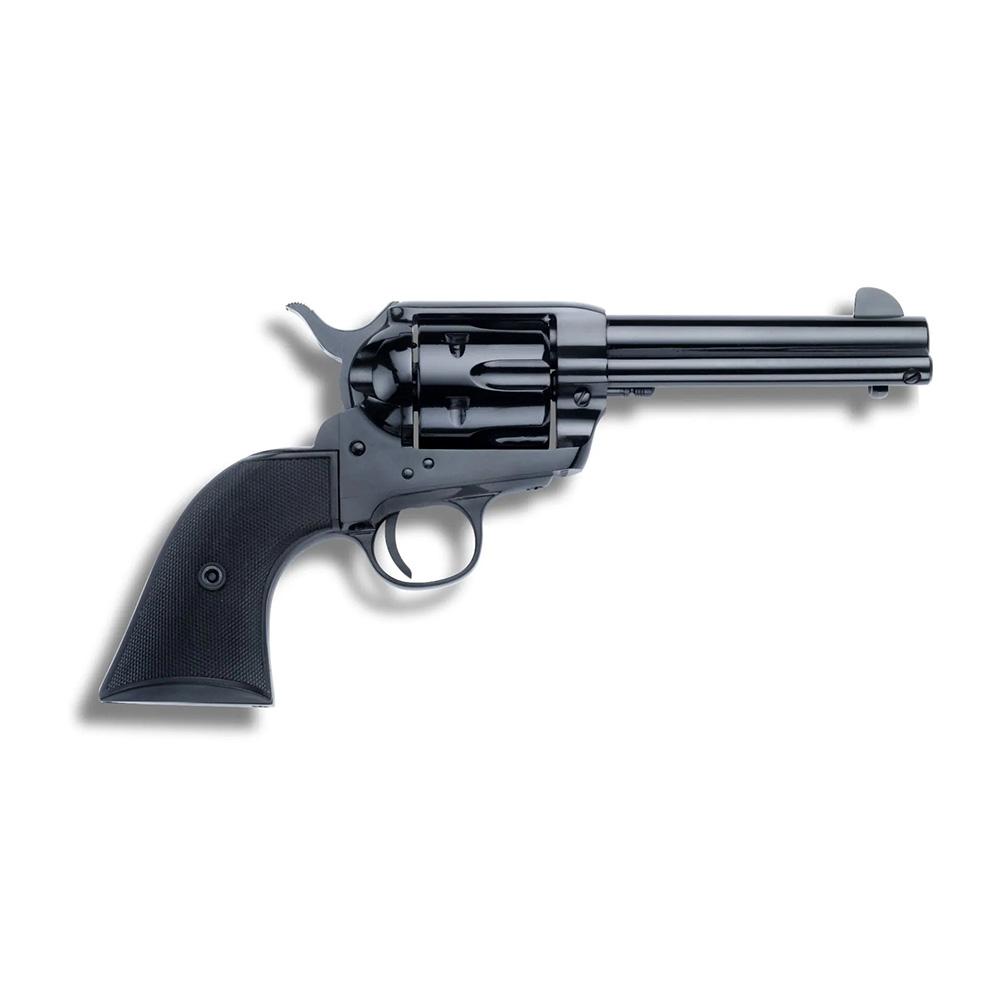
Taylors and Company 1873 SA .45 Colt 6rd 4.75″ Blued
Pros & cons
What works
- Authentic 1873 dimensions: 10.35" OAL and 1.73" cylinder width for period-correct CAS competition.
- Deep traditional blued finish on all steel components—superior in rust resistance to many parkerized finishes.
- Weighs 2.4 lbs (38.4 oz)—mass mitigates .45 Colt recoil for more controllable follow-up shots.
- Uberti-manufactured internals provide reliable lock time under 12 milliseconds from hammer fall.
Trade-offs
- No transfer bar safety—requires five-round carry protocol for safe operation.
- Black plastic Navy-size grips lack heft and aesthetic quality; a $60-$120 upgrade is typical.
- Manual cylinder pin release requires a tool (or cartridge rim) to operate, slower than modern push-button releases.
- Fixed sights are non-adjustable, limiting precision tuning for specific ammunition loads.
Video review
Expert review
Specs at a glance
About this product
What is the Taylors and Company 1873 SA .45 Colt 6rd 4.75″ Blued? The Taylors and Company 1873 SA .45 Colt is a modern-manufactured single-action revolver that faithfully replicates the design, proportions, and manual-of-arms of the original Colt Single Action Army revolver from the 1873 patent era. It is chambered for the .45 Colt cartridge, carries six rounds in a traditional half-fluted cylinder, and is finished in a deep, traditional blued steel across all major components. This piece specifically bridges the gap between a historical artifact and a functional firearm suitable for regular use under modern ammunition pressure standards.
What is the Taylors and Company 1873 SA .45 Colt used for?
This revolver is primarily engineered for Cowboy Action Shooting (CAS) competition, casual range shooting, and for collectors who value historical handling over tactical utility. Its single-action operation, fixed sights, and 4.75-inch barrel demand a deliberate shooting cadence, favoring marksmanship fundamentals and nostalgic engagement over rapid engagement. The 6-round capacity and .45 Colt chambering make it period-correct for CAS, while the modern steel and heat treatment allow it to handle modern factory loads safely, unlike many surviving 19th-century originals.
How does the Taylors and Company 1873 SA compare to the Uberti Cattleman 1873?
The Taylors and Company 1873 is mechanically identical to the base Uberti Cattleman from which it is sourced, but Taylors provides final assembly, inspection, and quality control stateside, offering a more consistent out-of-the-box experience. Both are Italian-made (by Uberti) and share the same lockwork, dimensions, and materials. The primary difference is curation; Taylors selects and tunes these imports, whereas a direct Uberti purchase relies on the factory line's finish. For the shooter prioritizing absolute lowest price, the direct import is the path. For those valuing immediate shootability with minimal gunsmithing, the Taylors version justifies its slight premium.
What does it weigh and what are the dimensions?
Unloaded, this revolver measures 10.35 inches in overall length with a 4.75-inch barrel, and it has a cylinder width of 1.73 inches. Its weight is a substantial 2.4 pounds (38.4 ounces), which is a full 8 ounces heavier than a compact polymer-frame pistol like a Glock 19, placing the mass forward to aid in managing .45 Colt recoil. The grip frame itself, based on the original 1873 'Navy' size, has a circumference of approximately 5 inches, which is noticeably smaller than a modern service pistol grip, dictating a specific two-finger hold for most shooters.
Who is this NOT for?
The Taylors 1873 SA is not for anyone seeking a defensive, duty, or rapid-response firearm. Its single-action design requires manually cocking the hammer for every shot, a deliberate process taking a minimum of 2-3 seconds for a trained shooter to execute a safe, aimed follow-up shot. It lacks modern safety features like a transfer bar, meaning it is unsafe to carry with all six chambers loaded—standard practice is to load only five. If your needs involve home defense or concealed carry, modern designs like our Stevens 334 Rifle or a modern double-action revolver are far more appropriate tools.
What's in the box?
You receive the revolver, a basic plastic or cardboard hard case, a single empty 6-round plastic moon clip (for ease of loading/unloading the cylinder), and the requisite owner's manual and lock. Unlike higher-tier replicas, no cleaning kit, additional grips, or custom presentation case is included. The packaging is utilitarian, designed to protect the firearm during shipping—the value is in the firearm itself, not the accessories.
Is the Taylors and Company 1873 SA worth it at $600.99?
At this price point, the Taylors 1873 SA offers excellent value for a shooter committed to the single-action platform. It provides reliable historical aesthetics and function at roughly two-thirds the cost of an American-made Ruger Vaquero, which, while more robust with its transfer bar safety, lacks the precise historical dimensions many CAS shooters require. Considering the cost of a true antique Colt SAA in shootable condition starts near $2,500, this $600 replica allows you to shoot the experience without risking a museum piece. For a budget-focused entry into Cowboy Action, it's a rational starting point, though your second purchase may be a dedicated shotgun like the Stevens 555 Sporting O/U for the full competition set.
Key attributes
| upc | 810012512428 |
| manufacturer | Taylors and Company |
| manufacturer part number | 200103 |
| shipping weight | 3.2 |
Frequently asked questions
- Is it compatible with +P .45 Colt ammunition?
- No, this revolver is not rated for +P or any other high-pressure .45 Colt ammunition. It is chambered for standard-pressure .45 Colt loads with a SAAMI maximum average pressure of 14,000 psi. Using +P ammunition, which can exceed 20,000 psi, risks cylinder failure and voids the warranty. Stick to factory loads from reputable brands like Winchester, Remington, or Fiocchi within SAAMI spec.
- Does this model have a transfer bar safety?
- No, it uses the traditional 1873-style hammer-mounted firing pin and manual cylinder pin safety. This means the hammer rests directly on a live round when fully loaded, so carrying with all six chambers loaded is unsafe. Standard safe carry procedure is to load only five rounds, leaving the hammer down on an empty chamber. This is a design feature for authenticity, not a flaw.
- Can I swap the black plastic grips for walnut?
- Yes, the grip frame uses the standard 1873 'Navy' size, which is widely supported by aftermarket makers like Altamont and Eagle Grips. Replacement is straightforward: remove the single screw in the grip's bottom, swap panels, and re-tighten. Expect to spend between $60 and $120 for a quality set of checkered walnut or stag grips, depending on the vendor.
- How long does shipping and background check take?
- For in-stock items, Ironclad Armory processes and ships to your selected FFL within 2-3 business days. Once the firearm arrives at your FFL, the background check (NICS) duration depends entirely on your state and local agency. In most states, the check is instant or takes less than 30 minutes, but some jurisdictions with mandatory waiting periods can delay pickup for 72 hours or more. Contact your selected FFL for their specific timeline.
- Is the barrel threaded for a suppressor?
- No, the 4.75-inch barrel is not threaded and has a traditional, non-removable front sight. Suppressing a single-action revolver is generally ineffective due to the significant cylinder gap, which allows high-pressure gas and sound to escape. If you are interested in suppressed shooting, you should look at modern closed-breech designs like bolt-action or semi-automatic pistols that can properly seal with a suppressor.