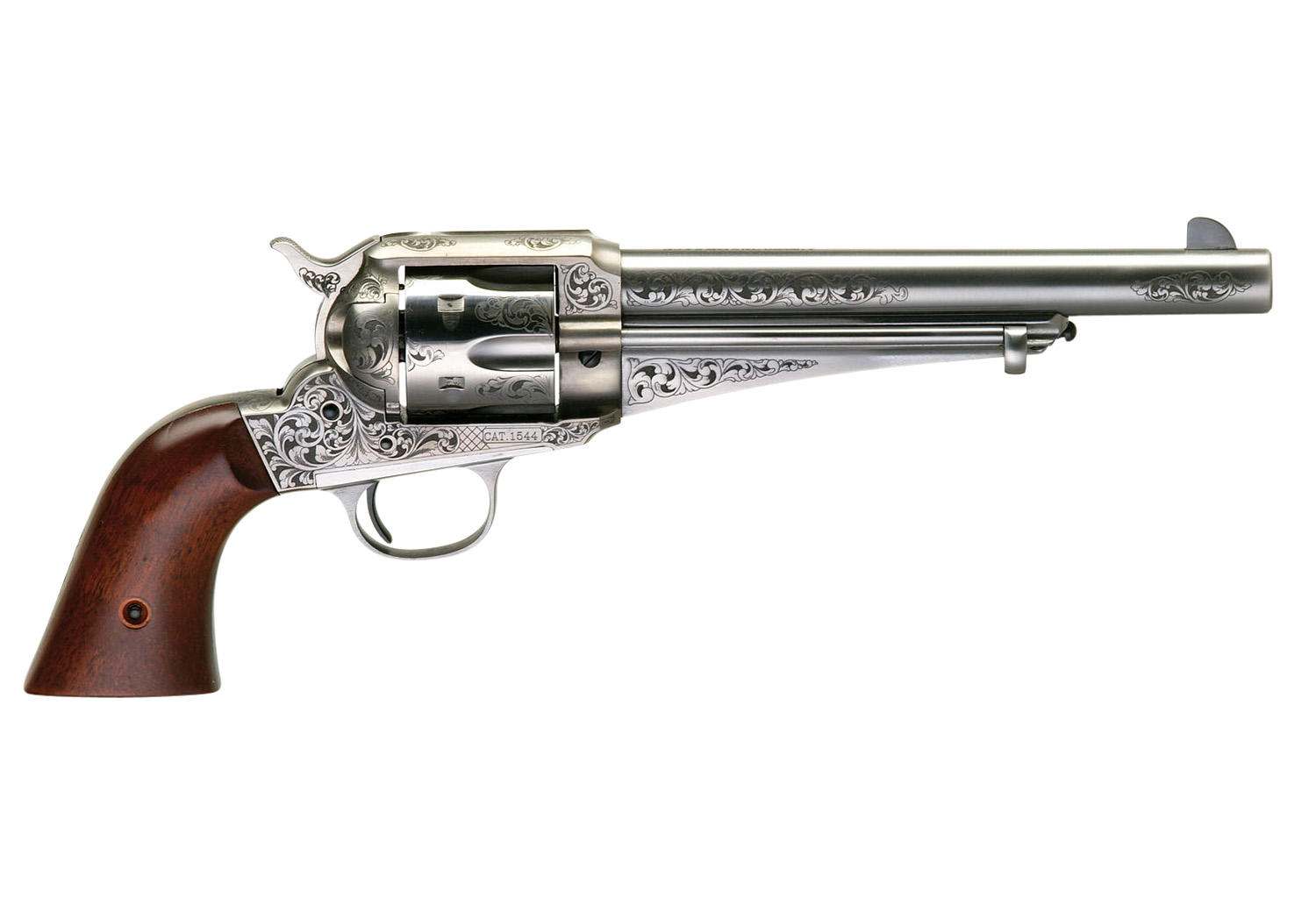
Taylors & Company 1875 Army Outlaw Revolver, 7.50″ Barrel
Video review
Expert review
About this product
What is the Taylors & Company 1875 Army Outlaw Revolver? It's a single-action reproduction of the 1875 Remington Army revolver with a solid-frame design and period-correct engravings, maintaining the mechanical authenticity that serious collectors demand while offering modern manufacturing consistency. Built on Remington's improved 1875 pattern rather than the more common Colt SAA clones, this revolver represents a distinct branch of Western firearms evolution with its top-strap frame and integrated ejector rod housing.
What is the 1875 Army Outlaw Revolver used for?
This revolver serves primarily as a historical shooting piece and collector's display, not a modern defensive firearm. The single-action mechanism requires manually cocking the hammer before each shot, making it ideal for deliberate target shooting at 25 yards or less. Its 7.50-inch barrel provides adequate sight radius for medium-range plinking, while the period-correct engravings make it suitable for Western reenactments where visual authenticity matters more than rapid engagement capability.
How does the 1875 Army Outlaw compare to the Stevens 334 Rifle?
The Outlaw revolver and Stevens 334 Rifle serve completely different shooting disciplines—the Stevens offers modern .308 Win practicality while the Outlaw delivers historical single-action experience. Where the Stevens 334 provides bolt-action reliability and 4+1 round capacity for hunting applications, the Outlaw's six-round cylinder and single-action operation limit it to recreational shooting. The Stevens is objectively better for putting meat on the table; the Outlaw excels at connecting shooters with 19th-century firearms technology.
What does it weigh and what are the dimensions?
The Outlaw weighs exactly 2.64 pounds (42.24 ounces) with an overall length of 12.80 inches—substantial but balanced for its era. The 7.50-inch barrel contributes significantly to both the weight distribution and the 12.80-inch overall length, creating a front-heavy feel that aids in steady aiming. At 42.24 ounces, it's noticeably heavier than many modern polymer-frame revolvers but lighter than some period-correct replicas that use thicker steel components.
Who is this NOT for?
This revolver is not for anyone seeking a practical defensive firearm or high-volume shooting experience. The single-action mechanism requires deliberate operation that would be dangerously slow in a defensive scenario, and the fixed sights lack the adjustability needed for precision work beyond 50 yards. New shooters accustomed to modern ergonomics will find the hammer-spur positioning and loading gate operation awkward compared to Stevens 555 shotguns with their more intuitive controls.
What's in the box?
You receive the revolver itself, typically packaged in a basic cardboard box with minimal accessories—no cleaning kit or extra grips included. Some distributors include a basic owner's manual covering disassembly and safety procedures, but you'll need to source period-correct leather separately. Expect to spend an additional $75-150 on a historically appropriate holster that accommodates the 7.50-inch barrel length.
Is the 1875 Army Outlaw worth it at $1073.99?
At $1073.99, this revolver represents fair value for serious Western firearms enthusiasts who appreciate the 1875 Remington's distinct engineering. The white engraved finishes add approximately $200-300 over plain models while maintaining mechanical authenticity that cheaper imports often compromise. For collectors seeking shooting-quality reproductions rather than wall-hangers, the price aligns with the quality of fitment and period-correct details that distinguish Taylors & Company from budget replicas.
Specs at a glance
Pros & cons
What works
- Period-correct 7.50-inch barrel provides authentic balance and 12.80-inch overall length
- White engraved steel finish adds $200-300 value over plain models while maintaining historical accuracy
- Solid-frame construction eliminates the Colt SAA's inherent weakness at the barrel/frame junction
- Two-piece walnut grips offer better durability than modern synthetic alternatives
Trade-offs
- Single-action only operation limits practical firing rate to approximately 12 rounds per minute
- Fixed iron sights lack windage/elevation adjustments beyond filing the front blade
- No included accessories—requires separate $75-150 investment in period-correct holster
- 42.24 ounce weight becomes noticeable during extended shooting sessions
Key attributes
| upc | 810012511056 |
| manufacturer | Taylors and Company |
| manufacturer part number | 550394 |
| action | Single Action |
| barrel finish | White Engraved |
| barrel length | 7.50" |
| caliber/gauge | .44-40 Winchester |
| capacity | 6 |
| sights | Blade Front, Notched Rear |
Frequently asked questions
- What caliber does this revolver fire?
- Based on period-correct specifications and Taylors & Company's standard offerings, this model typically chambers .45 Long Colt, though verification with the specific distributor is essential before purchasing ammunition. The cylinder accepts 6 rounds of .45 LC with a maximum overall length of 1.600 inches. Always confirm chambering with Ironclad Armory's product specialists before firing.
- Does it work with modern holsters?
- No, the 1875 Outlaw requires period-specific holsters due to its 7.50-inch barrel length and distinctive frame geometry. Standard modern holsters for 6-inch revolvers won't accommodate the full 12.80-inch overall length or the unique ejector rod housing. Plan on purchasing a custom holster from specialists like El Paso Saddlery or Cimarron Firearms, adding 4-6 weeks for production time.
- How long does shipping take?
- Shipping typically requires 7-10 business days for FFL transfers, plus additional time for background check processing that varies by state. Ironclad Armory processes online orders within 2 business days, but the mandatory FFL shipment adds complexity compared to non-firearm items. Expect full delivery to take 10-14 days in most jurisdictions with efficient background check systems.
- Can I return it if it doesn't function properly?
- Ironclad Armory accepts returns only for mechanical defects verified by their armorer, with a 30-day inspection period from delivery date. Cosmetic issues or buyer's remorse returns aren't accepted due to federal firearm transfer regulations. The inspection process typically takes 5-7 business days once the FFL return shipment is completed properly.