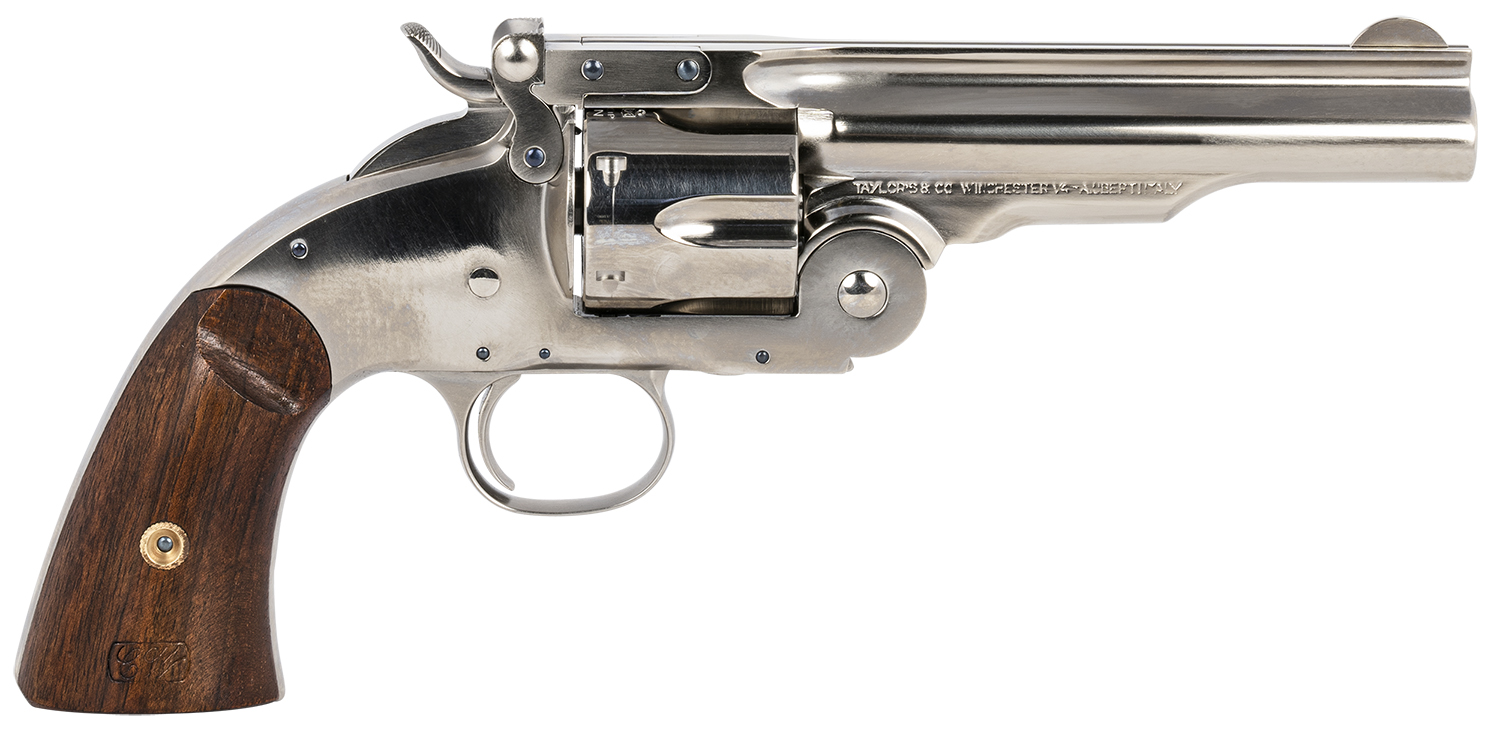
Taylors and Company Schofield TF Uberti .45 LC 5″ Nickel-Plated
About this product
What is the Taylors and Company Schofield TF Uberti .45 LC 5″ Nickel-Plated? It is a historically accurate, Italian-made reproduction of Major George Schofield's 1875 top-break cavalry revolver, chambered in .45 Long Colt with a five-inch barrel and nickel-plated finish. This piece replicates the mechanical advantage of the original rapid-ejection design while maintaining modern manufacturing tolerances under the oversight of Uberti and importation by Taylors & Company. It is a Category 1 Antique Replica under current ATF guidelines, making it federally legal for direct shipment in most jurisdictions, a crucial detail often misunderstood by modern buyers.
What is the Taylors and Company Schofield TF Uberti .45 LC 5" Nickel-Plated used for?
This revolver is engineered for single-action Cowboy Action Shooting competitions, ceremonial or display use, and as a premium functional collectible for historical firearms enthusiasts. Its 5-inch barrel and six-round capacity in .45 Long Colt are period-correct for SASS (Single Action Shooting Society) matches, while its nickel-plated finish offers superior corrosion resistance compared to traditional blued steel for display in uncontrolled environments. Its primary utility is mechanical demonstration; it reliably teaches the operation of the innovative Schofield latch that allowed faster cartridge extraction than the contemporary Colt SAA.
How does the Taylors and Company Schofield compare to a Cimarron Firearms 1875 Remington Outlaw?
This Schofield offers a fundamentally different mechanical system and historical design lineage than the solid-frame, gate-loading Cimarron Remington, making direct 'better or worse' comparisons inappropriate for informed buyers. The Schofield's top-break action allows ejection of all six spent cases simultaneously in roughly three seconds, versus the sequential ejection of a single-action army-style revolver; however, the Cimarron Remington typically has a more robust solid frame and can handle modern, higher-pressure .45 Colt ammunition with less reported strain on the latch mechanism. For shooters prioritizing fast reloading in a timed match, the Schofield platform is superior; for those prioritizing long-term durability with a wider range of ammunition, the Remington design is the more conservative choice.
What does it weigh and what are the dimensions?
The revolver features a total weight of approximately 2.8 pounds (45 ounces or 1275 grams), with an overall length of 10.75 inches from the muzzle to the back of the grip frame. This balance point, roughly 1.5 inches forward of the trigger guard, results from the 5-inch barrel married to the relatively heavy, milled-steel frame that houses the top-break hinge and latch system. The cylinder measures 1.75 inches in diameter, and the two-piece walnut grips have a circumference of approximately 5.5 inches at their widest point, suitable for medium to large hands.
Who is this NOT for?
This is not a suitable firearm for a first-time gun owner, a concealed carry application, or someone seeking a modern defensive tool. The single-action-only firing mechanism requires manually cocking the hammer for each shot, and the design is over 140 years old, lacking modern safety features like a transfer bar or firing pin block. Furthermore, enthusiasts interested in high-volume shooting with +P or non-standard .45 Colt loads should look at a modern platform like a Stevens 334 Rifle; the Schofield's historical metallurgy and latch system are not engineered for sustained, high-pressure use. If your primary goal is rugged utility, save your money.
What's in the box?
The factory packaging includes the revolver, the original two-piece walnut grip panels, a standard cable lock through the frame, and the manufacturer's warranty paperwork and test-fire casing required in certain states. Notably, it does not include a cleaning kit, a holster, a manual shell extractor (the top-break action renders one unnecessary), or any ammunition. The grips are fitted, but not epoxied, allowing for end-user replacement with optional pearl-style grips or custom fitting, which typically requires 30-60 minutes of hand-sanding for a perfect seam.
Is the Taylors and Company Schofield worth it at $1565.99?
At a $1565.99 MSRP, this revolver represents a significant investment in historical authenticity and mechanical recreation rather than pure functional utility. The cost is justified by the complex machining of the top-break hinge and latch, the high-polish nickel plating process, and the Uberti factory's adherence to dimensional blueprints, but it is objectively expensive compared to a modern production revolver. You are paying a premium for a specific, faithfully reproduced operating experience; if that historical operation is your priority—as it is for serious Cowboy Action shooters or collectors—the price is defensible. For general-range use or hunting, a more versatile and affordable option like the Stevens 555 Sporting 20 Gauge offers greater practical return.
Specs at a glance
Video review
Pros & cons
What works
- Historically accurate top-break action ejects all 6 spent cases in under 3 seconds.
- Nickel-plated finish provides superior corrosion resistance versus standard blued models.
- 5-inch barrel provides a balanced 10.75-inch overall length for fast target acquisition.
- Uberti-manufactured frame ensures modern-quality steel and tighter tolerances than some other replicas.
Trade-offs
- Single-action-only mechanism is impractical for any defensive or rapid-fire scenario.
- Prohibited from using +P ammunition, limiting power and load versatility compared to modern .45 Colt revolvers.
- Requires a dedicated, non-standard holster, adding $75+ and a 4-6 week wait for proper carry.
- Significant premium price of $1565.99 for a historical replica with limited practical utility.
Expert review
Key attributes
| upc | 810012510790 |
| manufacturer | Taylors and Company |
| manufacturer part number | 550670 |
| action | Break Open |
| barrel finish | Nickel-Plated |
| barrel length | 5" |
| caliber/gauge | .45 Long Colt |
| capacity | 6 |
| sights | Blade Front, Fixed Rear |
Frequently asked questions
- Is it compatible with modern .45 Colt +P ammunition?
- No, this revolver should only be used with standard-pressure .45 Long Colt ammunition loaded to SAAMI specifications, typically not exceeding 14,000 PSI. Using +P or high-pressure rounds risks damaging the century-old top-break latch design and can cause catastrophic frame stretching. Stick to factory loads from Federal, Winchester, or Remington labeled for standard pressure.
- Does this model fit in a standard Single Action Army holster?
- No, the Schofield's distinct frame profile, top-break latch, and 5-inch barrel require a dedicated, historically patterned holster. While holsters from makers like Triple K or Hunter Company exist, ordering one specific to the Schofield replica is mandatory and adds approximately $75-$120 and a 4-6 week lead time to your total investment.
- How long does shipping and transfer to an FFL take?
- For in-stock items, Ironclad Armory processes and ships within 3 business days. Transit via UPS or FedEx ground service typically takes 5-7 additional business days. Upon arrival at your chosen FFL dealer, the mandatory background check (NICS) and transfer paperwork generally add 1-3 days, assuming no state-specific waiting periods.
- What is the warranty and can I return it if defective?
- This revolver carries Taylors & Company's limited lifetime warranty on the frame and a one-year warranty on other components against defects in materials and workmanship. Firearms purchased through Ironclad Armory cannot be returned for a refund once transferred; defective items must be processed through the manufacturer's warranty service, a process that averages 6-8 weeks for assessment and repair.
- Does this work with a standard .45 Colt moon clip for speed loading?
- No, the Schofield design predates moon clips by several decades and its cylinder is not machined to accept them. Reloading is performed by breaking open the action, manually ejecting the spent cases en masse, and individually loading six fresh cartridges into the chambers, a process that takes a practiced shooter 8-12 seconds.