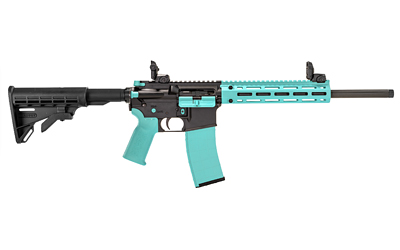
Tippmann Arms M4-22 LTE 16″ .22 LR 25rd
About this product
What is the Tippmann Arms M4-22 LTE 16" .22 LR?
The Tippmann Arms M4-22 LTE is a premium .22 LR semi-automatic rimfire rifle engineered to deliver authentic AR-15/M4 controls and compatibility at a fraction of centerfire ammunition cost. It serves dual roles as both a dedicated training platform for high-volume practice and a legitimate suppressor host thanks to its threaded 16-inch barrel. Its 7075-T6 and 6061 aerospace aluminum receiver construction provides the weight and balance profile essential for proper fundamentals transfer.
What is the Tippmann M4-22 LTE used for?
The Tippmann M4-22 LTE 16" is designed for high-volume, affordable marksmanship training and suppressor-focused recreational shooting. Its 25-round magazine capacity allows for realistic timed drills across a standard 3-minute bay rotation, while its 1/2"x28 threaded muzzle makes pairing with modern rimfire suppressors a routine install. This is not a disposable "plinker"—it's a precision instrument for bridging the gap between .22 LR practice and 5.56 NATO deployment.
How does the Tippmann M4-22 compare to the Stevens 334?
The Tippmann M4-22 offers superior ergonomic training value for manual-of-arms development compared to conventional rimfire bolt actions like the Stevens 334. Where one is better for learning precision rifle fundamentals at 100 yards, the Tippmann replicates the fire control, reloads, and accessory mounting of the standard military carbine. For shooters prioritizing familiarization with AR-15 controls, the Tippmann is substantially more effective than any bolt-action platform.
What does it weigh and what are the dimensions?
This rifle weighs 5.6 pounds unloaded and measures 34.75 inches from its adjustable stock's longest position to the muzzle threads. The 16-inch barrel provides a 1:16 twist rate optimized for stabilizing standard 40-grain .22 LR rounds up to 1500 fps, while the 7-inch M-LOK handguard offers 11.5 inches of modular rail space when fully configured. These dimensions create a 12.5-inch sight radius with the included flip-up sights deployed.
Who is this NOT for?
The M4-22 LTE is not for those seeking a "tacticool" rimfire to neglect basic maintenance. Its direct blowback system requires diligent bolt and chamber cleaning every 500 rounds to prevent fouling-induced malfunctions—centerfire AR owners accustomed to longer intervals must adjust their routine. It's also unsuitable for shooters requiring sub-MOA precision beyond 50 yards; this is a training tool, not a dedicated match rifle.
What's in the box?
The package includes the complete rifle with one factory 25-round polymer magazine, a set of aluminum flip-up sights pre-installed, and an owner's manual detailing takedown and proprietary part identification. The receiver extension includes its buffer and spring, so attaching an AR-15 pattern stock requires only a Castle nut wrench. You won't find thread protectors or cleaning kits—Tippmann assumes you already own the basics.
Is the Tippmann M4-22 LTE worth it at $474.95?
It's worth every penny if you need a durable, mil-spec compatible .22 LR trainer that won't develop receiver slop after 5,000 rounds. The investment pays for itself in ammunition savings within 1,500 rounds of .22 LR versus equivalent 5.56 NATO practice. Consider the alternative: buying a dedicated .22 LR upper and conversion kit for an existing AR often costs more than this complete Tippmann rifle while offering inferior reliability.
Specs at a glance
Video review
Pros & cons
What works
- Weighs 5.6 lb—matches centerfire AR heft for proper training transfer
- Fully-threaded 16" barrel accepts standard 1/2"x28 rimfire suppressors
- 25-round magazine capacity exceeds typical 10-round rimfire limits
- Aluminum receivers prevent polymer flex common on competitors like M&P15-22
Trade-offs
- Proprietary bolt and magazine—cannot use existing AR .22 conversions
- Requires cleaning every 500 rounds to maintain reliability in blowback system
- Flip-up sight adjustment tools not included—requires standard AR sight tool
- Single magazine in box mandates immediate extra purchase for practical drills
Expert review
Key attributes
| upc | 850050173359 |
| manufacturer | Tippmann Arms |
| manufacturer part number | A101203 |
| action | Semi-Auto |
| barrel length | 16" |
| caliber/gauge | .22 LR |
| capacity | 25 + 1 |
| color | Black, Robin's Egg Blue |
| model | M4-22 |
| product type | AR |
| safety | Two-Position |
| sights | Flip Up Front & Rear |
Frequently asked questions
- Is the M4-22 LTE compatible with standard AR-15 parts?
- It accepts most external AR-15 components but has proprietary internal fire control parts. Stocks, pistol grips, handguards, and triggers with AR-15/MIL-SPEC dimensions drop in, but the bolt carrier group, firing pin, and magazine catch are specific to the M4-22 platform. Always verify part numbers against Tippmann's technical documentation before ordering.
- Does it work with a standard AR-15 .22 LR conversion kit or magazine?
- No, the Tippmann requires its proprietary magazine design and will not function with standard CMMG-style conversion kits or magazines. The ejector and feed lips are integrated into the M4-22 magazine body, creating a more reliable feeding system than drop-in conversions over thousands of rounds of standard-velocity ammunition.
- Can I mount a suppressor or muzzle device?
- Yes. The rifle ships with a 1/2"x28 threaded barrel, the standard pitch for rimfire suppressors and muzzle devices. Direct-thread suppressors like the Dead Air Mask or SilencerCo Sparrow require no adapter. For muzzle brakes or compensators, verify the device is rated for .22 LR pressure and has the correct thread pitch before installation.
- How does the accuracy compare to bolt-action .22 rifles?
- Expect 1.5 to 2.5 MOA groups at 50 yards with match-grade ammunition, which is sufficient for positional and dynamic training scenarios. It will not match the sub-MOA precision of a <a href="/products/stevens-334-243win-20-3rd-black/">Stevens 334</a> bolt action due to its semi-automatic action and less rigid barrel harmonics. This is a trade-off for rapid-fire capability.