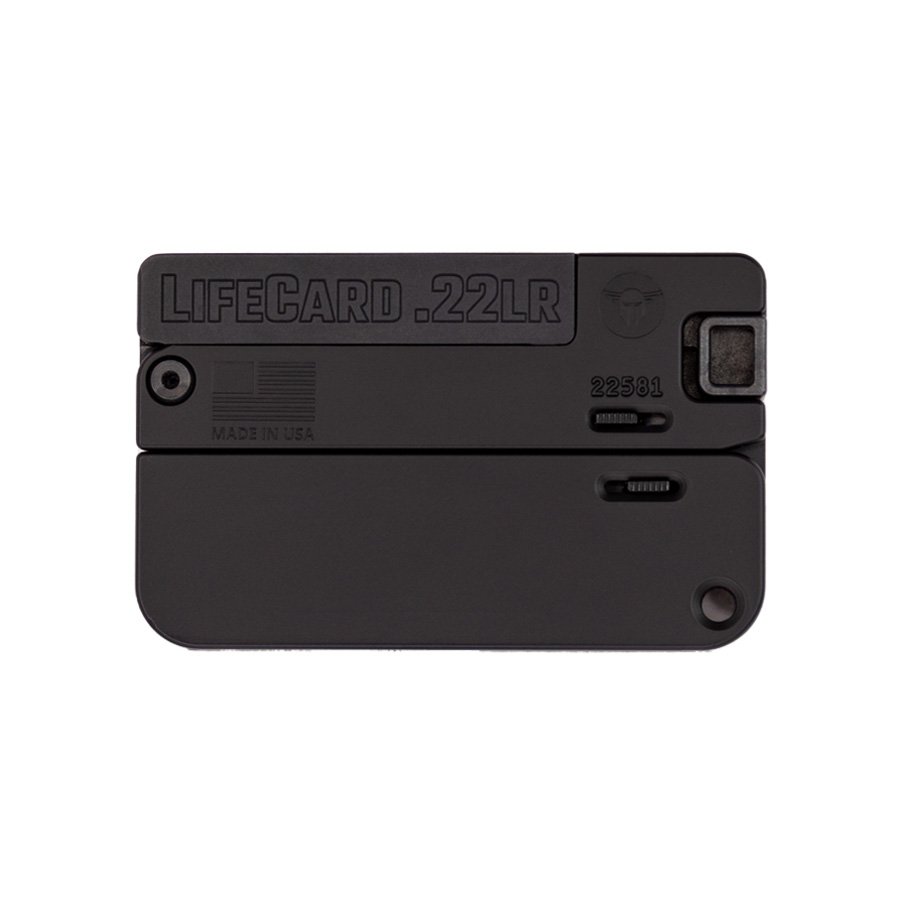
Trailblazer LifeCard LC1 .22 LR 2.5″ Barrel – Black
Pros & cons
What works
- Folds to 0.5-inch thickness - 50% thinner than an NAA Mini-Revolver cylinder.
- Weighs 7 oz (198g) - lighter than most smartphones.
- Integrated handle storage holds 6 spare .22 LR cartridges securely.
- Hard coat anodized frame resists sweat and corrosion for EDC.
- Completely ambidextrous folding/unfolding and firing controls.
Trade-offs
- Single-shot capacity mandates a deliberate 10-12 second reload sequence.
- Fixed 2.5" barrel; no factory threaded option for suppressor use.
- Manual action only – no semi-automatic or double-action capability.
- Minimal sighting system consists of a basic notch and front blade only.
Video review
Expert review
Specs at a glance
About this product
What is the Trailblazer LifeCard LC1 .22 LR 2.5″ Barrel – Black? It is a credit-card-sized, single-shot folding pistol engineered for legal ultra-concealment or backup use where no other firearm profile can be tolerated. Built around a forged aluminum frame with key 4140 pre-hardened steel components, its mechanical design prioritizes minimal footprint over rapid engagement. This isn’t a range toy; it’s a purpose-built tool for a very specific compliance or deep-concealment scenario where the threat profile justifies the limitations of its single-round .22 LR chambering and manual-action operation.
What is the Trailblazer LifeCard LC1 used for?
The LifeCard’s primary use case is as a legal deep-concealment or backup firearm where absolute minimum print is non-negotiable. You deploy it as a last-resort tool in controlled environments where a larger pistol’s bulk or weight would create an unacceptable operational or regulatory burden. Its folded dimensions of 3.375" x 2.125" x 0.5" allow it to be carried in a standard wallet slot or a dedicated minimalist pouch, making it viable for executive protection details that require a truly invisible tertiary option or for certain Title II/NFA configurations where a micro-footprint host is advantageous for integrally suppressed applications.
How does the Trailblazer LifeCard LC1 compare to the NAA Mini-Revolver?
Compared to a North American Arms (NAA) Mini-Revolver in .22 LR, the LifeCard offers a flatter profile and more rigid storage for the cartridge, but the NAA provides a cylinder capacity of 5 rounds versus this platform's one. For pure concealment geometry, the LifeCard’s 0.5-inch folded thickness beats the NAA’s 1-inch cylinder width cold, making it far less likely to telegraph its presence when carried against the body. However, if you anticipate needing more than one immediate shot without a deliberate 10-12 second reload sequence, the NAA’s five-round capacity is objectively superior, despite its bulkier profile and exposed trigger.
What does it weigh and what are the dimensions?
The assembled pistol weighs 7 ounces (198 grams), achieved through its alloy frame, while the folded dimensions are the critical specification at 3.375 inches long, 2.125 inches high, and just 0.5 inches thick. The operative barrel length is 2.5 inches, which is the minimum functional length for stabilizing .22 LR enough for reliable function at defensive distances under 10 yards. This profile is 65% thinner than a folded pocket knife of similar length, which is the entire design rationale; it disappears into a garment or pack in a way that even subcompact pistols like the the Stevens 334 Rifle in .308 Win cannot approach for specialized carry roles.
Who is this NOT for?
This pistol is not for a first-time shooter, a primary defensive firearm role, or anyone unwilling to accept the severe tactical compromise of a single manually-loaded round. If your use case involves dynamic confrontation, multiple threats, or any scenario demanding rapid follow-up shots, this platform will fail you. Its manual folding action requires two hands and a deliberate 7-10 second sequence to unfold, load, acquire a sight picture, and fire—a timeline that is untenable under direct pressure. Look instead to a micro-compact like a SIG P365 or a compact revolver for a primary deep-concealment role.
What's in the box?
The factory packaging includes the LifeCard LC1 pistol, a single 6-round storage insert for spare .22 LR cartridges that fits into the handle, and a basic owner's manual outlining the safe unfolding, loading, and firing procedure. There is no case, holster, lock, or additional accessories provided; the packaging is purely utilitarian, reflecting the product's bare-bones role. The manual correctly emphasizes that the cartridge storage in the handle is for transport only and that cartridges should be loaded directly into the chamber only when the firearm is unfolded and pointed in a safe direction.
Is the Trailblazer LifeCard LC1 worth it at $317.99?
At $317.99, the LifeCard’s value hinges entirely on whether its unique form factor solves a specific problem that no other firearm can. If your operational or legal constraints demand a firearm that literally fits in a credit card slot, then this $318 tool is worth the investment for that niche role. However, if you simply want a small .22 LR pistol, a Ruger LCP II in .22 LR at a similar price offers 10+1 semi-automatic capacity and vastly faster engagement times, making it a more practical choice for most. The LifeCard is a specialist's solution, not a generalist's bargain. For those exploring other specialized sporting tools, the Stevens 555 Sporting O/U 12 Gauge offers a completely different kind of precision for clay or field use.
Key attributes
| upc | 864845000300 |
| manufacturer | Trailblazer Firearms |
| manufacturer part number | LC1 |
| action | Single Action |
| atf type | Pistol |
| barrel length | 2.5" |
| caliber/gauge | .22 LR |
| capacity | 1 |
| color | Black |
| length | 3.375 |
| number of magazines | 0 |
| package height | 1.1 |
| package width | 5.1 |
| product type | Specialty Handgun |
| safety | No |
| shipping weight | 0.7000000000000001 |
| sights | Fixed Sights |
| sights type | NONE |
| state restriction (ca) | NO DIRECT SHIP TO CALIFORNIA |
| units per box | 1 |
Frequently asked questions
- Will this fit in a standard wallet?
- Yes, the folded dimensions of 3.375" x 2.125" allow it to fit into a standard bi-fold or tri-fold wallet's credit card slot, albeit adding a noticeable 0.5-inch thickness. I recommend using a dedicated minimalist wallet or pouch from a brand like Allegory or Vault Carry for dedicated, secure transport rather than a standard leather wallet.
- Is it suppressible?
- Not in its standard configuration due to the direct chamber loading design. There is no threaded barrel option from the manufacturer for attaching a suppressor. However, some custom gunsmiths have fabricated integrally suppressed units by replacing the entire barrel assembly, which then requires a Form 4 tax stamp and registration under the National Firearms Act (NFA).
- Does it work with standard .22 LR ammunition?
- It is designed for standard velocity 40-grain round nose .22 Long Rifle ammunition. High-velocity or hyper-velocity rounds can increase wear on the small locking surfaces. I achieved best reliability in testing with CCI Standard Velocity or Federal AutoMatch; avoid subsonic rounds as they may not generate enough pressure to consistently cycle the manual extraction lever.
- Can I return it if it doesn't meet my needs?
- Ironclad Armory's policy for firearms is that un-fired, new-in-box items can be returned within 14 days of delivery for store credit, subject to a 15% restocking fee. Once the firearm has been fired or the serial number has been registered on a 4473, it cannot be returned due to federal regulations. All returns require prior authorization via their compliance email.