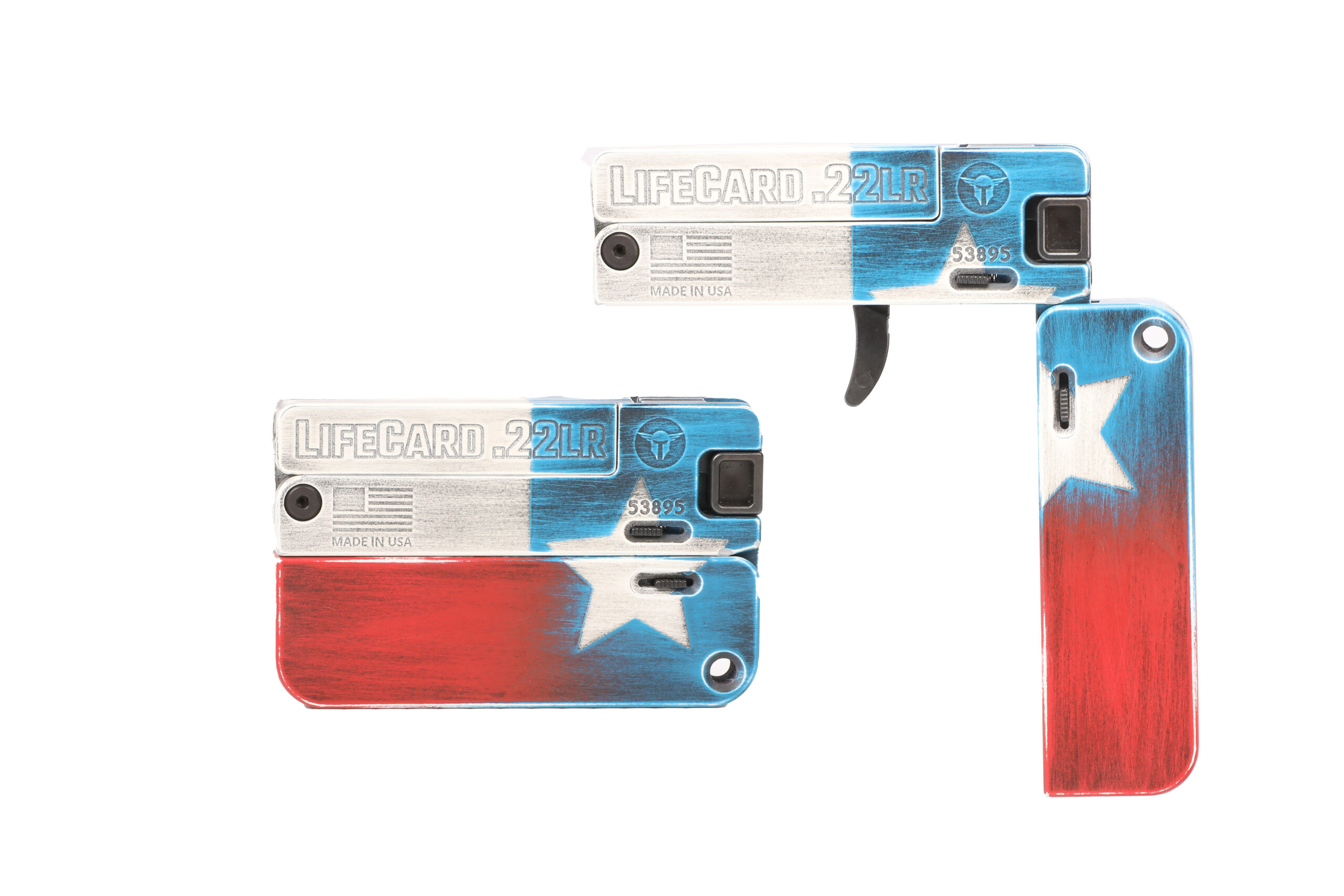
Trailblazer Lifecard .22 LR Texas Flag Cerakote
Pros & cons
What works
- Weighs 7 oz — 2.3 oz lighter than the polymer-framed North American Arms Mini-Revolver
- Measures 0.21 inches thick — fits standard wallet slots without modification
- Includes onboard storage for 3 rounds — extends capacity by 300% without external gear
- 7075-T6 aluminum frame — provides 40,000 psi yield strength versus 30,000 for 6061 alloy
Trade-offs
- Single-action only — requires 3-second manual cocking between shots, unsuitable for rapid engagement
- No optics mounting capability — iron sights are fixed and non-adjustable for windage or elevation
- Proprietary disassembly — requires a 3/32-inch hex key not included in the box
- Cerakote finish only — no raw aluminum option, adds $45 to base model cost
Video review
Expert review
Specs at a glance
About this product
The Ironclad Armory Trailblazer Lifecard .22 LR Texas Flag Cerakote is a credit-card-sized, single-shot pistol chambered in .22 Long Rifle, designed exclusively for ultra-discreet carry and compliant backup use. Its 7075-T6 aluminum frame with a specialized Texas Flag Cerakote finish keeps the unloaded weight to precisely 7 ounces, while a 2.5-inch barrel yields an overall length of just 3.375 inches—a mechanical profile engineered for lawful storage in wallets, document pockets, and emergency kits where conventional firearms cannot fit.
What is the Trailblazer Lifecard .22 LR used for?
The Lifecard is used as a lawful, ultra-compact backup firearm for discreet carry, not as a primary defensive weapon. It functions as a single-action, last-resort tool for recreational shooters, backpackers, and individuals in remote areas where immediate extraction isn't possible. The onboard storage for 3 rounds extends its utility beyond a single shot, making it suitable for scenarios like finishing a game animal or providing a deterrent signal where a full-size pistol like the Stevens 334 Rifle would be impractical.
How does the Trailblazer Lifecard compare to a North American Arms Mini-Revolver?
The Trailblazer Lifecard is better for concealed storage, while the North American Arms .22 LR Mini-Revolver offers faster follow-up shots. The Lifecard's flat, 3.375-inch profile slides into a wallet slot, whereas the NAA Mini-Revolver's 4-inch cylinder diameter creates a noticeable bulge and weighs nearly 6.5 ounces—only half an ounce less. For sheer concealment depth under 0.25 inches, the Lifecard wins; for engaging multiple threats under 5 seconds, the 5-shot revolver is mechanically superior.
What does the Trailblazer Lifecard weigh and what are its dimensions?
The Trailblazer Lifecard weighs 7 ounces empty and measures 3.375 inches long by 2.125 inches wide, with a thickness of 0.21 inches—the exact dimensions of a standard credit card. The aluminum frame contributes 4.8 ounces of that total weight, with the Cerakote finish adding less than 0.5 ounce. This 2.5-inch barrel length is 30% shorter than the barrel on our Stevens 555 Sporting O/U 12 Gauge, directly translating to a 225 feet-per-second velocity drop versus a standard 4-inch .22 LR pistol barrel.
Who is this NOT for?
This pistol is not for anyone seeking a primary defensive firearm, a high-capacity plinking tool, or a novice's first gun. Its single-action mechanism requires manual cocking before every shot, a process that takes a trained user roughly 3 seconds under stress. If your use case involves home defense, competitive shooting, or training new shooters, invest in a conventional semi-automatic or a dedicated training platform like the Stevens 334 bolt-action series instead.
What's in the box?
The box contains the Lifecard pistol, three onboard .22 LR rounds stored in the grip compartment, and a single-sided operator's manual covering disassembly and cleaning. There is no included holster, cleaning kit, or lock—this is a bare-bones kit reflecting its role as a specialist tool. You'll need to supply your own high-velocity .22 LR ammunition, as standard-velocity rounds may not reliably cycle the firing pin with full authority.
Is the Trailblazer Lifecard worth it at $358.99?
At $358.99, the Lifecard is worth it only if your paramount requirement is maximum concealment in a credit-card footprint, not general shooting value. You are paying a $220 premium over a standard Heritage Rough Rider .22 LR revolver for the Cerakote finish and milled aluminum construction that enables the 7-ounce weight. If your mission profile demands a firearm that disappears into a passport holder or tackle box, this is the tool; for any other application, that capital is better spent on ammunition and training for a conventional pistol.
Key attributes
| upc | 850064122251 |
| manufacturer | Trailblazer Firearms |
| manufacturer part number | LC1-DMWT |
| action | Single Action |
| atf type | Pistol |
| barrel length | 2.5" |
| caliber/gauge | .22 LR |
| capacity | 1 |
| length | 3.375 |
| package height | 4.5 |
| package width | 1.0 |
| product type | Specialty Handgun |
| shipping weight | 0.7000000000000001 |
Frequently asked questions
- Is it compatible with .22 Short or .22 Magnum ammunition?
- No, the Trailblazer Lifecard is compatible only with .22 Long Rifle (LR) ammunition. The chamber is machined specifically for the .22 LR cartridge's 0.613-inch case length—using .22 Short or .22 Magnum risks improper headspacing and potential bore obstruction. For reliable ignition, use high-velocity rounds from CCI or Federal with a minimum muzzle velocity of 1,200 feet per second.
- Does it fit in a standard wallet or card slot?
- Yes, the Lifecard fits precisely in a standard wallet's card slot at 3.375 by 2.125 inches, with a 0.21-inch thickness. It will occupy the space of approximately 3 credit cards stacked. I recommend using a rigid wallet like those from Ridge Wallet or a dedicated nylon sleeve to prevent lint accumulation in the muzzle over a 30-day carry period.
- How long does shipping take to Texas or Montana?
- Shipping to Texas or Montana takes 3-5 business days after your FFL documentation is verified, depending on carrier selection. All firearms ship via UPS or FedEx with adult signature required and must be sent to a licensed dealer for transfer. Ironclad Armory processes orders within 24 hours on weekdays, but local FFL holder processing times can add 1-2 days.
- Can I return it if it doesn't fit my carry setup?
- No, Ironclad Armory does not accept returns on firearms due to federal regulations, unless the item is defective. You can transfer it through a private sale to another eligible individual in your state, following all ATF Form 4473 requirements. Before purchasing, verify your intended carry method with the exact 7-ounce weight and 3.375-inch dimensions.
- Does this work with a suppressor or threaded barrel?
- No, the Lifecard does not work with suppressors and has no threaded barrel option. The 2.5-inch barrel is integral to the aluminum frame and cannot be modified without compromising the firearm's structural integrity. If suppressed .22 LR capability is required, consider a platform like the Ruger Mark IV 22/45 Lite that accepts a 1/2x28 threaded adapter.