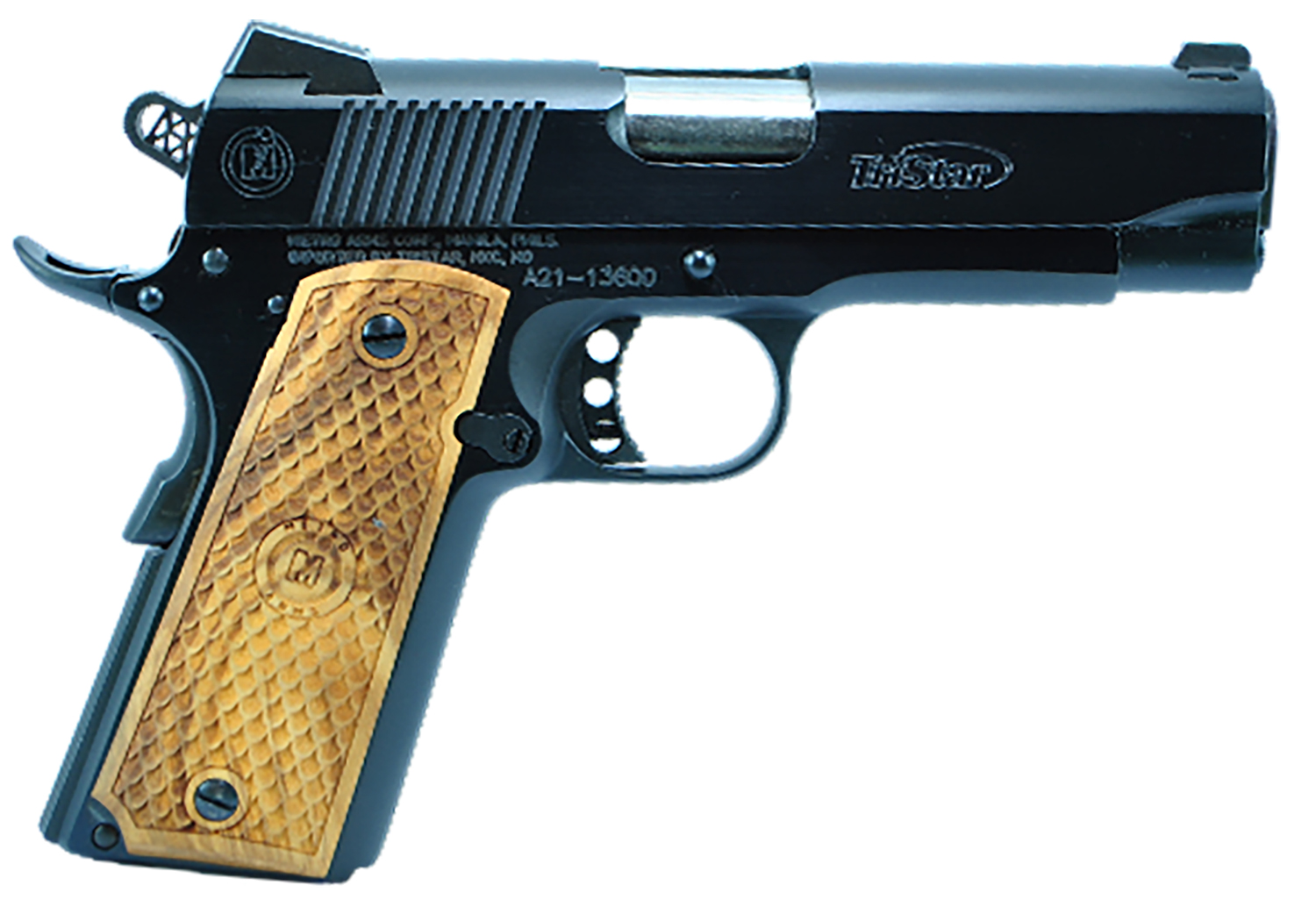
TriStar American Classic Commander 1911 9mm 4.25in Blued
About this product
The TriStar American Classic Commander is a 1911-style single-action semi-automatic pistol chambered in 9mm with a 4.25-inch barrel that serves as a budget-conscious introduction to the Commander platform with traditional blued steel construction and Novak-style sights. Originating in the early 1950s as Colt's answer to a more compact officer's sidearm, the Commander configuration typically features a 4.25-inch barrel and shortened slide compared to the Government Model’s 5-inch standard. TriStar's Turkish-made interpretation targets the entry-level market segment with a manufacturing partnership that emphasizes functional reliability over custom shop fit and finish.
What is the TriStar American Classic Commander 1911 used for?
The TriStar American Classic Commander is primarily used as a civilian range training pistol and a viable introduction to the 1911 platform's mechanical fundamentals. It serves well as a dedicated practice gun for shooters transitioning from striker-fired polymer frames to the specific manual of arms required for a single-action pistol with multiple safeties. Given its all-steel construction and 4.25-inch barrel, it provides a manageable recoil impulse in 9mm, making it suitable for extended sessions—a key consideration for new 1911 shooters working through the initial thumb safety and grip safety learning curve. Some owners will utilize it for home defense in states with magazine capacity restrictions, but its primary role is educational and recreational.
How does the TriStar American Classic Commander compare to the Springfield Armory Garrison 9mm?
The TriStar American Classic Commander is less expensive and employs a simpler, traditional blued finish compared to the forged carbon steel and more sophisticated Nitride finish on the Springfield Armory Garrison 9mm. The Springfield model, at around $850, delivers superior out-of-the-box trigger pull weight averaging 5.0 pounds versus the TriStar’s typically heavier 6.5-7.0-pound pull, and better frame-to-slide fit that contributes to slightly tighter mechanical accuracy. However, the TriStar, at $589.99, provides the essential 1911 experience, a perfectly functional action, and the same critical manual safety interface—making it a better choice for the budget-conscious learner who plans to spend the price difference on ammunition and professional training with our Stevens 555 shotguns for a comprehensive skillset.
What does it weigh and what are the dimensions?
The TriStar American Classic Commander weighs 34.2 ounces (969 grams) empty with a magazine, with an overall length of 7.75 inches (197 mm) and a height of 5.5 inches (140 mm) measured to the top of the Novak rear sight. Its 4.25-inch barrel provides a compromise between the full-size Government Model's 5-inch tube and more concealable Officer's models, yielding a 1.4-inch shorter overall package that balances muzzle velocity and holstering ease. The width across the slide measures 1.25 inches (32 mm) at its widest point, requiring a holster specifically molded for the 1911's slab-sided profile—generic nylon or Kydex pouches designed for Glock or S&W frames will not provide proper retention.
Who is this NOT for?
This pistol is not for the shooter seeking a custom-grade 1911 for competition, duty carry, or as a primary defensive weapon without significant aftermarket upgrades. Its investment-cast frame and MIM components, while adequate for range use, lack the forged strength and tighter tolerances demanded by IDPA or USPSA shooters in the Single-Stack division. It's also not ideal for the beginner's first-ever pistol purchase unless they've committed to the 1911's manual of arms through structured instruction covering thumb-safety and grip-safety deactivation under stress.
What's in the box?
The pistol ships with one single-stack 9-round metal magazine, a fitted polymer hard case, a cable-type gunlock, a basic cleaning kit with rod and patches, and the owner’s manual. The single magazine is the critical operational limitation—prospective buyers should budget for at least three additional quality steel or polymer-follower magazines at $25-$35 each from brands like Wilson Combat or Chip McCormick to facilitate proper training drills requiring multiple pre-loaded magazines. The supplied lock satisfies basic storage requirements but does not replace a dedicated pistol safe for households with children or legal compliance in certain jurisdictions.
Is the TriStar American Classic Commander worth it at $589.99?
At $589.99, yes, the TriStar American Classic Commander provides clear value as an entry point into the 1911 platform for the shooter who can't justify spending $900-$1200 on a forged-frame model from Springfield or Colt. You're getting the essential form, function, and familiarization needed to decide if this platform fits your shooting style before committing to a higher-tier model. However, that price requires accepting the Turkish manufacturing origin and the need for potential minor parts upgrades, like the extractor or firing pin, after the first thousand rounds, as discussed in our maintenance primers.
Specs at a glance
Video review
Pros & cons
What works
- Weighs 34.2 oz — provides solid steel recoil management for 9mm training.
- 4.25-inch barrel yields 7.75-inch overall length — 1.4 inches shorter than a standard Government 1911 for easier holster concealment.
- Novak-style rear sight with dovetail front — drift-adjustable for windage.
- Ambidextrous thumb safety — functional for both left and right-handed shooters without modification.
Trade-offs
- Single magazine included — insufficient for standard training drills requiring three mags minimum.
- 6.5-7.0 lb trigger pull — heavier and less crisp than premium 1911 offerings from Springfield or Colt.
- Investment-cast frame — lacks the forged steel durability of higher-priced models for sustained high-round-count use.
Expert review
Key attributes
| upc | 713780856247 |
| manufacturer | TriStar Arms |
| manufacturer part number | 85624 |
| action | Single Action |
| barrel length | 4.25" |
| caliber/gauge | 9mm |
| capacity | 9 + 1 |
| safety | Ambidextrous Thumb/Grip |
| shipping weight | 4.6 |
| sights type | Dovetail Front/Novak Rear |
| slide description | Serrated |
Frequently asked questions
- Is it compatible with standard 1911 magazines?
- Yes, it accepts standard Government or Commander-length 9mm 1911 magazines with a 9-round capacity. However, some aftermarket magazines with extended baseplates designed for full-length frames may protrude slightly at the base, and we recommend testing individual units like the Wilson Combat ETM 9mm or Tripp Research Cobra magazines for functional reliability.
- Does it fit in a standard 5-inch 1911 holster?
- No, the 4.25-inch barrel will seat properly but leave approximately 0.75 inches of open space at the muzzle in a holster molded for a 5-inch Government Model. You need a holster specifically designed for Commander-length 1911s from manufacturers like Galco, DeSantis, or Safariland using an exact model code specifying a 4.25-inch barrel length.
- Is the front sight dovetail compatible with Novak cuts?
- Yes, the front sight is a standard Novak-style dovetail with a tenon width of approximately 0.330 inches. Replacement fiber-optic or tritium front sights from Novak, Dawson Precision, or Trijicon that are advertised for 'Novak front cuts' can be directly installed, typically requiring a proprietary sight pusher tool and around 15 minutes of skilled bench work.
- How long does shipping take to an FFL?
- We process transfers through our licensed network within 3-5 business days for in-stock inventory, not including transit time, which varies by carrier zone but averages 2-6 business days for ground service. The receiving FFL will contact you directly to schedule the 4473 paperwork, so ensure their license is current in our system and they accept shipments from Ironclad Armory.
- Can I return it if it doesn't cycle reliably?
- We offer a 30-day functionality warranty covering manufacturer defects, but firearms cannot be 'returned' under standard e-commerce policies once the 4473 transfer is complete. You would file a warranty claim through our service desk, and we would facilitate a repair or replacement evaluation by TriStar Gunsmithing Services, which typically involves a 6-8 week turnaround for diagnoses and component replacement.